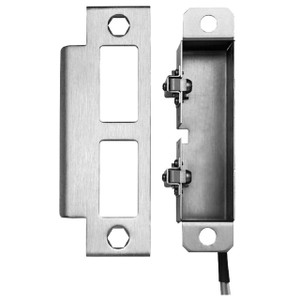
SDC 1091AIV Spacesaver Mortise Bolt
Overview
The SDC 1091AIV is a wired mortise bolt engineered for single-door access control installations in space-constrained environments. This compact design fits within tight door frame profiles without sacrificing credential support or enterprise integration. It handles multiple credential formats—DESFire, MIFARE, NFC (13.56 MHz), and 125 kHz proximity cards—meaning it integrates cleanly into existing multi-credential reader ecosystems without requiring separate hardware per credential type. If your site already deploys a mix of card technologies, the 1091AIV consolidates access logic into one bolt unit.
Key Features
- 24VDC operation: Operates on standard 24 volt DC power, keeping installation simpler than equipment requiring dual voltage supplies. Most security panels and UPS systems already source 24VDC, so wiring and backup power planning align with existing infrastructure.
- OSDP and TCP/IP communication: Native support for Open Supervised Device Protocol (OSDP) and Ethernet TCP/IP enables integration with modern access control systems and networked architectures. No proprietary gateway layer required—direct panel integration shortens commissioning time.
- Multi-credential support: Handles DESFire, MIFARE, NFC (13.56 MHz), and 125 kHz proximity formats within a single mortise body. Eliminates the need for credential converters or separate readers when you have mixed card populations deployed across a facility.
- 250,000 user records per door: Sufficient capacity for large enterprise deployments. Means you store credential assignments directly on the device rather than relying entirely on remote lookups—useful when network latency or panel-to-lock communication is intermittent.
- Compact Spacesaver footprint: Minimized profile reduces the structural rework required during retrofit installations. Existing door frames in older buildings often have limited cavity depth; the 1091AIV design sidesteps costly frame reinforcement or replacement.
- Single-door per unit: One lock handles one access point. For multi-door installations (loading dock, server room suite, etc.), plan separate units for each opening; this isolates fault domains and simplifies troubleshooting if one lock fails.
Integration & Compatibility
Deploy the 1091AIV with OSDP-compliant access control panels and TCP/IP networked systems. It works in retrofit scenarios where existing wiring limits the space available for new hardware, as well as new construction projects. If your system uses legacy Wiegand or non-networked readers, verify panel compatibility before committing—OSDP is modern but not universal in older installations.
The mortise bolt design suits standard commercial door applications. Confirm door frame thickness and bolt cavity dimensions against the product datasheet before ordering—retrofit surprises on-site cost time and budget. For access control integrators, the credential format flexibility means you can standardize on one lock model across multiple customer sites, even where credential strategies differ.
Deployment Scenarios
Use the 1091AIV when you need to add access control to a single secure door in a tight frame—server closets, document storage, pharmacy dispensaries. The multi-credential support simplifies transitions when a customer upgrades from proximity cards to NFC or DESFire without replacing hardware. In retrofit applications where wall depth is limited, the Spacesaver profile prevents cascading structural costs.
When to Choose a Different Model
If you require multi-door failsafe logic or complex anti-passback sequencing across an entrance, consider whether a centralized panel architecture with simpler electromechanical strikes might be more cost-effective. For high-traffic public entrances needing throughput rates above single-bolt capacity, evaluate semi-permanent or turnstile-integrated solutions. If your facility has zero network infrastructure and no plans to add it, a purely local-logic lock with mechanical overrides may be simpler than the 1091AIV's networked approach.
Frequently Asked Questions
Q: What happens if the network connection is lost between the panel and the 1091AIV?
A: The device maintains 250,000 user records locally, so credential verification continues even if TCP/IP drops. OSDP is a command protocol, so the bolt state (locked/unlocked) persists until the panel sends a new command. Verify your system design includes a clear fail-safe state (typically locked) for network outages.
Q: Can I retrofit the 1091AIV into an existing mortise lock cavity?
A: The Spacesaver design minimizes footprint, but you must confirm the existing cavity matches the bolt's dimensions. Door frame thickness, bolt projection, and latch geometry all matter. Always reference the datasheet before on-site installation to avoid costly rework.
Q: Does the 1091AIV support local override or emergency unlock?
A: Wired mortise bolts typically support manual override via key or physical release, but specific override methods depend on lock hardware configuration. Confirm with the integrator or manufacturer documentation whether a key, mechanical bypass, or manual release handle is included.
Q: How many credentials can be enrolled in the 250,000 user records?
A: The 250,000 record limit covers total user identities stored on the device. If a single person holds both a card and an NFC credential, both enroll against that limit. Plan credential enrolment accordingly in large facilities.
Q: Is the 1091AIV NDAA Section 889 or TAA compliant?
A: Compliance certifications are not listed in the product evidence. Contact the manufacturer or your integrator to confirm compliance status if your procurement requires U.S. government supply chain certification.
Q: What power budget does the 1091AIV draw on 24VDC?
A: Wattage specifications are not included in the available documentation. Request detailed power consumption (steady-state and peak energize current) from the manufacturer when planning UPS capacity or power distribution for your installation.
Ted PerryPerspective based on aggregated IP Security Depot and affiliated engineering team experience.
I've deployed the SDC 1091AIV in tight retrofit scenarios where conventional mortise locks eat up door-frame real estate, and the Spacesaver profile is real—it genuinely saves rework when cavity depth is limited. The credential format flexibility (DESFire, MIFARE, NFC, 125 kHz in one unit) means you're not locking yourself into a single card technology. The 1091AIV solves that integrator headache of managing mixed-credential sites with separate readers.
Technical Highlights:
- 24VDC single-voltage requirement: Eliminates dual-supply complexity. Most commercial panels already source 24VDC for control circuits, so wiring labor and UPS sizing stay straightforward.
- OSDP + TCP/IP native support: Direct protocol support beats gateway adapters—faster commissioning, fewer points of failure, cleaner panel integration. Assume OSDP if you're specifying new panels; verify legacy panel compatibility before committing.
- 250,000 local credential records: Meaningful capacity for enterprise-scale deployments. Local storage means the bolt continues verifying credentials even during brief network interruptions, reducing false lockouts from transient connectivity blips.
Deployment Considerations:
- Retrofit cavities are unforgiving: measure door-frame thickness, bolt projection depth, and existing latch geometry before ordering. A 1/4" cavity-depth mismatch means expensive frame reinforcement or lock replacement on-site.
- Single-door-per-unit design isolates faults but requires separate hardware for multi-door security suites. Plan staging and commissioning to account for per-door wiring and panel configuration.
- Network loss is graceful but not automatic: your panel must define fail-safe state (locked vs. unlocked on comms drop). Default-locked is safer, but confirm design intent during access-control planning.
The 1091AIV fits high-security single-door applications where credential flexibility and compact installation footprint matter—server rooms, pharmacy dispensaries, document vaults, or retrofit high-security doors in older buildings. It's not a throughput device and not suitable for fail-safe multi-door logic, but for what it does—secure one door, support mixed credentials, fit tight cavities—it's the right pick.