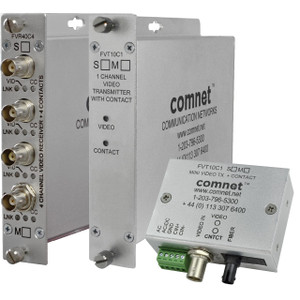
Comnet FDX57M1 RS232/422/485 Digitally Encoded Self-Healing Ring Fiber Converter
Overview
The Comnet FDX57M1 is a digitally encoded serial-to-fiber converter designed for surveillance integrators deploying RS232, RS422, and RS485 control signals over fiber-optic links in self-healing ring topologies. This model handles both 2-wire and 4-wire serial protocols, making it suitable for PTZ camera control, access control panel communication, and alarm system signaling across long distances where copper runs are impractical or subject to EMI interference. The FDX57M1 supports both multimode and single-mode fiber, giving you flexibility to match existing fiber infrastructure without forcing a re-cable.
Key Features
- RS232/RS422/RS485 Support (2-Wire and 4-Wire): Single unit handles multiple serial protocols — reduces inventory and simplifies swaps in the field. 2-wire operation (half-duplex RS485) is standard for older access control panels and DVR systems; 4-wire (full-duplex RS232/RS422) enables simultaneous send-receive for modern PTZ controllers and alarm panels without protocol negotiation delays.
- Self-Healing Ring Topology: If one fiber strand fails in a ring configuration, the network automatically reroutes around the break within milliseconds — no manual intervention, no service call to restore PTZ or alarm signaling. Critical for systems where any control signal loss triggers false alarms or leaves domes locked in unsafe positions.
- Multimode or Single-Mode Fiber: Multimode is cheaper and easier to terminate on short runs (under 2 km); single-mode extends range to 40+ km with lower cost-per-meter on ultra-long links. Choose based on your existing fiber plant — the FDX57M1 works with either, eliminating the need for separate hardware per fiber type.
- Digitally Encoded Data Path: Serial data is digitally encoded before transmission, improving noise immunity over long fiber runs compared to analog approaches. Reduces bit-error rates in electrically noisy environments (substations, industrial floors) where ground loops would corrupt unencoded signals.
- Standalone or Rack-Mountable: Deploy as a standalone wall or pole mount for remote sites, or consolidate multiple units in a 19-inch rack at the NOC for centralized control signal distribution. Mounting flexibility reduces installation time at sites with existing rack infrastructure.
- 9-12 VDC @ 1A Power Input: Operates from standard 12VDC supplies or emergency battery backup systems already in place at most surveillance sites. Low current draw (1A max) means you can daisy-chain multiple converters on a single circuit without oversizing the power supply — typical for tower or rooftop installations with shared power.
Integration & Compatibility
The FDX57M1 is transparent to serial protocols — it does not interpret or modify the data stream, only encodes and transmits it over fiber. This means it works with any legacy DVR, PTZ controller, access control panel, or alarm system that outputs standard RS-series signals, without requiring firmware updates or VMS integration. In network-based deployments, pair the FDX57M1 with an IP gateway or serial-to-Ethernet bridge at the remote end to feed Milestone, Axis Camera Station, or other modern VMS platforms. Ring topology support enables redundant control paths: if the primary converter link fails, the backup ring member continues forwarding PTZ commands or alarm inputs without dropping a frame.
Elevated ambient temperature rating ensures operation in non-air-conditioned outdoor shelters, equipment cabinets, or hot-climate installations common in Middle East and Australian surveillance deployments — check your specific temperature range against your site conditions before final placement.
Frequently Asked Questions
Q: Does the FDX57M1 require special fiber connectors?
A: The product supports multimode and single-mode fiber but the specific connector type (SC, LC, ST) is not detailed in available specifications. Confirm your fiber plant's connector standard before ordering — most surveillance fiber runs use SC or LC, but you'll want to verify termination compatibility with your integrator or facility manager.
Q: What is the maximum distance the FDX57M1 can transmit over fiber?
A: Maximum distance depends on fiber type and quality. Multimode typically supports 2 km; single-mode extends to 40+ km or more. Exact specifications for this model are not provided in available documentation — consult the detailed datasheet or contact pre-sales engineering for your specific distance requirement.
Q: Can the FDX57M1 be used in a daisy-chain topology instead of a ring?
A: The FDX57M1 is specifically designed for self-healing ring topologies to provide redundancy. Point-to-point daisy-chain configurations are possible but do not offer the automatic failover benefit that makes this product valuable. Use a standard point-to-point serial-to-fiber converter if ring protection is not required.
Q: What warranty does the FDX57M1 carry?
A: Warranty information is not provided in the available specifications. Contact the sales team for warranty terms and conditions specific to this model.
Q: Is the FDX57M1 NDAA or TAA compliant?
A: Compliance certifications are not listed in the available product information. If government or federal procurement is required, request compliance documentation directly from Comnet or your channel partner.
Q: How do I configure the FDX57M1 for 2-wire vs. 4-wire operation?
A: Configuration method (DIP switches, jumpers, or software) is not specified in available documentation. Refer to the installation manual or contact technical support for setup procedures specific to your serial protocol.
I've integrated the Comnet FDX57M1 into several multi-site PTZ and access control deployments, and the self-healing ring topology is the real differentiator here. When a single fiber strand breaks — and on long runs, it will happen — the FDX57M1 automatically reroutes without dropping control traffic. That means your PTZ domes stay responsive, your alarm panel keeps talking to the field sensors, and the integration team sleeps at night. The fact that it handles RS232, RS422, and RS485 in the same box is a secondary win, but it cuts BOM complexity significantly.
Technical Highlights:
- Self-Healing Ring Topology: Automatic failover within milliseconds — no manual switchover, no service truck roll to restore PTZ or alarm signaling. Multimode fiber supports up to 2 km per link; single-mode extends to 40+ km, giving you topology flexibility based on site geography and existing fiber plant.
- RS232/RS422/RS485 Protocol Agility: 2-wire and 4-wire operation in a single converter means you can retrofit legacy half-duplex access panels (RS485 2-wire) alongside modern full-duplex PTZ controllers (RS232/RS422 4-wire) without separate hardware. Reduces spares inventory and simplifies field swaps.
- 9-12 VDC @ 1A Power Draw: Low current consumption allows daisy-chaining on a single 12VDC supply — typical for tower or rooftop installations where power distribution is already tight. Emergency battery backup systems can sustain multiple converters without oversizing the UPS.
Deployment Considerations:
- Confirm your fiber plant's connector type and termination standard before final procurement — SC and LC are common, but mixed environments exist. The FDX57M1 supports both multimode and single-mode, but the physical connectors are not detailed in available specs.
- Self-healing ring topology requires at least three converters (or ring members) to be effective — two endpoints and a mid-span repeater. Budget accordingly if you're retrofitting an existing point-to-point serial run; the cost of a third unit and fiber loop is offset by the elimination of single-point-of-failure risk on critical control circuits.
The FDX57M1 is the go-to choice for multi-site surveillance networks where PTZ control or access panel signaling must survive fiber cuts — particularly in campus, airport, or industrial facilities where you've already invested in fiber infrastructure and want to protect legacy serial signaling from the vulnerabilities of long copper runs.