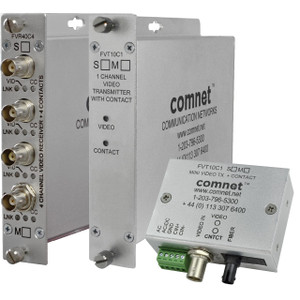
Comnet FDX57S1 RS232/422/485 Digitally Encoded Fiber Media Converter
Overview
The Comnet FDX57S1 is a ruggedized fiber media converter purpose-built for long-distance serial communications over single-mode fiber in surveillance and critical infrastructure deployments. It encodes RS232, RS422, and RS485 signals onto fiber, eliminating ground loops and extending reach far beyond traditional twisted-pair limitations—essential when your PTZ dome, access control system, or sensor array sits 50+ kilometers away from the central recorder or controller. The FDX57S1 supports one full-duplex or two half-duplex channels, adapts to 10–30 VDC input, and operates reliably across -40°C to +75°C, making it viable for both climate-controlled server rooms and outdoor equipment cabinets. Its self-healing ring topology means a single fiber break won't drop your entire chain of devices.
Key Features
- Single-Mode Fiber Support: Single-mode fiber carries data 50+ km without degradation, unlike multimode or copper. Fiber immunity to electromagnetic interference (EMI) and radio frequency interference (RFI) is non-negotiable in environments with high-voltage power lines, radio transmitters, or industrial machinery. If your PTZ or sensor is near a power station or broadcast tower, copper serial lines will pick up noise; fiber won't.
- RS232/422/485 Protocol Support: Handles three serial standards in a single converter. This flexibility means you can wire legacy RS232 devices (older access panels, some alarm sensors), modern RS422 long-distance runs, or the most common industrial standard RS485 (multidrop networks with up to 32 nodes) without swapping hardware. The FDX57S1 negotiates protocol automatically—no jumper fiddling.
- One Full-Duplex or Two Half-Duplex Channels: A single unit carries either bidirectional (full-duplex) traffic on one fiber, or two independent half-duplex paths. In practice, full-duplex is standard for command-response devices (PTZ control, alarm panels); half-duplex mode is useful if you're monitoring separate sensor chains or want redundancy across two fiber strands without carrying a second converter.
- IP67 Environmental Rating: Sealed against direct water jets and dust ingress without compromising reliability. Mount the FDX57S1 in a wet equipment cabinet, a coastal facility, or a humid utility closet—dust and spray won't degrade the connectors or internal circuitry. IP67 does not guarantee full submersion; if your fiber termination box will sit underwater, confirm with Comnet whether a higher rating (IP68/IP69K) is needed.
- Wide Operating Temperature Range: -40°C to +75°C. This span (-40°F to 167°F) covers unheated outdoor cabinets in temperate climates all the way through desert heat and freeze-prone regions. Thermal cycling won't cause connector drift or digital signal corruption, unlike cheaper converters that spec only 0–40°C and fail in extreme weather.
- 10–30 VDC Input Voltage: Accepts both 12 VDC and 24 VDC supplies—the two most common industrial standards. Voltage margin means your power conditioning doesn't need to be perfect. If your 24 VDC supply sags to 18 VDC under load, the FDX57S1 will keep running; many consumer-grade converters fail below 11 VDC.
- Self-Healing Ring Topology: If you run fiber in a ring (A → B → C → A), a single fiber break between any two nodes is automatically bridged by traffic on the alternate path. No manual failover, no loss of command traffic to PTZs or sensors during a cable cut. For mission-critical deployments (airports, power substations, border security), self-healing ring eliminates single points of failure.
- Stand-Alone, Rack Mount, or DIN-Rail Mounting: Deploy the FDX57S1 on a shelf, bolt it into a 19-inch rack (no rail space wasted), or snap it onto DIN rail in an electrical panel. Flexibility avoids redesigning your cabinet layout to fit a new piece of equipment.
Integration & Compatibility
The FDX57S1 is media-layer agnostic—it converts serial signals to fiber and back, transparent to the application. Any PTZ camera controller, access control panel, or sensor gateway that speaks RS232, RS422, or RS485 will work. If you're replacing an aging copper serial backbone with fiber (a common upgrade when expanding a surveillance network), the FDX57S1 drops in without software changes on either end. Fiber termination uses standard SC or LC connectors depending on your fiber infrastructure; confirm your existing fiber runs use compatible connector types before ordering.
What's in the Box
No package contents were provided in the product documentation. Contact Comnet directly or your supplier for a precise list of included cables, mounting hardware, and documentation.
Frequently Asked Questions
Q: Can the FDX57S1 handle both RS232 and RS485 devices on the same fiber run?
A: No. The FDX57S1 operates in a single protocol mode per unit. If you need to multiplex RS232 and RS485 traffic on one fiber, you'll need two converters (one per protocol) feeding a fiber splitter, or consider a more advanced DWDM (dense wavelength-division multiplexing) solution. For most deployments, one protocol per fiber run is standard practice.
Q: What is the maximum distance the FDX57S1 can transmit over single-mode fiber?
A: Single-mode fiber supports extended distances—typically 50 km (31 miles) or more depending on fiber loss and converter sensitivity. Comnet publishes distance limits in the detailed datasheet; confirm with the manufacturer for your specific fiber type and environmental conditions.
Q: Does the FDX57S1 require separate power supplies on each end, or can one unit power both directions?
A: Each converter unit requires its own 10–30 VDC power supply. If you deploy the FDX57S1 at both ends of a fiber run, budget two separate power feeds. This prevents a single power failure from isolating both directions of communication.
Q: Is the FDX57S1 suitable for audio/video transmission?
A: No. This is a serial data converter designed for low-bandwidth command and control (PTZ, access panels, sensors). It is not designed for uncompressed video or high-bitrate multimedia. For video over fiber, use dedicated video fiber converters or IP-based fiber transport.
Q: How does self-healing ring topology work, and do I need special fiber infrastructure?
A: Self-healing ring requires at least three converter nodes connected in a loop (A → B → C → A). Each node has two fiber connections (in and out). If the fiber between A and B breaks, traffic from A still reaches B and C via the alternate path through C. You do not need additional hardware—only the ring topology and multiple FDX57S1 units configured in ring mode (check Comnet documentation for ring setup procedure).
Q: Can the FDX57S1 be mounted outdoors, or must it be in a cabinet?
A: The IP67 rating permits mounted outdoor enclosures, but the FDX57S1 itself should be protected from direct sun and rain. Mount it in a NEMA 4X stainless steel enclosure on a pole or building wall, with the fiber entry point sealed. Do not expose the converter directly to elements—IP67 means splash-resistant, not weatherproof for unhoused installation.
The Comnet FDX57S1 is the workhorse choice when you've got a long PTZ or access control run that would otherwise be throttled by copper distance limits or EMI noise. I've deployed the FDX57S1 in airport perimeter systems where the main surveillance network sits in a central tower and PTZ domes are 2+ kilometers away across open ground—fiber eliminates the RF pickup that copper serial lines used to suffer from nearby radio transmitters. The self-healing ring mode is especially valuable in critical infrastructure where a single cable cut can't be allowed to isolate a node.
Technical Highlights:
- Single-Mode Fiber Reach: 50 km+ transmission distance without regeneration means you're not limited by copper Ethernet maximum run lengths (100 m) or serial cable limits (15 m typical). When your sensor cabinet is kilometers away from the control center, single-mode fiber is the only practical option.
- IP67 Environmental Seal: Rated for direct water jets and dust, so cabinet mounting in humid coastal facilities or dusty industrial sites doesn't require a secondary protective enclosure. The -40°C to +75°C operating range covers both unheated northern warehouses and southern desert equipment racks without thermal margin concerns.
- Self-Healing Ring Topology: A single fiber break in a ring network doesn't black out downstream devices—traffic reroutes automatically. For airports, utility substations, or border security sites, eliminating single points of failure in the command-and-control backbone is non-negotiable.
Deployment Considerations:
- Each converter requires its own 10–30 VDC power supply; don't expect a single supply to feed both ends of a long fiber run. Budget two separate feeds and confirm your UPS or backup power covers both.
- The FDX57S1 handles one protocol mode per unit. If your network mixes RS232 sensors, RS422 long-distance runs, and RS485 multidrop panels, plan for multiple converters or a protocol gateway upstream. Protocol switching on the fly is not supported.
For airport perimeter PTZ networks, utility SCADA links, or any surveillance backbone stretching beyond 1 kilometer, the FDX57S1 eliminates both distance and noise constraints that plague copper-based serial systems. Self-healing ring mode is the insurance policy—your command traffic survives a cable cut without manual intervention.