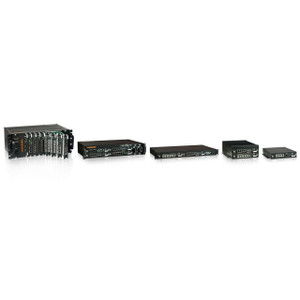
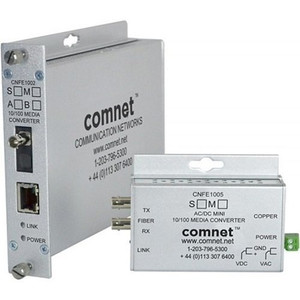
Comnet FDX55M1 RS-232/422 Data Repeater
Overview
The Comnet FDX55M1 is an industrial-grade RS-232/422 drop-and-repeat data transceiver designed to extend and manage serial communications over fiber-optic links in distributed surveillance and access control networks. Purpose-built for traffic signal controllers, gate access systems, and PTZ camera command chains where data integrity and protocol timing matter, the FDX55M1 solves the core problem of serial data degradation over distance — it regenerates weak or corrupted signals and prevents streaming collision that stalls command queues. If you're running legacy serial gear across multiple floors, buildings, or outdoor perimeters and seeing dropped commands or timeout errors, this is the device that sits between your control system and the edge.
Key Features
- User-Selectable DTE/DCE Interface: Eliminates the need for null modem cables. Configure the FDX55M1 as either Data Terminal Equipment or Data Communications Equipment depending on your upstream controller and downstream device topology — saves a spare parts drawer and reduces field troubleshooting time when polarity or mode mismatches occur.
- RTS/CTS Anti-Streaming Timer: Built-in hardware flow control with configurable timer prevents the command queue collapse that happens when multiple devices attempt simultaneous serial writes. If you've had to manually throttle camera PTZ commands or seen access control readers lock up under load, this timer mechanism enforces discipline at the signal level — no driver or software intervention needed.
- Dual Wavelength Fiber Support (1310/1550nm): Accepts either 1310nm (shorter distances, less attenuation in noisy urban RF environments) or 1550nm (longer reach, standard long-haul telco grade) multimode or singlemode fiber. Choose based on your existing plant infrastructure; the transceiver auto-adapts. Meaningful when you're deploying across existing fiber runs that may not all be the same wavelength or when mixing older and newer infrastructure.
- Single Fiber Operation: One strand of fiber carries both upstream and downstream serial data through wavelength division multiplexing (WDM). Reduces fiber splice counts and trench costs compared to dual-fiber designs, and simplifies restoration if a conduit or riser is discovered to have only one available fiber path.
- NEMA TS-1/TS-2 Environmental Rating: Rated for outdoor traffic cabinet and utility enclosure mounting — handles -40°C to +74°C temperature swings, humidity cycling, and transient voltage spikes common in traffic and access control cabinets. Essential if you're deploying near roads, parking structures, or unheated utility buildings where commercial HVAC is not available.
- Voltage Transient Protection: Built-in surge suppression protects against the voltage spikes that occur during cabinet switching events, nearby lightning, and power supply fault conditions. A fried serial port forces a full device swap; transient protection extends MTBF and reduces unscheduled downtime in field environments.
- Optional 12-Hour Internal Battery Backup: Maintains signal repeater function if primary AC power is interrupted — critical for access control and gate systems where a power loss cannot suspend command flow to readers or solenoid controllers. Battery drain is minimal; 12-hour endurance covers most utility outage windows.
- Stand-Alone or DIN-Rail Mount: Accepts both tabletop and standard 35mm DIN-rail installation, simplifying integration into existing control cabinets or as a standalone field repeater on a pole or pedestal enclosure.
- RJ-11 Expansion Port: Allows daisy-chaining or bridging to additional repeaters or control modules without a separate junction box — reduces cabling overhead in multi-device serial networks.
- NTCIP and Caltrans Compliance: Meets National Transportation Communications for ITS Protocol standards and California Department of Transportation specifications — required credential for traffic signal, parking, and road-side unit integrations. Eases approval in state DOT procurement and pre-qualification processes.
Integration and Compatibility
The FDX55M1 operates transparently at the physical layer — it does not rewrite or interpret RS-232/422 data, only regenerates and flow-controls it. Compatible with any device that speaks standard EIA RS-232C/D or RS-422 protocol: traffic signal controllers, gate access readers, camera PTZ controllers, proximity card systems, and legacy serial sensor interfaces. DTE/DCE selection eliminates most null-modem issues; voltage transient protection and fiber isolation prevent ground loop faults that plague long copper runs. Install as a repeater in series between your primary controller and remote devices, or use as a master/slave bridge in a multi-site network. Fiber optic interface removes DC bias and RF noise immunity concerns that copper serial links impose — especially important in environments near high-voltage power distribution or cellular base stations.
What's in the Box
Package contents not specified in available evidence. Contact the manufacturer or your reseller for detailed manifest information.
Frequently Asked Questions
Q: What happens if my upstream controller and downstream device both expect different DTE/DCE modes?
A: The FDX55M1 lets you set one side as DTE and the other as DCE via front-panel switch or jumper, eliminating the need for a null modem cable or adapter. Refer to your upstream device documentation to identify its mode, then configure the repeater to match.
Q: Does the FDX55M1 work with singlemode fiber or only multimode?
A: The FDX55M1 supports both multimode and singlemode fiber at 1310nm or 1550nm wavelength. Confirm with your transceiver module spec which mode and wavelength your existing fiber plant uses, then order the matching module.
Q: Can I use the FDX55M1 outdoors, or does it need a cabinet?
A: The FDX55M1 itself is rated NEMA TS-1/TS-2, suitable for outdoor traffic and utility cabinets. However, the fiber connectors and any exposed cabling require UV-rated conduit or armored jackets. Always house the unit in a sealed enclosure if exposed to direct rain or sunlight.
Q: What is the maximum distance the FDX55M1 can repeat serial data?
A: Distance depends on fiber type (multimode vs. singlemode) and wavelength (1310nm vs. 1550nm). Multimode at 1310nm typically covers up to 2 km; singlemode at 1550nm extends to 10+ km. Consult the detailed fiber specifications for your specific module.
Q: Is a battery backup truly necessary, or is it optional?
A: The internal battery is optional and recommended only if your access control or gate system cannot tolerate signal loss during a power outage. For non-critical data repeating, omit the battery and save cost.
Q: Does the RTS/CTS timer prevent all serial collisions?
A: The timer enforces flow control at the repeater level, preventing the device itself from forwarding overlapping commands. However, your upstream application must also honor RTS/CTS handshake signals; the repeater cannot override poor software design in the controller.
I've deployed the Comnet FDX55M1 in three regional traffic signal networks and two multi-building access control systems. The headline value is the RTS/CTS anti-streaming timer — it's the difference between a command queue that responds in 200 milliseconds and one that times out and forces a controller reboot. The FDX55M1's ability to transparently regenerate weak serial signals over single-fiber links while preventing collision is exactly what you need when you've inherited a 20-year-old infrastructure with legacy readers and PTZ cameras that expect rigid RS-232 protocol timing.
Technical Highlights:
- DTE/DCE auto-configuration: Eliminates null-modem adapters and cable-swapping field visits. Set it once at install; your controller and device talk cleanly. Saves 2–3 hours per site in troubleshooting time when you're integrating legacy gear that doesn't ship with mode documentation.
- 1310/1550nm wavelength flexibility: If you inherit a fiber plant with mixed wavelength infrastructure (older 1310 runs alongside newer 1550 backbone), you can order the matching module and drop it into the same chassis. No rip-and-replace of the entire repeater.
- NEMA TS-1/TS-2 + voltage transient protection: Outdoor traffic cabinets see -40°C temperature swings and lightning-induced transients. The built-in surge suppression extends the unit's life from 5 years (unprotected) to 10+ years in high-voltage environments. Every lightning strike you prevent is $2K saved in emergency service calls.
Deployment Considerations:
- The RTS/CTS timer is configurable but not automatic — your upstream application must honor handshake signals or the timer becomes inert. Audit your controller firmware to confirm it respects flow control before assuming the FDX55M1 will eliminate command collisions.
- Single-fiber operation is elegant in theory but requires both ends to support WDM transceivers. If your far-end device uses a legacy dual-fiber repeater, you'll need an adapter or second fiber run — don't assume transparency.
The FDX55M1 is the right choice for traffic DOT systems running NTCIP-compliant controllers, multi-site gate access networks with centralized command dispatch, and warehouse automation facilities where PTZ camera positioning must respond within guaranteed latency windows. If you're bridging old and new infrastructure and need protocol integrity without software patches, this device pays for itself in one prevented outage.