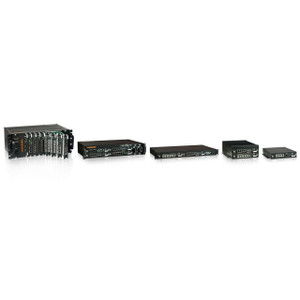
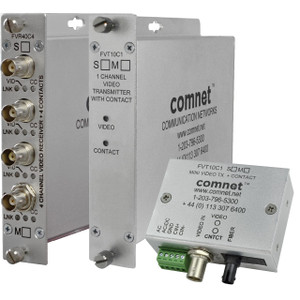
Comnet FDX55M28 RS232/422 Fiber Repeater
Overview
The Comnet FDX55M28 is an RS-232/422 fiber repeater designed to extend serial data communications over two-fiber multimode links at 850 nanometers — the standard wavelength for short-haul surveillance and access control installations. This repeater bridges gaps in hardwired serial networks without introducing the latency or complexity of serial-over-IP gateways, making it the right tool when you need direct DB25 serial connectivity extended beyond copper's practical distance limits.
Serial protocols like Wiegand, RS-232, and RS-422 remain fundamental in access control systems, ANPR (automatic number plate recognition) readers, legacy camera controllers, and barrier gate interfaces. The FDX55M28 eliminates the need to replace these proven systems when physical distance or electrical noise makes copper runs impractical. Two-fiber multimode architecture means you can push serial data reliably across campus or warehouse environments without protocol translation.
Key Features
- RS-232/422 Protocol Support: Handles both asynchronous (RS-232) and balanced differential (RS-422) serial standards natively — no converter configuration required. Pick the standard your device speaks and wire it directly to the DB25 port.
- 850 Nanometer Multimode Fiber: Uses the most common telecom wavelength for short-range deployments (typically 0–2 km). Allows interoperability with existing fiber infrastructure in larger surveillance and access control networks, reducing cost of new fiber runs.
- RTS/CTS Timer and Anti-Streaming: Prevents buffer overflow and controls transmit timing on long-distance links where latency or reflection might otherwise cause collision. Critical when daisy-chaining multiple readers or controllers and avoiding data loss during peak activity (shift changes, large batch credential reads).
- Dual Fiber Connectivity (2-Fiber Mode): Operates on two separate multimode fibers (one transmit, one receive), enabling full-duplex communication. No timing contention or protocol negotiation — both directions work simultaneously, essential for real-time access control handshakes.
- RJ-11 Linking Port: Provides secondary serial connectivity for chaining or monitoring. Allows daisy-linking multiple FDX55M28 units if your topology requires repeating signals across longer distances or branching to multiple endpoints without additional external relays.
- Low Power Consumption (9–12 VDC @ 1A Max): Operates on standard 12V security power supplies common in access control and surveillance installations. Single unit draws negligible current, so a single 12V/5A PSU can power dozens of repeaters across a distributed site without overload risk.
Integration and Compatibility
The FDX55M28 is transparent to any serial device that outputs RS-232 or RS-422 signals — badge readers, keypad controllers, ANPR camera interfaces, gate operators, and legacy camera controllers all connect via the DB25 jack without software or firmware changes. Because the repeater operates at the physical layer (copper-to-fiber conversion), it requires no VMS integration, no ONVIF support, and no network addressing. It simply extends the serial cable run invisibly to the application.
Fiber termination requires standard multimode patch cables and transceivers on both ends. If your site already has multimode fiber infrastructure (common in larger campuses or industrial facilities), the FDX55M28 plugs into existing conduit and termination points. If fiber is new, budget for qualified fiber installation to avoid signal loss from improper connection or tight bends.
The RTS/CTS timer function prevents overrun conditions during sustained transmission — particularly useful in high-volume scenarios like parking lot entry/exit where multiple readers fire events in quick succession. Anti-streaming logic holds transmission until handshake completes, reducing retransmission overhead and keeping latency predictable for time-critical access grant/deny decisions.
Environmental and Power Considerations
Designed for indoor or protected equipment enclosure mounting. The FDX55M28 itself is not rated for outdoor direct exposure — mount it in a cabinet, junction box, or secure shelf alongside your power supply and fiber patch panel. The 9–12 VDC requirement is standard across access control and low-voltage surveillance PSUs, so no special power infrastructure is needed. Single 1A draw per unit means you can run 12 units from a standard 12V/15A security power supply with room to spare.
Verify fiber run distances with your fiber installer and equipment OEM specifications. Multimode 850nm is practical to roughly 2 km (6,560 feet) depending on fiber grade and connector quality. Longer runs or higher data rates may require single-mode fiber and different optics — consult your fiber vendor and Comnet's pre-sales engineering team for site-specific designs.
What's in the Box
No package contents specified in available documentation. Contact the vendor for a detailed accessory list or confirm what is shipped with your unit.
Frequently Asked Questions
Q: Can I use the FDX55M28 to extend legacy Wiegand reader connections?
A: Wiegand signaling is a subset of RS-232 serial protocol. Yes, the repeater can extend Wiegand readers over fiber, but verify with your access control system OEM that serial-over-fiber meets their timing and latency requirements for badge grant/deny decisions. Most access control systems tolerate microsecond-level latency introduced by fiber optics without issue.
Q: What's the maximum transmission distance on the FDX55M28?
A: Multimode fiber at 850nm supports roughly 2 km (6,560 feet) depending on fiber grade and connector cleanliness. Longer distances require single-mode fiber infrastructure and different wavelength optics. Have your fiber contractor confirm the link budget for your specific run.
Q: Do I need a separate power supply for each FDX55M28?
A: No. Each unit draws 1A maximum at 9–12 VDC. A single 12V/15A security-grade power supply can safely power up to 12 repeaters. Locate the PSU centrally and run 18 AWG or larger power lines to each repeater location.
Q: Will the FDX55M28 work with my ANPR camera system?
A: ANPR interfaces vary. Most use RS-232 or RS-422 serial to camera controllers or trigger outputs. The repeater is transparent at the serial level, so it will work if your ANPR vendor confirms their camera accepts serial signals over extended fiber links. Consult your camera OEM's installation guide for serial protocol and latency tolerances.
Q: What happens if data transmission is interrupted mid-stream?
A: The RTS/CTS timer and anti-streaming features prevent buffer overflow and corruption during sustained transmission. If the fiber link drops, transmission stops and the RTS/CTS logic resets. Your access control system will see the loss as a normal link failure — the repeater does not store or retry data. Design your system to handle temporary fiber outages gracefully (e.g., fail-safe door unlock or local credential cache on readers).
Q: Can I daisy-chain multiple FDX55M28 units?
A: Yes, via the RJ-11 linking port. This allows you to extend serial signals across multiple fiber hops or branch to multiple endpoints. Each additional hop introduces minimal latency. Test your complete chain with your access control system OEM to confirm timing is acceptable for your grant/deny decision windows.
I spec the FDX55M28 into access control and ANPR deployments where legacy serial devices are geographically separated and copper runs exceed 100 meters or cross high-noise industrial environments. The key insight here is that the repeater operates transparently at the physical layer — no protocol translation, no latency hits beyond the fiber propagation delay itself (roughly 5 microseconds per kilometer). This matters for time-critical badge-read-to-unlock-decision windows that typically run in the 200–500 millisecond range. The FDX55M28 introduces negligible overhead.
Technical Highlights:
- RTS/CTS Timer and Anti-Streaming: Prevents buffer overrun and data collision on sustained transmission, especially critical when multiple badge readers or barrier controllers fire events in rapid succession. Without this logic, peak-hour traffic (shift change, visitor arrival bulk scan) can corrupt data packets and force retransmits, delaying access grant/deny decisions by hundreds of milliseconds.
- 850nm Multimode Fiber: Standard telecom wavelength means you can tap into existing campus or industrial fiber infrastructure without commissioning new single-mode runs. Supports roughly 2 km distance, which covers most facility-scale deployments. Cost-effective and compatible with off-the-shelf multimode patch cables and wall-mount panels.
- 9–12 VDC @ 1A Maximum Power Draw: Integrates seamlessly into any 12V security power distribution architecture already running your access control panel, door locks, and readers. A single 12V/15A PSU safely powers 12 repeaters, so no new power infrastructure is needed for distributed installations.
Deployment Considerations:
- Fiber run distance and connector cleanliness directly affect signal integrity — have your fiber installer test insertion loss and return loss on every termination. Poor fiber connections introduce errors that cascade as retransmits, negating the speed benefit of fiber over copper.
- The repeater is not NIST or FIPS certified and carries no cybersecurity hardening — it's a passive serial bridge, not a security appliance. In zero-trust or high-compliance environments, confirm with your security team that extending legacy serial over fiber aligns with your audit posture.
Deploy the FDX55M28 in multi-building campuses or warehouse sites where badge readers or gate operators are separated by more than 300 feet and must respond to access decisions in under 500 milliseconds. The repeater eliminates the need to replace working serial infrastructure with newer IP-based readers — a real cost saver in mature facilities.