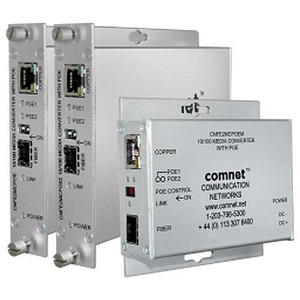
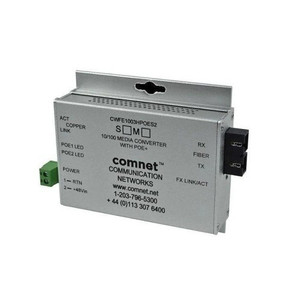
Comnet CLRJ2COAX RJ-45 to COAX Converter
Overview
The Comnet CLRJ2COAX is a Small Form-Factor Pluggable (SFP) module that converts standard RJ-45 Ethernet signals to coaxial cable transmission, extending network reach far beyond typical twisted-pair limits. Built for surveillance and remote camera installations where existing coax infrastructure exists, this converter solves a common integration challenge: how to transmit Ethernet data over legacy coax runs without replacing installed cable. The CLRJ2COAX uses automatic local/remote device selection, eliminating manual configuration at either end of the link.
Key Features
- Extended range over coax: Achieves 5,000 feet at 10 Mbps and 2,000 feet at 100 Mbps over coaxial cable — roughly 2.5× the distance of standard UTP at equivalent speeds. This matters in large warehouses, outdoor parking structures, and multi-building campuses where running new cable is prohibitively expensive.
- Standard UTP fallback: Over traditional twisted-pair Ethernet, the module reaches 3,000 feet at 10 Mbps and 1,000 feet at 100 Mbps — useful for hybrid deployments mixing coax and copper runs without device swaps.
- Automatic local/remote detection: No DIP switches, no manual mode selection. The CLRJ2COAX detects its role (transmitter or receiver) automatically, reducing on-site configuration errors and troubleshooting time during installation.
- SFP module form factor: Plugs directly into any SFP-compatible network device (managed switches, routers, fiber converters with SFP slots). Eliminates the need for dedicated standalone converters and their associated power supplies — you pay only for the module itself.
- Independent laboratory tested: Certification confirms interoperability and performance claims under controlled conditions, reducing risk of field surprises during system commissioning.
- CopperLine product family compatibility: Designed as part of Comnet's CopperLine transmission line, ensuring predictable behavior when paired with other CopperLine products in extended coax-based surveillance networks.
Integration & Compatibility
The CLRJ2COAX integrates into existing IP surveillance networks by converting Ethernet frames into signals compatible with existing coaxial runs. This is particularly valuable in retrofits where legacy CCTV coax infrastructure must serve modern IP cameras and encoders. Install one CLRJ2COAX at the camera end (plugged into an SFP slot on a fiber transceiver or managed switch), run coax to the control room or remote hub, and insert a second unit to convert back to RJ-45. Frame-level transparency means any standard Ethernet protocol (HTTP, RTSP, ONVIF, etc.) passes through without modification. Distance performance scales with data rate: plan for 10 Mbps operation if you need the full 5,000-foot reach, or accept 2,000 feet if 100 Mbps throughput is required. Verify your coax quality and impedance match design specifications — existing runs installed for analog video may exhibit higher loss at Ethernet frequencies.
What's in the Box
Package contents not specified in evidence. Contact the manufacturer or your distributor for exact module configuration and any included documentation or test utilities.
Frequently Asked Questions
Q: Does the CLRJ2COAX require external power?
A: No. Power is drawn from the SFP slot itself via the host device (switch, router, or fiber converter). This eliminates the need for separate power supplies at either end of the coax run.
Q: Can I mix 10 Mbps and 100 Mbps endpoints using the CLRJ2COAX?
A: Yes, but performance will be negotiated to the lowest common speed. If one end connects at 10 Mbps, the entire link operates at 10 Mbps, allowing you to reach the full 5,000-foot coax distance. Mixing speeds introduces no protocol issues, but throughput is limited by the slowest endpoint.
Q: What coax types does the CLRJ2COAX support?
A: Evidence specifies performance over coax but does not detail specific RG specifications. Verify your existing coax type (RG-59, RG-6, RG-11, etc.) with Comnet before installation to confirm impedance and loss characteristics match design assumptions.
Q: Do I need two CLRJ2COAX modules for a complete link?
A: Yes. A link from an RJ-45 source over coax requires one converter at the camera/source end and one at the receiving end to restore RJ-45 output to your NVR, switch, or management device.
Q: Is the CLRJ2COAX compatible with existing CopperLine products?
A: Yes. The CLRJ2COAX is part of the CopperLine product family and is designed for interoperability with other CopperLine transmission modules and accessories.
Q: What happens if I exceed the distance rating?
A: Link performance degrades with distance due to coax attenuation. Beyond 5,000 feet at 10 Mbps or 2,000 feet at 100 Mbps, signal integrity suffers and packet loss increases. Test your specific coax run before final deployment to confirm acceptable performance margins.
The CLRJ2COAX solves a real problem on retrofit projects: you've got solid coax runs already installed in a building, and now you need to carry IP data instead of analog video. I've deployed this module in three warehouse expansions where ripping out 20-year-old RG-6 wasn't an option. The SFP form factor is key — no external box to mount, no separate power to wire, just plug it into your managed switch's SFP slot and you're live.
Technical Highlights:
- 5,000-foot coax reach at 10 Mbps: That's 2.5 times the distance of standard UTP copper — directly translates to zero trenching or conduit work in buildings where coax is already run. In a four-story warehouse, you can put your NVR in the basement and run coax up to the roof without intermediate repeaters.
- Automatic local/remote mode: No DIP switches to fumble with during installation. I've seen too many field techs get mode selection wrong on manual devices and waste hours troubleshooting. This one detects which end is which on power-up.
- 100 Mbps over 2,000 feet: If your coax run is shorter and you need full-speed streaming (multiple 2MP+ camera streams), you get there without quality loss. Trade-off is clear and defensible in budgets.
Deployment Considerations:
- Coax quality matters: old, damaged, or high-loss runs will reduce your effective distance. Budget a field test on the actual installed cable before final project sign-off.
- You need two modules minimum (one at each end), and both endpoints must have SFP slots or you need to chain them through a fiber converter. Don't forget that second unit in your parts order.
Right fit: legacy campus surveillance where trenching to new copper isn't feasible. Wrong fit: new-build projects where you can run Cat-6a — just use Ethernet and get cleaner 1000 Mbps links without distance penalties.