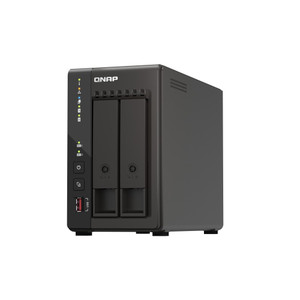
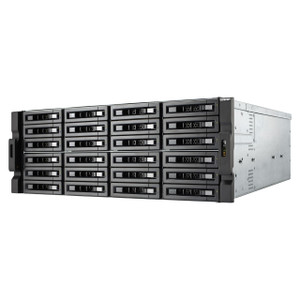
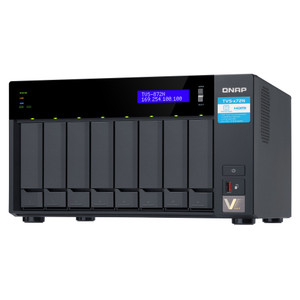
QNAP QVP-41B-8G-P-US NVR with Integrated 16-Port PoE Switch
Overview
The QNAP QVP-41B-8G-P-US collapses two pieces of rack gear into one chassis: a full network video recorder and a sixteen-port Gigabit PoE switch, each running independently but sharing a common power supply and management plane. For small-to-mid commercial deployments — retail, light industrial, multi-tenant buildings — that means one device on the shelf instead of two, one cable run to the IDF, and no separate PoE injector budget to track. Starting channel capacity is 8 live cameras with a licensed path to 24, so the box can grow without a hardware swap as the camera count climbs.
The integrated switch delivers sixteen 30-watt Gigabit PoE ports against a 140-watt total power budget. At the IEEE 802.3at ceiling of 30W per port, that budget supports roughly four to five simultaneous high-draw cameras (PTZ or multi-sensor) before you hit the wall — plan your port loading before you commission. Mix standard 802.3af cameras and the budget stretches considerably further. Two dedicated 2.5GbE host management ports keep NVR traffic separated from camera traffic, which matters once you push toward the 288 Mbps max throughput ceiling.
Local storage rides on four 3.5-inch SATA 6Gb/s bays — the unit ships without drives, so pair it with surveillance-rated HDDs sized to your retention policy. At 288 Mbps continuous ingest across all channels, a four-bay build with 4TB drives delivers roughly 30+ hours of headroom per TB depending on codec and resolution. Scale to 8 or 10TB per bay and multi-week retention is straightforward for most deployments.
Key Features
- 16×30W Gigabit PoE Ports, 140W Budget: Enough to power sixteen standard IP cameras without a single external injector. Budget caps at 140W total — at mixed 8–15W loads (typical fixed cameras) you'll run all sixteen ports comfortably. High-draw PTZ cameras at 25–30W will reduce usable port count; map wattage before final design.
- 288 Mbps Max Throughput: Sets a hard ceiling on total camera bitrate the NVR can ingest and write simultaneously. Running sixteen 1080p streams at roughly 4–6 Mbps each lands around 64–96 Mbps — well within limits. Push to 4MP/4K streams at higher bitrates and you'll want to audit total ingest before commissioning all 24 channels.
- 8 GB DDR4 RAM (2×4 GB SO-DIMM, Upgradeable): Two SO-DIMM slots means you can upgrade memory if you push toward the 24-channel ceiling with analytics enabled. Starting at 8 GB provides solid headroom for base channel counts.
- 4-Bay 3.5-inch SATA Storage (No HDD Included): Select drives from QNAP's compatibility list — surveillance-optimized drives rated for 24/7 write cycles are the correct choice here. Budget for your retention period at commissioning; adding drives later is straightforward with hot-swap capable bays.
- Dual-Boot Flash OS (4 GB): The 4 GB flash stores a dual-boot OS protection layer, meaning a failed primary OS partition doesn't brick the unit — the system can recover from the secondary partition. Reduces on-site service calls for OS-level failures.
- 2×2.5GbE Host Management Ports: Dedicated uplink ports isolate NVR management and recording traffic from the PoE camera LAN. This separation prevents a saturated camera port from degrading VMS access or remote viewing sessions.
- Scalable Channel Licensing (8 to 24 Channels): Ships with 8 active channels. Licensing to 24 channels is a software operation — no hardware swap needed as your camera count grows. Useful for phased deployments where budget limits initial camera count.
Integration and Compatibility
The QVP-41B-8G-P-US runs QNAP's QVP (QVR Pro) NVR operating system, which supports ONVIF-compliant cameras from most major manufacturers alongside native QNAP QVR Pro camera management. The two RJ45 combo ports (noted in evidence alongside the 2.5GbE ports) provide additional network flexibility. For deployments already running a third-party VMS platform, verify ONVIF Profile S/G compatibility before committing — the QVP platform is most straightforward when used with QNAP's own QVR Pro stack or ONVIF-standard cameras. Pair this unit with surveillance-grade PoE switches on any camera segments that exceed the built-in sixteen-port count, feeding back to the 2.5GbE uplinks.
Frequently Asked Questions
Q: How many cameras can the QVP-41B-8G-P-US support at maximum?
A: The unit ships licensed for 8 channels and can be licensed up to 24 channels maximum. Local display camera count may differ — refer to QNAP's current licensing documentation for per-channel upgrade pricing.
Q: Does the QVP-41B-8G-P-US ship with hard drives?
A: No. The system ships without HDDs. You must install compatible 3.5-inch SATA drives. Consult QNAP's HDD compatibility list before purchasing drives to ensure supported models — surveillance-rated drives rated for 24/7 write cycles are strongly recommended.
Q: What is the total PoE power budget on the QVP-41B-8G-P-US?
A: The total PoE budget is 140 watts across all sixteen ports. Each port supports up to 30W (802.3at). If all sixteen cameras draw the maximum 30W, total draw would exceed the budget — plan your per-port wattage to stay within 140W combined.
Q: Can I upgrade the RAM in the QVP-41B-8G-P-US?
A: Yes. The unit has two SO-DIMM DDR4 slots, currently populated with 2×4 GB for a total of 8 GB. The maximum supported memory is 8 GB per spec — both slots are occupied at default configuration, so a RAM upgrade would require replacing the existing modules with higher-capacity DDR4 SO-DIMMs up to the platform maximum.
Q: What network ports are available on the QVP-41B-8G-P-US beyond the PoE camera ports?
A: Beyond the sixteen PoE Gigabit camera ports, the unit provides two 2.5GbE host management ports and two RJ45 combo ports for additional network connectivity and uplink flexibility.
Q: What is the maximum recording throughput of the QVP-41B-8G-P-US?
A: Maximum throughput is 288 Mbps. This is the ceiling for simultaneous camera ingest and local recording. Plan total camera bitrates across all active channels to stay within this limit, especially when scaling toward 24 channels with high-resolution streams.
The QVP-41B-8G-P-US is one of the more practical all-in-ones I've seen at this price tier — the 140W PoE budget with sixteen individual 30W ports means you're genuinely powering a full small-site camera deployment without a separate switch in the rack. The 288 Mbps throughput ceiling is the number I'd put in front of any integrator before they spec it for a dense high-res deployment.
Technical Highlights:
- 16×30W PoE, 140W Budget: At typical fixed-camera loads of 8–12W per port, all sixteen ports run simultaneously with budget to spare. Reserve headroom if you're mixing in PTZ cameras — a single 25–30W PTZ can consume as much as three standard cameras.
- 288 Mbps Max Throughput: Running 24 channels of 4MP at 8 Mbps each would hit 192 Mbps — within limits, but leaving less than 100 Mbps of headroom for motion-triggered secondary streams or analytics offload. Stay under 70% of the ceiling for stable 24/7 operation.
- Dual SO-DIMM DDR4, 8 GB Max: Both slots ship populated at 2×4 GB, so there is no free slot for a simple expansion — a memory upgrade means swapping both modules. Not a deal-breaker, but worth knowing before you assume you can add a stick in the field.
Deployment Considerations:
- The unit ships without HDDs — size your drive budget before the install date. At 288 Mbps peak ingest across four bays, plan for surveillance-rated SATA drives; desktop-class drives will accumulate errors under sustained 24/7 write load.
- The base 8-channel license is the shipped state. If your contract calls for more than 8 cameras at day one, confirm channel license procurement before the truck rolls — field license activation is software-only but must be planned ahead.
This unit is well-suited for retail chains, light-commercial office campuses, or school buildings deploying 8–20 cameras per location where consolidating the NVR and PoE switch into a single managed device reduces both rack space and ongoing switch-licensing overhead.