QNAP TVS-882-I3-8G-US 8-Bay Desktop NAS with Intel Core i3-7100
Overview
The QNAP TVS-882-I3-8G-US is an eight-bay desktop NAS appliance built around an Intel Core i3-7100 dual-core 3.9 GHz processor — a platform that delivers consistent throughput for small-to-mid-size surveillance archives, mixed-workload file serving, and virtualization use cases where a low-power Atom simply won't keep up. The asymmetric bay layout (six 3.5-inch + two 2.5-inch SATA) gives you the flexibility to combine high-capacity spinning disks with SSD caching or fast all-flash tiers in the same chassis, without adding an expansion unit. If you're evaluating the broader QNAP NAS lineup, the TVS-882-I3-8G-US sits in the TVS-882 family's entry i3 position — same chassis and expansion options as the i5 variant, lower clock and core count, lower acquisition cost.
Key Features
- Intel Core i3-7100 at 3.9 GHz (dual-core, 64-bit x86): The 3.9 GHz clock is higher than many NAS-class Celeron/Pentium builds at the same price point. For real-time 4K transcoding or on-the-fly surveillance stream re-encoding, single-thread performance matters more than core count — this CPU handles simultaneous decode/re-encode workloads that stall slower chips.
- Up to 64 GB DDR4 UDIMM across four slots: Ships with 8 GB installed; the four-slot DDR4 design means you can scale to 64 GB (4 × 16 GB) without replacing existing DIMMs. Large RAM headroom is directly relevant if you run multiple VMs, containers, or QVR Pro camera licenses concurrently — each VM needs dedicated memory budget, and running out forces swap to disk, which kills latency.
- 512 MB DOM flash (dual OS): The dedicated 512 MB flash stores the QTS operating system independently of your data drives. Dual OS means a failed system partition rolls back automatically — you don't lose array access because of a botched firmware update, which matters in unattended deployments.
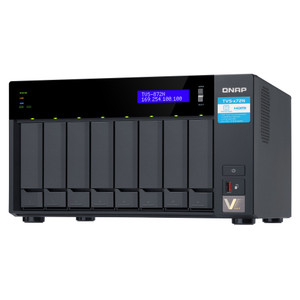
- 6 × 3.5-inch + 2 × 2.5-inch SATA 6Gb/s bays: The mixed bay layout is the defining physical characteristic of this unit. Load the six 3.5-inch bays with high-capacity surveillance-optimized HDDs for raw retention volume, then use the two 2.5-inch bays for SSD read/write cache — a common configuration for network video recorders and NAS-based VMS back-ends where random-read latency on playback is the bottleneck. SATA 6Gb/s on all bays means no throughput penalty mixing drive types.
- 64-bit x86 architecture with Intel HD Graphics: Unlike ARM-based NAS units, the x86 platform runs the full QTS/QuTS software stack including QVPN, QVR Pro, and Linux Station without emulation overhead. The integrated Intel HD Graphics outputs support hardware-accelerated transcoding, reducing CPU load on 4K video streams compared to software-only decode paths.
- Four-slot DDR4 UDIMM memory bus: DDR4 bandwidth advantages over DDR3 show up in NAS workloads with heavy parity calculations (RAID 6, RAID 5 rebuild under load) and in-memory deduplication. Four physical slots also give you upgrade flexibility — a two-slot design at the same max capacity requires removing existing modules.
Integration and Compatibility
The TVS-882-I3-8G-US runs QNAP's QTS platform, which supports a wide range of surveillance NAS use cases including QVR Pro (QNAP's native VMS), ONVIF-compatible IP camera ingestion, and third-party VMS integration. The x86 architecture enables running containerized applications via Container Station and virtual machines via Virtualization Station alongside NAS workloads — relevant for deployments that need an edge compute layer co-located with storage. PCIe expansion (verify slot count and generation against the full hardware spec sheet before ordering) allows adding 10GbE NICs or additional NVMe cache devices depending on your throughput requirements. When pairing with PoE switches for a camera network, plan the NAS's NIC configuration to match your aggregate camera stream bandwidth — a single GbE uplink saturates quickly beyond 8–10 simultaneous 4K streams at full bitrate.
For storage planning on a multi-camera surveillance deployment, note that the TVS-882-I3-8G-US supports standard RAID modes (0, 1, 5, 6, 10 via QTS) across the six 3.5-inch bays; the two 2.5-inch bays are typically dedicated to SSD cache rather than included in the primary RAID volume, which affects your usable capacity calculation. Confirm RAID mode and cache configuration with your storage sizing before committing drive quantities.
Frequently Asked Questions
Q: What is the maximum RAM supported in the TVS-882-I3-8G-US?
A: The TVS-882-I3-8G-US supports up to 64 GB using four DDR4 UDIMM slots (4 × 16 GB maximum configuration). It ships with 8 GB installed.
Q: What drive types fit in the TVS-882-I3-8G-US?
A: The unit has six 3.5-inch SATA bays and two 2.5-inch SATA bays, all running at SATA 6Gb/s (backward compatible with SATA 3Gb/s). The 3.5-inch bays accept standard HDDs; the 2.5-inch bays accept SSDs or 2.5-inch HDDs. Drives are not included.
Q: What processor does the TVS-882-I3-8G-US use?
A: It uses an Intel Core i3-7100 dual-core processor running at 3.9 GHz with a 64-bit x86 architecture and Intel HD Graphics integrated GPU.
Q: Can the TVS-882-I3-8G-US run QVR Pro for surveillance?
A: Yes — the 64-bit x86 platform fully supports QVR Pro and other QNAP surveillance applications. Camera license counts and performance will depend on stream resolution, bitrate, and available RAM. Verify current QVR Pro camera channel limits against your specific camera count and resolution targets before deployment.
Q: Is the TVS-882-I3-8G-US still actively sold or is it a legacy model?
A: QNAP designates the TVS-882-i3-8G as a legacy model on their hardware specifications page. Verify current availability and confirm replacement/successor models in the TVS series if long-term vendor support is a procurement requirement.
The TVS-882-I3-8G-US (often searched as TVS 882 I3 8G US) is a unit I'd recommend specifically when a customer needs x86 compute co-located with NAS storage but can't justify the i5 price delta — the i3-7100's 3.9 GHz single-thread speed holds up well for QTS application workloads, and four DDR4 slots mean you're not painted into a corner on memory.
Technical Highlights:
- Intel Core i3-7100, 3.9 GHz dual-core: Higher per-core clock than most NAS-class Celerons — relevant when QVR Pro is doing real-time stream processing or Container Station workloads need fast single-thread response.
- 64 GB DDR4 max across four UDIMM slots: Ships at 8 GB; the four-slot design means 16→32→64 GB upgrades don't require pulling existing modules. Critical for VM-heavy deployments where each guest needs a hard memory reservation.
- 512 MB DOM flash with dual OS support: Firmware lives off your data drives entirely. A corrupted QTS update rolls back without touching the RAID array — an operational continuity detail that matters in unstaffed remote sites.
Deployment Considerations:
- The asymmetric bay layout (6×3.5-inch + 2×2.5-inch) is best used with the 2.5-inch bays as dedicated SSD cache rather than folded into the main RAID volume — mixing SSD and HDD in the same RAID group typically produces SSD-write-endurance issues in surveillance write-heavy workloads.
- QNAP marks this as a legacy SKU — if your procurement cycle extends beyond 12–18 months, validate that QTS firmware updates and QVR Pro version support will continue for your required support window before committing.
Best fit for a mid-size retail or small campus deployment running 8–16 cameras into QVR Pro with a containerized analytics application alongside — enough CPU and memory headroom for both workloads, without paying for cores you won't use.