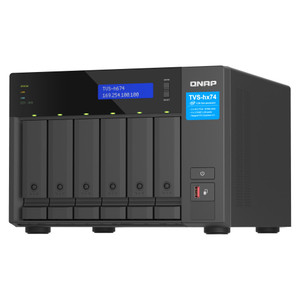
QNAP TVS-H674-I3-16G-US 6-Bay ZFS NAS with Intel Core i3 Processor
The TVS-H674-I3-16G-US is a six-bay, ZFS-based NAS appliance built around Intel's 12th-generation Core i3-12100 quad-core processor — a platform that hits a practical sweet spot for SMB file serving, surveillance storage, and light virtualization without the cost overhead of a six-core SKU. At 16 GB of pre-installed DDR4 and a ceiling of 64 GB, the system can grow with workloads that outpace entry-level NAS hardware. If you've been evaluating the QNAP NAS lineup and need a unit that handles concurrent iSCSI, NFS, and SMB sessions alongside a QNAP Surveillance Station workload, this is where that conversation typically lands.
Overview
The TVS-H674-I3-16G-US runs QNAP's QuTS hero operating system — the ZFS-native QTS variant — rather than the standard ext4-based QTS. That distinction matters operationally: ZFS delivers inline data integrity verification (checksumming every block on read and write), copy-on-write snapshots that don't degrade pool performance over time, and SED (Self-Encrypting Drive) storage pool support with a maximum pool size of 308 TB across up to 128 discrete storage pools. For environments where data corruption is a liability — archival, compliance, or multi-camera surveillance recording — ZFS's self-healing behavior is the primary reason to choose this platform over a conventional NAS running ext4.
The Intel® UHD Graphics 730 integrated GPU enables hardware-accelerated video transcoding within QNAP's multimedia and surveillance applications, offloading that work from the CPU cores and keeping transcoding responsive even when the i3-12100 is under general I/O load. The 64-bit x86 architecture means full compatibility with QNAP's virtualization stack (Virtualization Station, Container Station) and any x86-native application that runs on QuTS hero.
Key Features
- Intel Core i3-12100, 4-core/8-thread, burst to 4.3 GHz: The 12th-gen Alder Lake architecture delivers meaningful IPC gains over older Celeron/Pentium NAS platforms. Eight logical threads keep concurrent NFS mounts, iSCSI initiators, and background scrub jobs from competing for a single execution pipe — practical headroom for a six-camera surveillance deployment running simultaneous playback and live recording.
- ZFS Storage Pools — up to 128 pools, 308 TB max pool size: Unlike traditional NAS RAID, ZFS pools absorb silent data corruption before it propagates. Each write is checksummed; any read mismatch triggers automatic repair from redundant data. For 24/7 surveillance or compliance archiving where a corrupted segment may not be discovered for weeks, ZFS's self-healing is a real operational safeguard, not a marketing checkbox.
- Maximum Volume Size of 250 TB: A single ZFS volume can span up to 250 TB, eliminating the volume-count juggling that plagues ext4-based NAS deployments at scale. That translates to a single mount point for large surveillance archives or backup repositories.
- Up to 64 GB DDR4 RAM (16 GB installed): ZFS is RAM-hungry by design — the ARC (Adaptive Replacement Cache) lives in system memory and dramatically accelerates random-read workloads. Starting at 16 GB gives a workable baseline; the 64 GB ceiling means you can right-size the cache budget as the workload grows without replacing the unit.
- Intel UHD Graphics 730: Hardware-accelerated H.265/H.264 transcoding via the integrated GPU reduces CPU load during live video playback or stream remuxing in QNAP Surveillance Station. On a six-bay unit sized for mixed NAS-plus-NVR duty, offloading transcoding to the GPU keeps the i3 cores available for storage I/O.
- SED Storage Pool support (308 TB max): Self-Encrypting Drives managed at the pool level provide hardware-enforced encryption without the CPU overhead of software AES — important when the unit handles regulated data (HIPAA, PCI, financial records) alongside surveillance footage.
- 64-bit x86 architecture: Full application compatibility with QNAP's Container Station (Docker/LXC), Virtualization Station (KVM VMs), and any x86 package in the QNAP App Center — including third-party NVR software that won't run on ARM-based NAS platforms.
Integration & Compatibility
The QuTS hero OS underpins compatibility with standard enterprise storage protocols: SMB/CIFS (Active Directory domain join), NFS v3/v4, iSCSI (with CHAP authentication), and AFP. The x86 platform supports QNAP's Virtualization Station for running Windows or Linux VMs directly on the network attached storage unit — a common deployment pattern for small branch offices that want to consolidate a file server and an NVR onto one device. Container Station supports Docker workloads, so custom surveillance analytics containers or MQTT brokers can run on-box alongside the storage stack.
For surveillance integrators, QNAP Surveillance Station (included with QuTS hero) supports a broad camera compatibility list and can be paired with PoE switches for a camera-to-storage end-to-end solution. The ZFS snapshot capability integrates with backup tools (RTRR, Rsync, HBS 3) for off-site replication — important for compliance deployments that require a secondary copy of surveillance footage.
If your environment uses a dedicated VMS platform rather than QNAP's built-in Surveillance Station, the TVS-H674-I3-16G-US can present storage via iSCSI LUN or NFS share to an external network video recorder, keeping the NAS in its native role as a storage target rather than a processing node.
Frequently Asked Questions
Q: What operating system does the TVS-H674-I3-16G-US run, and how is it different from standard QTS?
A: The TVS-H674-I3-16G-US runs QuTS hero, QNAP's ZFS-based OS variant. Unlike standard QTS (which uses ext4), QuTS hero provides inline data integrity checksumming, copy-on-write snapshots, and self-healing storage pools — features that matter for 24/7 surveillance recording and compliance archiving where silent data corruption is a real risk.
Q: What is the maximum RAM the TVS-H674-I3-16G-US supports?
A: The unit supports up to 64 GB of RAM. It ships with 16 GB pre-installed, leaving room to expand as ZFS ARC cache demand or virtualization workloads grow.
Q: How large can a single storage pool get on the TVS-H674-I3-16G-US?
A: A single ZFS storage pool can reach 308 TB, and the system supports up to 128 separate storage pools. Maximum individual volume size is 250 TB.
Q: Can I use the TVS-H674-I3-16G-US as an NVR for IP cameras?
A: Yes. QNAP Surveillance Station runs natively on QuTS hero and supports a wide range of IP cameras. The Intel UHD Graphics 730 provides hardware-accelerated transcoding for live view and playback, reducing CPU overhead. Alternatively, the unit can serve as an iSCSI or NFS storage target for a third-party VMS platform.
Q: Does the TVS-H674-I3-16G-US support SED (Self-Encrypting Drive) pools?
A: Yes. QuTS hero includes SED storage pool support, enabling hardware-level drive encryption without software AES overhead — relevant for environments handling regulated data alongside surveillance footage.
Q: What processor does the TVS-H674-I3-16G-US use?
A: It uses an Intel Core i3-12100 (12th-gen Alder Lake), a 4-core/8-thread processor with a burst frequency of up to 4.3 GHz, running on a 64-bit x86 architecture.
The TVS-H674-I3-16G-US is one of those platforms I recommend when a deployment is caught between a prosumer NAS and a full rack-mount storage server. The Intel Core i3-12100's 4-core/8-thread architecture with a 4.3 GHz burst ceiling gives it real headroom for concurrent workloads — something that becomes apparent fast when you're running Surveillance Station alongside active SMB shares and a ZFS scrub job in the background.
Technical Highlights:
- ZFS Pool Ceiling — 308 TB / 128 Pools: The maximum pool size and pool count aren't theoretical limits — they reflect ZFS's ability to span drives across RAID groups within a single pool. For a six-bay chassis that will eventually hold 20TB+ drives, reaching 308 TB means this unit won't be the bottleneck when raw capacity expands.
- Intel UHD Graphics 730 Transcoding: Hardware-accelerated decode offloads H.265 and H.264 stream processing from the i3 cores during live Surveillance Station view sessions. In a multi-camera deployment pulling 10–15 streams simultaneously, the iGPU keeps the CPU free for storage I/O scheduling rather than frame decoding.
- 64 GB RAM Ceiling with 16 GB Base: ZFS ARC scales aggressively with available RAM — doubling RAM from 16 GB to 32 GB on a busy NAS frequently cuts random-read latency by 30–50% on cache-friendly workloads. The 64 GB ceiling means this unit can be memory-upgraded in place as workload demands grow, rather than forcing a platform replacement.
Deployment Considerations:
- QuTS hero (ZFS) requires drives to be formatted on-box — you cannot import an existing ext4 QTS pool without data migration. Plan for a fresh pool build if migrating from a standard QTS system.
- The i3-12100 variant has four cores versus the i5-12400's six cores in the higher TVS-h674 SKU. If the deployment involves heavy on-box virtualization (multiple VMs running concurrently alongside active storage I/O), budget the core count carefully before committing to the i3 tier.
This platform fits best in a mid-sized surveillance deployment — 10 to 30 cameras writing to a dedicated ZFS pool — where data integrity and snapshot-based retention management matter more than raw camera count throughput. The combination of ZFS self-healing, SED pool support, and on-box Surveillance Station makes it a credible single-appliance solution for branch offices or healthcare clinics that need compliant, auditable video retention without a separate server.