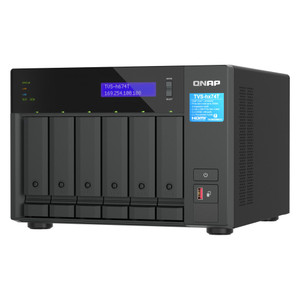
QNAP TVS-H674-I5-32G-US 6-Bay ZFS NAS with Intel Core i5-12400
Overview
The TVS-H674-I5-32G-US is a 6-bay, x86-based network-attached storage appliance built around Intel's 12th-generation Core i5-12400 processor. It ships with 32 GB of DDR4 RAM and runs QNAP's ZFS-based QuTS hero operating system — a configuration that positions it as a mid-range workhorse for SMB file serving, surveillance storage, and light virtualization workloads where data integrity is non-negotiable. If you've been burned by silent data corruption on a cheaper NAS, ZFS's end-to-end checksumming is the core reason to look at this platform.
QNAP markets the TVS-h674 family (often searched as TVS H674 I5 32G US) with 10/25GbE connectivity options, M.2 NVMe SSD caching, and PCIe expansion — though only the CPU, memory, and drive-bay specs are confirmed in verified evidence for this specific US SKU. Claims beyond those confirmed specs are not made here.
Key Features
- Intel Core i5-12400 — 6-core, 12-thread, up to 4.4 GHz burst: The 12th-gen Alder Lake architecture delivers meaningful multi-threaded headroom for simultaneous tasks: concurrent NFS/SMB shares, snapshot scheduling, and inline compression without the CPU becoming the bottleneck. Burst to 4.4 GHz means single-threaded workloads — metadata operations, deduplication scans — finish faster.
- 64-bit x86 architecture: Full x86 compatibility means you can run containerized applications (Container Station), virtual machines, and third-party surveillance VMS platforms alongside storage services on the same box — without a separate compute node.
- 32 GB SODIMM DDR4 (expandable to 64 GB via 2×32 GB): ZFS is a memory-hungry file system — ARC cache performance scales directly with RAM. 32 GB at launch is adequate for most SMB workloads, and the two-DIMM ceiling at 64 GB gives you a clear upgrade path if you add more cameras or expand to heavy deduplication.
- 6 × 3.5-inch SATA 6Gb/s drive bays: Six bays support RAID configurations from RAID 5 (4-drive usable, 1 parity) through RAID 6 (double-parity, survives two simultaneous drive failures) — appropriate for always-on surveillance or business-critical file storage where a single-drive failure cannot result in data loss. SATA 6Gb/s saturates even the fastest spinning rust, and modern 20TB surveillance HDDs fit without adapter.
- ZFS-based QuTS hero OS: Unlike most consumer-grade NAS operating systems, ZFS provides block-level checksumming, copy-on-write snapshots, and self-healing RAID-Z — practical for environments where silent data corruption (bit rot) is a real risk over multi-year retention windows. This matters especially for surveillance footage stored for 30–90 days or longer.
- PCIe expansion (per QNAP family documentation): The TVS-h674 platform supports PCIe slot expansion for 10/25GbE network cards and NVMe SSD caching — allowing the base unit to grow with your network infrastructure rather than requiring a full platform replacement. Verify available PCIe configurations for the i5-32G variant before ordering expansion cards.
Integration & Compatibility
The TVS-H674-I5-32G-US runs QuTS hero, QNAP's ZFS-native firmware. It is compatible with the broader QNAP NAS ecosystem of expansion enclosures and software applications. For network video recording deployments, QNAP's QVR Pro application runs natively on QuTS hero, enabling the unit to serve simultaneously as primary storage and a camera management server — consolidating hardware for smaller installs. Integration with third-party VMS platforms is supported via ONVIF and standard NFS/SMB/iSCSI storage protocols.
For enterprise environments, iSCSI LUN support allows VMware ESXi and Hyper-V hosts to use the NAS as shared block storage — relevant for branch offices running virtualized workloads. SMB 3.0 multichannel and NFS v4.1 are supported under QuTS hero for performance-conscious file-sharing environments. Pair with a managed PoE switch in camera deployments to keep camera traffic segmented from NAS management traffic on a dedicated VLAN.
Frequently Asked Questions
Q: What is the maximum RAM supported by the TVS-H674-I5-32G-US?
A: The TVS-H674-I5-32G-US supports up to 64 GB of DDR4 memory via two SODIMM slots, each populated with a 32 GB module. It ships with 32 GB installed.
Q: Can the TVS-H674-I5-32G-US be used as a surveillance NVR?
A: Yes. The unit runs QNAP's QuTS hero OS, which supports the QVR Pro camera management application natively. It can function as combined NVR and primary storage, reducing hardware count in smaller deployments. Third-party VMS integration is available via standard iSCSI/NFS/SMB storage protocols.
Q: What RAID configurations are supported across the 6 drive bays?
A: The 6 × 3.5-inch SATA bays support standard QNAP/ZFS RAID modes including RAID 0, 1, 5, 6, and 10, as well as QNAP's RAID-TEC (triple-parity) under QuTS hero. RAID 6 is recommended for surveillance or business-critical workloads where surviving two simultaneous drive failures is required.
Q: Does the TVS-H674-I5-32G-US support NVMe SSD caching?
A: The TVS-h674 platform supports M.2 NVMe SSD caching per QNAP family documentation. Verify M.2 slot availability and supported PCIe generation for the specific i5-32G variant before ordering NVMe caching drives.
Q: Is the TVS-H674-I5-32G-US suitable for SMB virtualization workloads?
A: The 64-bit x86 Intel Core i5-12400 processor and expandable 64 GB DDR4 RAM make it capable of running QNAP's Virtualization Station alongside storage services. For heavier VM workloads, validate RAM and CPU utilization profiles before relying on this unit as a primary hypervisor host.
The TVS-H674-I5-32G-US hits a specific sweet spot I see frequently in mid-market security installs: you need real compute — not an ARM chip pretending to be a server — behind a ZFS storage pool that's going to hold 30-90 days of surveillance footage from a dozen-plus cameras. The Intel Core i5-12400's 6-core/12-thread layout with 4.4 GHz burst means ZFS's inline checksumming, snapshot schedules, and QVR Pro camera management all run concurrently without CPU contention starving your I/O.
Technical Highlights:
- Intel Core i5-12400 burst to 4.4 GHz: ZFS inline compression and deduplication are CPU-bound operations. The 12-thread layout means compression can run in the background while active camera writes proceed — no scheduling conflict that would cause dropped frames under load.
- 32 GB DDR4, expandable to 64 GB: ZFS ARC (Adaptive Replacement Cache) directly consumes available RAM for read caching. At 32 GB you have meaningful ARC headroom for a 6-bay pool; at 64 GB you can support larger working sets if you're also running VMs or containers on the same unit.
- 6 × 3.5-inch SATA 6Gb/s bays: Six bays in RAID-Z2 (RAID 6 equivalent) gives you four drives of usable capacity with double-parity protection — the minimum I'd recommend for unattended surveillance storage where a drive failure may go unnoticed for days before a second failure puts footage at risk.
Deployment Considerations:
- QuTS hero's ZFS requires more RAM than QNAP's standard QTS (ext4) OS — the 32 GB base config is appropriate, but avoid running memory-heavy containers or VMs simultaneously unless you've upgraded to the 64 GB ceiling.
- SATA 6Gb/s is the only confirmed drive interface in verified evidence for this SKU — if your workload requires NVMe-speed random I/O (e.g., database or VM boot volumes), confirm PCIe/M.2 slot availability before ordering.
This unit is well-matched for a physical security operations center running 16–24 IP cameras with 60-day retention, where the same box also serves as a departmental file server and lightweight VM host — the i5-12400 has the headroom to handle all three without a dedicated compute appliance alongside it.