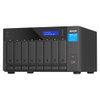
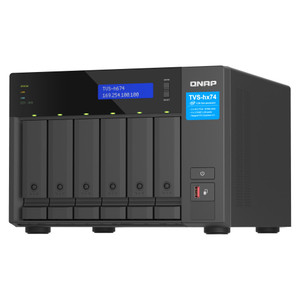
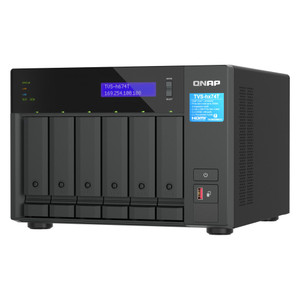
QNAP TVS-H874-I5-32G-US 8-Bay ZFS NAS with Intel Core i5 and PCIe Gen 4
Overview
The TVS-H874-I5-32G-US is an 8-bay ZFS-based network-attached storage appliance built around an Intel Core i5-12400 six-core/12-thread processor running the QuTS hero operating system. For SMB environments and security integrators managing large-scale surveillance storage, video archives, or shared file infrastructure, this unit hits a practical midpoint: enough compute headroom for inline ZFS checksumming and deduplication without the power draw and cost of the i9 variant in the same QNAP NAS family. The i5-12400 bursts to 4.4 GHz, keeping real-time RAID rebuilds and simultaneous stream access from stalling production workflows.
Key Features
- Intel Core i5-12400 (6-core/12-thread, burst to 4.4 GHz): Six physical cores handle concurrent tasks that single-threaded NAS CPUs choke on — simultaneous RAID rebuild, antivirus scanning, and active NVR stream ingestion all competing for the same storage fabric. The 4.4 GHz burst keeps latency-sensitive operations like database commits and VMS index writes from queuing behind background tasks.
- 32 GB DDR4 RAM: ZFS is memory-intensive by design — the ARC (Adaptive Replacement Cache) uses RAM to absorb read-heavy workloads before hitting spinning disks. 32 GB gives the ARC meaningful headroom on an 8-bay system, which translates to noticeably faster repeated-access patterns in surveillance playback and file server scenarios alike.
- 8 SATA 6 Gbps drive bays: Eight bays wired at SATA 6 Gbps gives you the physical capacity to build a serious RAID-Z2 (6+2 parity) pool while keeping two drives as hot spares or SSD cache. On an all-7200 RPM configuration that's comfortably 112–128 TB raw before any RAID overhead — enough for multi-camera 24/7 retention at high bitrates without overflow management headaches.
- 2 x PCIe Gen 4 slots: PCIe Gen 4 doubles the per-lane bandwidth of Gen 3 — useful when you drop in a 10GbE card or an NVMe expansion adapter. If your switching infrastructure already runs 10GbE, a single slot upgrade here eliminates the 2.5GbE bottleneck on heavy concurrent read/write. The second slot keeps room open for a future GPU-accelerated transcoding or AI inference card without displacing networking.
- 2 x 2.5 Gigabit Ethernet (onboard): Dual 2.5GbE ports support link aggregation for ~5 Gbps effective throughput to a compatible switch — adequate for most SMB NVR or file-server deployments without requiring an immediate 10GbE upgrade. If you're already running a PoE network switch with 2.5GbE uplinks, these ports bond without additional hardware.
- M.2 NVMe SSD caching support: Pairing NVMe SSDs as a read/write cache in front of spinning disks dramatically flattens the latency curve on mixed workloads — particularly relevant for VMS platforms that hammer the storage layer with simultaneous indexed reads and live writes. This avoids buying an all-flash array when spinning-disk capacity is still the cost-effective choice for long retention.
- USB 3.2 Gen 2 connectivity (2x Type-A + 1x Type-C): USB 3.2 Gen 2 runs at 10 Gbps — fast enough for direct-attach backup to an external SSD without becoming the bottleneck. The Type-C port opens options for display output or direct high-speed peripheral attachment beyond what a Type-A-only backplane allows.
- QuTS hero ZFS-based OS: ZFS is not a marketing differentiator here — it's a structural decision. End-to-end checksumming catches silent data corruption that standard RAID would pass through undetected. For compliance-sensitive surveillance archives or long-retention storage, ZFS integrity verification is a substantive advantage over traditional NTFS or ext4 volumes on competing NAS platforms.
Integration and Compatibility
The TVS-H874-I5-32G-US runs QuTS hero, QNAP's ZFS-based OS, which integrates with major VMS platforms for NVR-grade storage — connecting this unit to network video recorders or using it as the primary NVR storage backend is a documented deployment pattern. The dual PCIe Gen 4 slots accommodate QNAP-compatible 10GbE NICs, Fibre Channel adapters, or additional NVMe expansion cards, giving architects flexibility when the network or capacity requirements evolve. The onboard Intel UHD Graphics 770 supports hardware-accelerated transcoding for media workflows, offloading the CPU during simultaneous encode/decode operations. For integrators building out a surveillance storage backbone, the combination of ZFS integrity, PCIe expansion, and robust RAM makes this a credible anchor appliance. Refer to QNAP's HCL for confirmed drive and expansion card compatibility before specifying third-party components.
Frequently Asked Questions
Q: What operating system does the TVS-H874-I5-32G-US run, and why does it matter for data integrity?
A: It runs QuTS hero, QNAP's ZFS-based operating system. ZFS performs end-to-end checksumming on all data blocks, which means silent data corruption — a real risk on long-retention storage — is detected and flagged rather than passed through silently. This is a meaningful structural difference from NAS platforms running traditional filesystems.
Q: Can I add 10GbE networking to the TVS-H874-I5-32G-US?
A: Yes. Two PCIe Gen 4 slots are available for expansion cards. A QNAP-compatible 10GbE NIC installed in one slot provides a direct path to 10GbE switching infrastructure. PCIe Gen 4 delivers up to twice the bandwidth per lane compared to Gen 3, so the slot won't bottleneck a single-port 10GbE card.
Q: What is the maximum raw storage capacity of the TVS-H874-I5-32G-US?
A: With 8 SATA 6 Gbps bays, maximum raw capacity depends entirely on the drives you install. Using current 20TB SATA drives, you can reach up to 160TB raw before RAID overhead. A RAID-Z2 configuration (6 data + 2 parity) on 8 x 20TB drives yields approximately 120TB usable — adequate for multi-camera 24/7 surveillance retention at commercial bitrates.
Q: Does the TVS-H874-I5-32G-US support SSD caching?
A: Yes. The unit supports M.2 NVMe SSD caching, which can be used to accelerate read and write performance in front of spinning-disk pools. This is particularly useful in mixed VMS workloads where live stream writes and simultaneous playback reads compete for the same spindle bandwidth.
Q: What is the processor in the TVS-H874-I5-32G-US?
A: The Intel Core i5-12400, a 6-core/12-thread processor with a burst speed of up to 4.4 GHz. This is the mid-tier CPU option in the TVS-h874 family — sufficient for ZFS operations, inline deduplication, and moderate transcoding workloads without the additional cost or power draw of the i9 variant.
Q: Can the TVS-H874-I5-32G-US be used as NVR storage for IP camera systems?
A: Yes. The combination of QuTS hero's ZFS integrity, 8 high-capacity bays, dual 2.5GbE (with link aggregation), and PCIe expansion for 10GbE makes it a capable storage backend for VMS/NVR deployments. Verify compatibility with your specific VMS platform using QNAP's published compatibility lists before deployment.
The TVS-H874-I5-32G-US is the version of the TVS-h874 I'd specify for integrators who need ZFS data integrity and meaningful expansion headroom without paying the i9 premium. The i5-12400's 6-core/12-thread architecture with a 4.4 GHz burst handles the compute load QuTS hero demands for real-time ZFS checksumming plus simultaneous stream access — a combination that trips up underpowered NAS platforms in mixed-load conditions.
Technical Highlights:
- PCIe Gen 4 (x2 slots): Gen 4 doubles per-lane bandwidth vs Gen 3 — install a 10GbE NIC in one slot and you still have a full slot open for NVMe expansion or a future AI inference card. That second slot matters three years from now when requirements shift.
- 32 GB RAM for ZFS ARC: ZFS performance scales directly with available RAM for its read cache. 32 GB on an 8-bay system gives the ARC enough room to cache hot data and absorb bursty read patterns — you'll see it in surveillance playback responsiveness when multiple operators scrub the same camera archive simultaneously.
- Dual 2.5GbE with link aggregation: Bonded, these two ports deliver roughly 5 Gbps aggregate to your core switch without a NIC upgrade. For deployments not yet on 10GbE switching fabric, that's a practical ceiling that handles most SMB workloads without forcing an immediate infrastructure spend.
Deployment Considerations:
- If your VMS platform requires iSCSI block storage rather than SMB/NFS file shares, verify your specific VMS version supports QNAP QuTS hero iSCSI targets before committing — most major platforms do, but version-specific quirks exist.
- The i5 variant ships with 32 GB RAM. ZFS deduplication is RAM-intensive well beyond this — if you plan to enable dedup on large pools, validate memory requirements against your expected dataset size before enabling it in production; dedup tables that exceed ARC capacity collapse performance significantly.
This unit is well-matched for mid-size physical security operations centers running 32–64 camera deployments with 30–90 day retention requirements, or for SMB shared storage where ZFS integrity and PCIe expansion justify the investment over a basic consumer NAS.