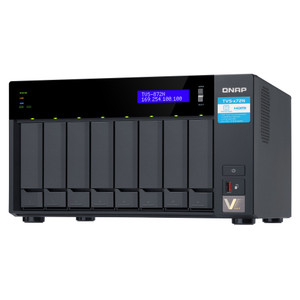
QNAP TVS-872X-I3-8G-US 8-Bay 10GbE NAS with iSCSI IP-SAN and Intel Core i3
Overview
The QNAP TVS-872X-I3-8G-US is an 8-bay desktop NAS purpose-built for environments where a single network storage platform needs to handle file serving, virtualization, IP-SAN block storage, and media tasks simultaneously. Powered by an Intel Core i3 processor on a 64-bit x86 architecture, it runs a full x86 application stack — meaning you're not limited to QNAP's own apps. Docker containers, Linux VMs, and Windows VMs all run natively, which matters when you need to consolidate edge workloads onto shared storage hardware without buying a separate application server.
For network-attached storage deployments where bandwidth is the bottleneck rather than spindle count, the built-in 10GBASE-T RJ45 port eliminates the need for an add-in card and delivers the throughput headroom to keep eight drives busy across concurrent users. This puts it squarely in the category of prosumer-to-SMB NAS appliances that can actually justify 10GbE without a six-figure budget.
Key Features
- Intel Core i3 / 64-bit x86 Architecture: A real x86 processor means you can run standard x86 VMs and containers directly on the NAS — no cross-compilation, no ARM compatibility headaches. Useful when you need a lightweight Milestone or Genetec recording server co-resident with storage.
- 8 GB SODIMM DDR4, expandable to 64 GB (2 × 32 GB): Ships with 8 GB baseline — adequate for NAS duties and light virtualization. If you're running multiple VMs or a heavier IP-SAN workload, the two SODIMM slots support up to 64 GB, which is the practical ceiling for this class of i3 platform. Upgrade RAM before you run out of headroom, not after performance degrades.
- 8 Drive Bays: Eight bays give you enough raw capacity for multi-TB surveillance retention or general-purpose file storage, with RAID flexibility from RAID 0/1/5/6/10 down to JBOD. Eight bays also means you have room for a hot spare without sacrificing usable capacity tiers.
- Built-in 10GBASE-T RJ45 Connectivity: The onboard 10GbE port is 5-speed (100M/1G/2.5G/5G/10G), so it negotiates down to whatever your switch supports. No SFP+ module to source or lose — standard Cat6A patch cable is all you need to hit full 10G. For PoE switch deployments feeding IP cameras back to this NAS, that 10G uplink is the difference between a smooth multi-stream recording workflow and a congested 1G bottleneck.
- M.2 NVMe SSD Caching: NVMe cache slots let you front-end spinning drives with flash for read-heavy workloads like VMS playback or database temp space. You get SSD-class latency on frequently accessed data without replacing the entire drive pool — the right tradeoff when HDDs are still cost-effective for raw capacity.
- 4K HDMI Output (Intel UHD Graphics 630): The integrated Intel UHD Graphics 630 drives a 4K HDMI display directly from the NAS. For surveillance deployments, this means local live-view or playback without a separate workstation — plug in a monitor and the NAS doubles as a dedicated display station. Not a substitute for a full VMS client workstation, but eliminates a device in smaller installations.
- iSCSI IP-SAN Support: Block-level iSCSI targets let you present storage volumes directly to VMware ESXi, Hyper-V, or bare-metal servers as if they were local disks. This is the feature that elevates the TVS-872X-I3-8G-US beyond a file server into shared storage infrastructure — critical when your hypervisor cluster needs shared block storage without a dedicated SAN appliance.
Integration and Compatibility
The x86 platform and QNAP's QTS operating system support a wide ecosystem: Surveillance Station for IP camera recording (compatible with hundreds of ONVIF and RTSP cameras), Virtualization Station for KVM-based VMs, Container Station for Docker workloads, and native iSCSI/NFS/SMB for cross-platform file sharing. For a deeper look at the full QNAP storage and NAS lineup, including higher-channel and rackmount options, the brand catalog covers the complete range. If you're planning storage for a larger camera count, review the NAS storage selection guide to right-size drive count and RAID against your retention requirements. Pairing with a network video recorder or using the NAS as primary VMS storage are both viable architectures depending on camera count and redundancy needs.
Frequently Asked Questions
Q: How much RAM does the TVS-872X-I3-8G-US ship with, and what is the maximum?
A: It ships with 8 GB of SODIMM DDR4 RAM across two slots. The maximum supported is 64 GB using two 32 GB SO-DIMMs.
Q: Does the TVS-872X-I3-8G-US support iSCSI for VMware or Hyper-V shared storage?
A: Yes. The unit supports iSCSI IP-SAN, allowing you to present block-level storage volumes to VMware ESXi, Hyper-V, or other iSCSI initiators directly over the network.
Q: What network speeds does the built-in port support?
A: The onboard 10GBASE-T RJ45 port is 5-speed: 100M, 1G, 2.5G, 5G, and 10G. It auto-negotiates to the highest speed your switch supports, so no special switch is required to use it at lower speeds.
Q: Can I run virtual machines directly on the TVS-872X-I3-8G-US?
A: Yes. The Intel Core i3 64-bit x86 processor supports KVM-based virtualization. QNAP's Virtualization Station lets you run Windows or Linux VMs locally, and Container Station supports Docker containers.
Q: Does the TVS-872X-I3-8G-US have an HDMI output for local display?
A: Yes. The Intel UHD Graphics 630 drives a 4K HDMI output, suitable for local surveillance live-view or direct desktop access without a separate PC.
Q: What is the TVS-872X-I3-8G-US (often searched as TVS 872X I3 8G US) compatible with for IP camera surveillance?
A: QNAP Surveillance Station supports hundreds of IP cameras via ONVIF and manufacturer-specific drivers. The x86 platform and 10GbE connectivity make it viable as primary VMS storage or as a standalone recorder for mid-size camera counts.
The TVS-872X-I3-8G-US sits at an interesting crossover point: it's a legitimate 10GbE storage appliance with an x86 processor, which means it can serve as both primary NAS storage and a light application host in the same chassis. That 10GBASE-T RJ45 port negotiates five speeds, so you're not forced into a 10G switch refresh on day one — you get the headroom when your infrastructure catches up.
Technical Highlights:
- 64 GB RAM ceiling (2 × 32 GB SODIMM DDR4): Ships at 8 GB, but the two-slot design lets you scale to 64 GB as VM count or iSCSI workload grows — plan that upgrade into your initial budget if this is going into a virtualized environment from day one.
- Intel UHD Graphics 630 with 4K HDMI: Local 4K display output from the integrated GPU means a monitor and keyboard turns this into a standalone surveillance viewing station — one less device to rack or desk-mount in a small security operations room.
- iSCSI IP-SAN block storage: Presenting iSCSI targets to a VMware or Hyper-V cluster is the use case that separates this unit from a basic SMB file server. It's the right architecture when you need shared block storage for a small hypervisor cluster without a dedicated SAN budget.
Deployment Considerations:
- The i3 processor is the entry point in the TVS-872X line — if your workload includes heavy concurrent VM I/O plus active Surveillance Station recording plus NVMe caching management simultaneously, evaluate whether the i5 variant in the same family gives you needed headroom before committing.
- RAM upgrade is a day-one decision for virtualization workloads: 8 GB is tight for running multiple VMs alongside QTS OS overhead. Order the SO-DIMMs at the same time as the unit to avoid a second shipping cycle.
The TVS-872X-I3-8G-US is the right fit for a small-to-mid enterprise branch office or security operations deployment where a single appliance needs to handle IP camera storage via Surveillance Station, provide iSCSI block volumes to a two- or three-node hypervisor cluster, and serve SMB/NFS file shares — all over a single 10GbE uplink without separate dedicated hardware for each function.