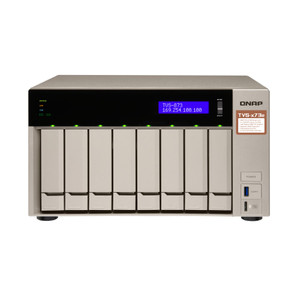
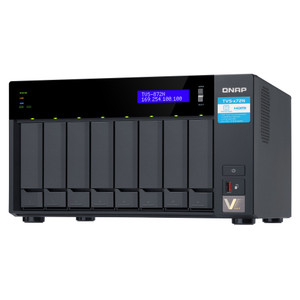
QNAP TVS-673E-4G-US 6-Bay NAS iSCSI IP-SAN with AMD Quad-Core APU
The TVS-673E-4G-US is a six-bay network-attached storage and iSCSI IP-SAN appliance built around AMD's R-Series RX-421BD quad-core APU — a processor that pairs x86 compute muscle with an embedded Radeon R7 GPU on a single die. That combination makes this NAS a practical fit for SMB file serving, virtualization workloads, and 4K multimedia transcoding without needing a discrete graphics card or separate compute server. If you're running a mixed environment — shared storage plus light VM hosting plus a 4K display output at the rack or workstation — the TVS-673E-4G-US covers all three from one chassis.
Key Features
- AMD RX-421BD Quad-Core APU, Burst to 3.4 GHz: The 64-bit x86 architecture means this runs a full QNAP QTS or QuTS hero OS environment with real application support — not a stripped-down embedded stack. The 3.4 GHz burst ceiling handles bursty transcoding or snapshot operations without throttling, which matters if you're running Plex, Virtualization Station, or Container Station alongside file services simultaneously.
- Embedded Radeon R7 GPU: Hardware-accelerated video transcoding and 4K HDMI output live here. Offloading decode/encode to the GPU keeps the CPU cores free for storage I/O and VM overhead — a real factor when you're streaming 4K surveillance footage or media to a local display at up to 3840 × 2160 @ 30Hz without a separate GPU card consuming a PCIe slot.
- 4GB DDR4 RAM, Expandable to 64GB: Ships with 4GB — workable for basic NAS duties but expect to upgrade if you're running multiple VMs or containers. The 64GB ceiling gives you room to scale: 16GB handles moderate virtualization, 32–64GB opens the door to memory-intensive applications like databases or analytics workloads co-located on the appliance.
- Dual PCIe Expansion Slots: Two PCIe slots let you add 10GbE or 25GbE NICs, NVMe caching cards, or additional storage controllers without replacing the unit. For a growing environment, this is the spec that extends the useful life of the appliance — add a 10GbE card now, add an NVMe cache tier later when budget allows.
- USB QuickAccess Port: Direct USB connection to the NAS for initial setup or file access without going through the network — useful during commissioning or in headless rack environments where you need to grab data quickly without configuring a network path first.
- Six USB 3.2 Ports (2x Gen 2 + 4x Gen 1): USB 3.2 Gen 2 peaks at 10 Gbps per port — fast enough to treat external SSDs as a real backup or overflow tier rather than a slow legacy connection. Four Gen 1 ports (5 Gbps each) handle peripherals, UPS monitoring dongles, or expansion enclosure tethering without consuming the high-speed ports.
- iSCSI IP-SAN Capability: Beyond standard NAS file protocols (SMB/NFS/AFP), the TVS-673E-4G-US presents block storage over iSCSI — meaning VMware, Hyper-V, or bare-metal servers can mount LUNs directly, treating this unit as a SAN target. That's a meaningful architecture choice for shops that need block-level storage without the cost of dedicated Fibre Channel infrastructure.
- 4K HDMI Output at 3840 × 2160 @ 30Hz: Drives a local 4K display directly from the NAS — practical for video surveillance review stations, media editing review setups, or HTPC-style deployments where the NAS is also the playback device. The 30Hz ceiling is adequate for video playback; not suitable for high-refresh gaming or fluid desktop animation.
Integration and Compatibility
The QNAP NAS lineup integrates with VMware vSphere, Citrix XenServer, and Microsoft Hyper-V for block-storage provisioning via iSCSI. The x86 architecture supports network-attached storage workloads alongside QNAP's Container Station (Docker/LXC) and Virtualization Station for running Windows or Linux VMs directly on the appliance. The dual PCIe slots accommodate QNAP's own QM2 NVMe+10GbE combo cards, reducing cabling and slot consumption in space-constrained deployments. For environments already running a network video recorder stack, the TVS-673E-4G-US can serve as a tiered storage target, offloading long-term retention from primary NVR storage — pair it with a PoE switch infrastructure plan to keep network segmentation clean. Consult a storage capacity and retention planning guide before sizing drives for surveillance or backup use cases, since camera stream count and retention period drive bay and drive sizing more than raw chassis count.
Frequently Asked Questions
Q: What processor does the TVS-673E-4G-US use, and is it fast enough for running VMs?
A: It uses the AMD R-Series RX-421BD, a 4-core 64-bit x86 APU with burst speed up to 3.4 GHz. It's capable of running light-to-moderate virtualization workloads via QNAP Virtualization Station — 1–3 VMs with modest RAM and CPU allocation. For heavier VM workloads, plan to upgrade the RAM from the base 4GB toward the 64GB maximum and expect the dual PCIe slots to carry a 10GbE NIC for adequate throughput.
Q: Can the TVS-673E-4G-US be used as iSCSI block storage for VMware or Hyper-V?
A: Yes. The unit supports iSCSI IP-SAN, which allows VMware ESXi, Microsoft Hyper-V, and other hypervisors to mount LUNs over a standard IP network. This makes it a cost-effective block-storage option for small virtualization clusters that don't justify full Fibre Channel infrastructure.
Q: What is the maximum RAM the TVS-673E-4G-US supports?
A: The unit ships with 4GB DDR4 and supports up to 64GB. Upgrading RAM is strongly recommended before deploying memory-intensive workloads like multiple concurrent VMs, container stacks, or in-memory database applications.
Q: Does the TVS-673E-4G-US support 4K display output?
A: Yes. It includes HDMI output capable of driving a display at up to 3840 × 2160 (4K) at 30Hz, powered by the embedded Radeon R7 GPU. This enables local 4K media playback or surveillance footage review directly from the NAS without a separate playback device.
Q: What expansion options are available on the TVS-673E-4G-US?
A: The unit includes dual PCIe expansion slots, allowing you to add 10GbE or 25GbE network cards, NVMe SSD caching cards, or additional storage controllers. This is the primary upgrade path for increasing throughput as storage or network demands grow.
Q: What USB connectivity does the TVS-673E-4G-US provide?
A: Six USB 3.2 ports total: 2 × USB 3.2 Gen 2 (10 Gbps) and 4 × USB 3.2 Gen 1 (5 Gbps). The Gen 2 ports are fast enough for external SSD backup targets. A USB QuickAccess port is also included for direct host-to-NAS file access without a network connection.
The TVS-673E-4G-US is one of the more versatile six-bay units in the QNAP lineup, specifically because the AMD RX-421BD APU gives you a real x86 compute platform rather than a stripped ARM core — that distinction matters the moment you need to run containers or VMs alongside storage duties. The embedded Radeon R7 GPU also means 4K hardware transcoding doesn't eat your CPU headroom, which is directly relevant if this box is serving surveillance footage to a review station while simultaneously handling file traffic.
Technical Highlights:
- 64-bit x86 Architecture: Unlike ARM-based NAS units, the RX-421BD runs a full application stack — Docker containers, Windows/Linux VMs via Virtualization Station, and x86-native QNAP apps all work without compatibility caveats. Burst clock to 3.4 GHz keeps latency-sensitive operations snappy.
- Dual PCIe Slots: This is the spec that determines long-term value. Adding a QM2-2P-384 (NVMe + 10GbE) occupies one slot and delivers both SSD caching and high-speed network connectivity — a single-card upgrade that meaningfully changes the unit's throughput ceiling without chassis replacement.
- 64GB DDR4 RAM Ceiling: The 4GB base is fine for file serving but genuinely limiting for virtualization. Budget for a RAM upgrade at deployment time — 16GB is a practical floor for running 2–3 light VMs concurrently, and the 64GB max gives you room if workloads grow.
Deployment Considerations:
- The iSCSI IP-SAN capability is only as fast as your network — deploying this as a VMware datastore on 1GbE will bottleneck heavily under concurrent VM I/O. Plan the 10GbE NIC addition at initial deployment rather than retrofitting after performance complaints surface.
- The 4K HDMI output runs at 30Hz maximum — adequate for video review and media playback, but confirm with end users if they expect a desktop workstation feel, since 30Hz can feel sluggish for daily GUI use compared to 60Hz displays.
For a SMB environment running a hybrid file-server and virtualization workload — say, a 10–50 user office with a small Hyper-V cluster and local 4K surveillance review — the TVS-673E-4G-US with a 10GbE NIC and 16–32GB RAM is a deployable, cost-justified answer that avoids the expense of separate compute and storage infrastructure.