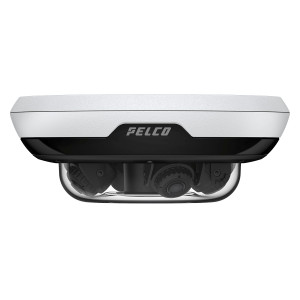
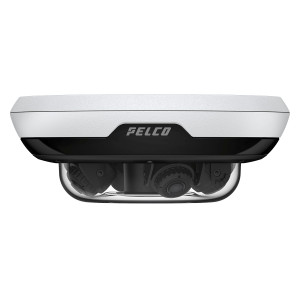
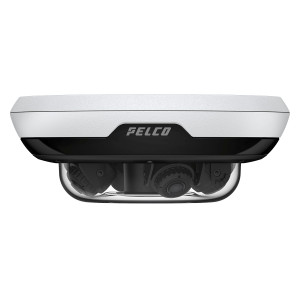
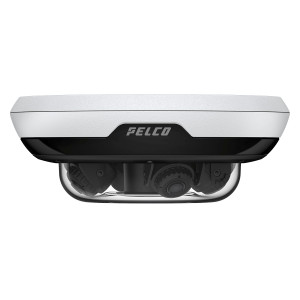
Pelco SMLE1-32V5-4H Sarix Multi Enhanced 32MP 4-Sensor Panoramic Camera
The Pelco SMLE1-32V5-4H is a 4-sensor panoramic IP camera system designed to eliminate blind spots across expansive areas. Each of the four independent 5MP sensor heads produces rectilinear (undistorted) output without de-warping overhead, meaning you get sharp, straight-edged images across the entire 360° field without the processing lag that stitching introduces. This architecture delivers 32MP aggregate resolution, making distant facial and object identification practical on perimeter applications where conventional single-camera coverage falls short. The 3.3–5.7mm varifocal lens on each head lets you adjust focal length per sensor to match your specific mounting height and coverage geometry—a real advantage on irregular building profiles or tall fence lines where uniform lens angles won't work.
Key Features
- 360° panoramic coverage with four independent 5MP heads: Eliminates traditional coverage gaps that occur between single-camera rotations. Each head operates as a discrete sensor, so you capture true simultaneous multi-direction surveillance rather than time-sequenced PTZ pans.
- 32MP aggregate resolution for identification at distance: Across perimeter surveillance applications, higher total megapixels mean readable faces and license plates at greater distances. At 32MP across four heads, you get roughly 8x the data density of a single 4MP camera for the same installed footprint.
- 3.3–5.7mm varifocal lens per sensor: Unlike fixed-lens designs, varifocal adjustment accommodates mounting at varied heights and angles without requiring different camera models. Reduces lens inventory and installation complexity on large deployments.
- H.265 compression reduces storage bandwidth by 40–60% versus H.264: When recording 24/7 across four continuous streams, H.265's efficiency directly lowers recorder CPU load and storage capacity requirements. On a 30-day retention mandate with dozens of multi-head systems, this compounds into meaningful CapEx and power savings.
- 130 dB SureVision wide dynamic range: Handles extreme lighting contrasts—such as bright perimeter lighting alongside shadowed building facades—without washing out detail in either the bright or dark regions. Critical for dawn/dusk identification work where conventional WDR fails.
- Built-in infrared and 0.018 lux low-light sensitivity: Operates in near-total darkness with onboard IR illumination. No separate night-vision unit or external lighting infrastructure required, cutting installation cost and power draw.
- Smart Analytics and Object Detection on every head: Each sensor independently processes motion, person detection, and loitering analytics. Reduces false-alarm rates compared to single-camera analytics that must infer multi-direction threats from a single viewpoint.
- IP66/IP67 environmental rating and IK10 impact resistance: IP66 withstands direct rain and dust without degradation; IP67 handles brief submersion. IK10 rating means the housing tolerates 20J impacts (equivalent to a 5 kg steel ball dropped from 40 cm)—relevant for high-traffic areas or outdoor applications prone to accidental bumps or vandalism attempts.
- PoE+ power delivery: Single PoE+ (802.3at) cable carries power and data. No separate power supplies, conduit, or breaker circuits. Simplifies rough-in and reduces installation labor on retrofit projects.
- Full ONVIF compliance (Profiles S, T, G, M): Integrates with major VMS platforms and third-party analytics engines without proprietary middleware. Flexibility to switch recorders or add specialized analytics without camera replacement.
- Operating range –40°C to +65°C: Handles extreme temperature swings without enclosure heaters or coolers. Relevant for uninsulated perimeter installations, data center exteriors, or refrigerated warehouse zones.
- Integrated microSD storage and HTTPS encryption: Built-in backup safeguards against recorder failure. HTTPS encryption protects video streams in transit across untrusted networks—mandatory for compliance-sensitive deployments (healthcare, government, finance).
Integration and Compatibility
The SMLE1-32V5-4H streams four independent H.265 and H.264 video streams, each tagged with ONVIF metadata. This means your network video recorder sees four distinct camera feeds, allowing per-head motion detection and analytics configuration. Verify your NVR supports at least four simultaneous streams at 5MP resolution to avoid CPU bottlenecks. For IP camera implementations on older Milestone or Genetec systems, confirm ONVIF Profile S and Profile T support in your VMS release notes—older VMS builds may require firmware updates to recognize all four heads as discrete video sources.
Deployment Guidance
Use Pelco's lens calculator to confirm seamless 360° overlap between the four heads at your intended installation height. Gaps in coverage eliminate the core advantage of the SMLE1 design. On pole-mounted or corner installations, validate sight lines to confirm no architectural elements block any sensor's field of view. PoE+ switch ports (minimum 90W available power per camera) must be verified before deployment—budget for gigabit uplink capacity if you are integrating multiple panoramic systems on a single network segment, as four simultaneous 5MP streams consume roughly 25–40 Mbps depending on scene complexity and compression tuning.
Frequently Asked Questions
Q: Does the SMLE1-32V5-4H work with Milestone XProtect or Genetec?
A: Yes. Full ONVIF Profile S and Profile T support ensures compatibility with both platforms. Confirm your VMS version is current—older Milestone and Genetec releases (pre-2019) may require firmware patches to recognize all four sensor heads as independent video sources. Contact your VMS vendor to verify ONVIF multi-stream support on your specific release.
Q: What is the warranty on the SMLE1-32V5-4H?
A: 5-year manufacturer warranty covering defects in materials and workmanship.
Q: Can I adjust the lens focal length after installation?
A: Yes. The 3.3–5.7mm varifocal lens on each head allows post-installation adjustment. This is useful if mounting geometry changes or if you need to shift coverage between near-field and far-field identification. Adjustment requires physical access to the lens barrel.
Q: What are the power requirements for the SMLE1-32V5-4H?
A: PoE+ (IEEE 802.3at) delivers all required power and data via a single cable. Typical draw is 25–35W depending on IR duty cycle and sensor load. Verify your PoE+ switch has sufficient available wattage per port (minimum 30W recommended for headroom).
Q: Is infrared included, or do I need external lighting?
A: Infrared illumination is built in. At 0.018 lux sensitivity and integrated IR, the SMLE1-32V5-4H operates in near-total darkness without external lighting infrastructure. This reduces installation cost and power draw compared to auxiliary night-vision systems.
Q: Does the camera support edge storage for redundancy?
A: Yes. Integrated microSD card slot (up to 512GB on compatible cards) provides local backup of video streams, protecting against recorder downtime. Configure your NVR to prioritize network recording and use microSD as failover storage.
Marty AllisonPerspective based on aggregated IP Security Depot and affiliated engineering team experience.
The SMLE1-32V5-4H (often searched as SMLE1 32V5 4H) is the right choice if you have a genuine 360° coverage mandate and can justify four independent sensor streams in your VMS. The core strength is rectilinear output from each head—no de-warping, no stitching artifacts, no real-time processing overhead. On panoramic systems that stitch images, you lose sharpness at the seams and incur CPU penalty at the recorder. The SMLE1 avoids this entirely, delivering four clean 5MP feeds that process independently.
Technical Highlights:
- Rectilinear sensor output without de-warping: Each 5MP head produces undistorted imagery that integrates natively with edge analytics. On competing stitched-panoramic designs, de-warping introduces 10–15% CPU overhead per camera; the SMLE1 eliminates this penalty entirely.
- H.265 compression at 40–60% bandwidth reduction: Across four simultaneous streams at 5MP each, H.265 versus H.264 means roughly 30–50 Mbps savings per camera on a typical mixed-scene deployment. Over 24/7 recording on 10+ systems, that compounds to measurable recorder CPU relief and meaningful storage CapEx reduction.
- 3.3–5.7mm varifocal lens flexibility: Unlike fixed-lens multi-sensor designs, varifocal adjustment post-installation means you can correct coverage gaps without swapping lens assemblies. On large perimeter builds, this cuts spare-parts inventory and avoids field re-engineering.
- IK10 impact rating: 20J tolerance is practical for high-traffic perimeters, fence-line installations, or sites with documented vandalism history. IK08 cameras fail under this same impact; IK10 provides a margin.
Deployment Considerations:
- Verify your NVR supports four independent ONVIF video streams at 5MP without CPU saturation. Older Milestone and Genetec instances (pre-2019) sometimes require profile updates to handle multi-head panoramic systems correctly.
- PoE+ switch capacity is non-negotiable. At 25–35W per camera, running three or four SMLE1 units on a single 48-port PoE+ switch will consume one-third of total available wattage. Budget accordingly or segment cameras across multiple switches.
- Varifocal lens calibration requires field access. If cameras are mounted in high or difficult-to-reach locations, plan for post-installation lens tuning as part of commissioning. Skipping this step will result in soft focus on one or more heads.
Deploy this model on large perimeter installations, critical infrastructure fence lines, and warehouse exteriors where continuous 360° coverage and identification-range performance justify the four-stream NVR footprint. Skip it if your VMS cannot handle multiple independent streams per camera or if you need only 90–180° coverage—a single varifocal bullet camera will be more cost-effective.
Key Specifications:
Field of View: 360°
Color: White