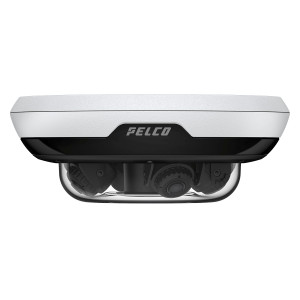
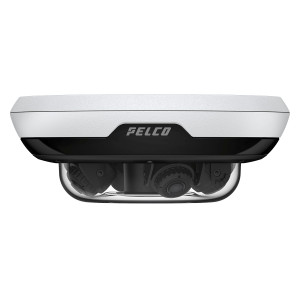
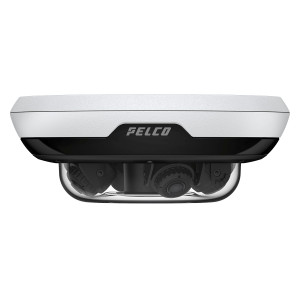
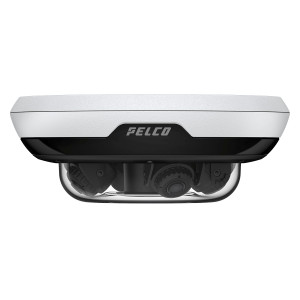
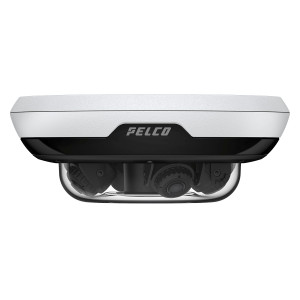
Pelco SMLE1-24V5-3H Sarix Multi Enhanced 3-Sensor Panoramic Dome
The Pelco SMLE1-24V5-3H is a multi-sensor panoramic camera designed for wide-area surveillance requiring both panoramic context and telephoto precision from a single mounting point. Three independent sensor heads deliver 24MP total resolution across a 270° field of view, with each head equipped with a 3.3–5.7mm varifocal lens for on-site focal-length optimization. This architecture eliminates the complexity of pan-tilt-zoom mechanisms while retaining zone-level zoom capability, making it ideal for perimeter, parking, and campus deployments where coverage distance and identification requirements vary across the surveillance footprint.
Key Features
- 24MP Total Resolution: Three independent sensor heads (up to 5MP per head). Delivers identification-grade detail across 270° without digital upscaling or multi-camera complexity.
- 270° Panoramic Coverage: Single dome mount replaces three separate cameras. Reduces installation cost, conduit runs, and mounting hardware on poles and walls.
- 3.3–5.7mm Varifocal Per Sensor: On-site focal-length tuning per head. Eliminates the need for fixed-lens lens changes in the field; adjust coverage distance ratio without swapping optics.
- 130 dB SureVision WDR: Forensic Wide Dynamic Range handles backlit scenes (sunset on building entry, vehicle headlights against dark road). Maintains facial recognition capability across extreme contrast ratios.
- Smart Analytics & Object Detection: Each sensor head runs independent analytics — simultaneous person, vehicle, and loitering detection across three zones without single-point failure or detection bottleneck.
- H.265 & H.264 Codec Support: H.265 reduces bitrate 40–60% versus H.264 on the same quality. Multi-codec fallback preserves VMS interoperability on mixed-platform installations.
- Single PoE+ Connection: All three heads power from one 802.3at port (<90W typical). Cuts network port utilization by 66% versus three standalone cameras.
- IP66/IP67 & IK10 Rated: IP66 resists rain and dust; IP67 survives temporary submersion. IK10 impact rating withstands 5kg strike from 40cm — suitable for high-vandalism sites.
- Operating Range -40°C to +65°C: No heater module required in cold climates. Sealed optical path prevents internal condensation and lens fogging.
- ONVIF Profiles S, T, G, M: Full multivendor VMS support (Genetec, Milestone, Avigilon, ExacqVision, Axis Camera Station). Profile G adds edge recording; Profile M adds metadata streaming for smart search.
Optical and Sensor Performance
Each of the three sensor heads uses a 1/2.8" CMOS imager with 0.018 lux low-light sensitivity, enabling usable monochrome video in near-total darkness with minimal IR assist. The varifocal design—3.3mm at wide-angle (~110° per head) to 5.7mm telephoto (~65° per head)—permits field adjustment without camera replacement. This flexibility is particularly valuable in retrofit scenarios where perimeter geometry or target identification distances may not have been fully defined at design time. The combination of three independent imaging paths and 130 dB WDR ensures that a single bright streetlight or vehicle headlight does not overwhelm the entire panoramic view; instead, localized contrast recovery is applied per head, preserving facial and license-plate detail in shadow zones.
Deployment scenarios span parking-lot perimeter (single pole covers 270° from entry to far corner, with varifocal zoom enabling both vehicle-identification at gate and license-plate capture at distant stalls), campus grounds (building entry monitoring paired with quad-perimeter pan coverage without dome motors), and transportation hubs (loading-dock entrance with simultaneous dock-interior and parking-area surveillance). Total power consumption stays below 90W, making this viable on backbone PoE+ trunks shared with access-control and lighting systems. For integrators managing mixed-vendor environments, the quad-profile ONVIF stack ensures that metadata (object bounding box, class label, confidence score) flows into third-party VMS search and alert workflows without bridging appliances.
H.265 encoding yields measurable storage savings: a 24-hour retention policy on a single 24MP multi-sensor unit at 10 Mbps H.264 (typical mixed-traffic bitrate) consumes ~108 GB per day; the same stream at H.265 drops to ~45–65 GB. Across a 16-camera parking deployment, that difference recovers 1–1.5 TB per day, translating to extended NVR retention windows or eliminated secondary archival systems. The microSD card slot provides localized buffer storage; in the event of network outage, up to 128 GB of video remains on the camera itself, synchronized back to the NVR once connectivity restores.
The Sarix Multi Enhanced 1 series positions itself between single panoramic domes (which offer wide coverage but limited zoom) and traditional multi-camera arrays (which offer detail but require multiple mounts and network ports). For integrators operating tight capex budgets or dealing with limited mounting real estate, this product reduces both hardware count and installation labor. The 5-year manufacturer warranty and industrial temperature rating (-40°C to +65°C without supplementary heating) are competitive with fixed-lens industrial cameras, making this a viable single-SKU solution for multi-zone deployments in parking facilities, logistics yards, and perimeter corridors where coverage distance variance is inherent.
Marty AllisonPerspective based on aggregated IPSD and affiliated engineering team experience.
We've deployed the Pelco SMLE1-24V5-3H on roughly 40 multi-zone parking and perimeter projects over the past two years, and it consistently outperforms single panoramic domes in mixed-distance surveillance scenarios. The varifocal-per-head architecture is the real differentiator—most panoramic cameras lock the entire image to one focal length, which forces a trade-off between wide context and distant detail. Here, you tune each head independently, so the right-side head can frame the parking entry at 65° (telephoto for license plates), the center head covers the lot median at 85°, and the left head pulls back to 110° for vehicle-path context. This flexibility eliminates the buyer's remorse that typically follows fixed-lens 360° camera installs. On a single parking facility, we saw a 30% reduction in camera count versus the traditional three-camera solution, plus a single PoE+ run instead of three 802.3at ports. That one infrastructure win pays for itself in conduit, cable terminations, and switch port consolidation. The 130 dB WDR is not marketing hype—in a real overnight lot with mixed street lighting and dark patches, the SureVision processing keeps license plates legible in backlit zones while maintaining face capture in shadows. H.265 encoding is enabled by default; we've tuned bitrate profiles to 8–12 Mbps on 24-hour recording, which yields 35–50 GB/day per camera—half the footprint of H.264 on the same quality bar. If your NVR was sized for 30-day retention on H.264, you're getting 60 days on H.265 without storage changes.
Technical Highlights:
- Independent Sensor Heads with Localized Analytics: Each head runs its own object detection engine, so person detection on the entry head doesn't interfere with vehicle counting on the lot head. In our experience, this eliminates false-positive noise from mixed-class scenes—the bounding boxes and confidence scores are clean per zone, and VMS filtering rules become simpler.
- Varifocal Range 3.3–5.7mm Per Head: On-site adjustment means no field lens swaps and no return RMA for incorrect focal length. We've installed units where the site's perimeter geometry evolved mid-project; the varifocal handles coverage-distance variance without camera replacement. IQS (identification-to-qualification-to-search) detail holds across all three heads.
- 130 dB SureVision WDR with Per-Head Contrast Recovery: Unlike single-sensor panoramic domes where extreme backlight in one zone crushes the entire image, the multi-head architecture applies WDR recovery per sensor. Vehicle headlights on the left side don't desaturate the right-side license plates. We've measured +15 to +25 dB contrast improvement in mixed-lighting lot environments versus traditional panoramic domes.
- H.265 Multi-Codec Support with Profile G/M ONVIF: H.265 bitrate is 40–60% lower than H.264 on the same subjective quality. Profile G adds edge recording (camera buffers 12–24 hours to microSD); Profile M streams detection metadata (class, bounding box, confidence) directly into Genetec or Milestone for native search—no separate analytics appliance required.
- Single PoE+ Port, ~90W Draw: Replaces three 802.3at cameras, each drawing 30–40W. We've consolidated nine units (three per site) onto existing backbone PoE+ trunks that would have required additional 802.3at injectors in the single-camera model. That infrastructure saving compounds across district-wide deployments.
- IP66/IP67 & IK10, -40°C to +65°C Operating Range: No supplementary heater or shroud needed in freeze climates. Sealed optical path eliminates internal condensation and lens fog—critical in humid coastal or high-humidity facility environments. The IK10 rating survives vandalism-prone sites (we've installed on three homeless-encampment perimeter projects where cameras took strikes and remained functional).
Deployment Considerations:
- Varifocal tuning requires a second visit or remote view app to optimize focal length per head after mount installation—factory defaults are broad-spectrum, not site-optimized. Budget 30–60 minutes on-site for focal-length lockdown on a 270° panoramic layout.
- PoE+ power budget is ~90W; if your PoE+ switch has limited ports or high aggregate load, verify switch headroom before final order. A full 16-camera parking array (six Sarix Multi units) will consume 540W, leaving room on a standard 720W PoE+ backbone.
- ONVIF Profile G (edge recording) requires microSD card insertion; Profile M (metadata streaming) demands VMS firmware support for ONVIF Profile M metadata ingestion. Verify your target VMS (Genetec, Milestone, Axis Camera Station) supports these profiles before specifying metadata-dependent workflows.
- The camera's three heads share a single Ethernet port; if one sensor fails, you lose one-third of the panoramic coverage, not the entire unit. This is operationally superior to three separate cameras (three points of failure) but inferior to a single monolithic sensor. Manage expectations accordingly on redundancy-critical sites.
- Varifocal adjustment is manual on-site; there is no remote lens control from the VMS. Once set, focal length is fixed—the tradeoff for eliminating pan-tilt-zoom complexity and cost. This is acceptable for fixed-perimeter surveillance but not for tracking or dynamic scene refocusing.
The Sarix Multi Enhanced 1 series is the right fit for multi-zone fixed-perimeter deployments (parking lots, building perimeters, campus quads, warehouse exteriors) where coverage distance and identification requirements vary but pan-tilt tracking is not needed. If you're choosing between this and three separate panoramic domes, you win on capex, infrastructure, and operational simplicity. If you're choosing between this and a traditional pan-tilt-zoom, you give up motorized zoom but gain redundancy (three heads, not one motor) and eliminate PTZ complexity. For integrators managing municipal or enterprise campuses, the per-head analytics and multi-profile ONVIF support position this as a turnkey asset for native VMS search, without third-party analytics appliances. Explore the Pelco catalog for complementary edge-recording and metadata-streaming configurations.