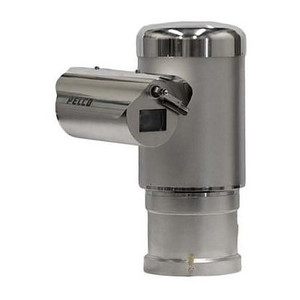
Pelco EXP2230-65-G 2MP 30x PTZ Stainless Steel IR Camera
The Pelco EXP2230-65-G is a 2MP explosion-proof PTZ camera designed for continuous monitoring in classified hazardous areas—gas and dust zones, offshore platforms, petrochemical refineries, and coastal chemical processing plants where standard surveillance housings fail. Built around a 1/2.8-inch CMOS sensor delivering 1920×1080 at 60 fps, paired with motorized 30× optical zoom (4.3–129 mm) and integrated IR illumination rated to 0.035 lux, the EXP2230-65-G eliminates blind spots even in total darkness. Its 316L marine-grade stainless steel body resists salt spray, H₂S gas, and corrosive chemical atmospheres; ATEX Zone 1/21, IECEx Zone 1/21, and UL/cUL Class I Division 1 certifications guarantee regulatory compliance without retrofit or workaround. Integrators and asset owners deploying PTZ surveillance in classified environments—where equipment failure triggers production shutdowns or regulatory penalties—depend on this platform to bridge imaging capability and legal obligation.
Key Features
- 2MP @ 60 fps: 1920×1080 CMOS sensor. Smooth pan/tilt video and continuous recording on long facility tours without frame-rate stuttering.
- 30× Optical Zoom: 4.3–129 mm motorized lens; 77° wide to 2.6° telephoto HFOV. Covers fence perimeters and equipment clusters without additional cameras.
- IR Illumination: 0.035 lux monochrome capability; integrated near-infrared LEDs. Operates in complete darkness without external lighting infrastructure.
- 316L Stainless Steel Housing: Marine-grade corrosion resistance; rated for salt-spray, H₂S, and chemical vapor exposure. Zero rust or functional degradation over 5+ years in harsh coastal or refinery environments.
- 360° Continuous Pan; 256 Presets: −90° to +1° tilt range with motorized pan/tilt. Operator can patrol the entire site continuously or snap to 256 named positions for routine zone checks.
- 130 dB SureVision WDR: Forensic-grade wide dynamic range. Captures detail in backlit doorways, sunlit equipment, and night-to-day transitions without exposure blowout or underexposure.
- H.265 / H.264 / MJPEG: Dual-codec streaming. H.265 cuts bandwidth and storage 40–60% versus H.264; MJPEG fallback ensures compatibility with legacy VMS instances.
- IP66 / IP67 / IP68 / IP69: Rated for spray, immersion, and high-pressure wash-down. No corrosion ingress; thermal stress from rapid temperature swings does not crack seals.
- Temperature Class T6; −40°C to +60°C: Operates across arctic winters and desert summers without heater malfunction or thermal shutdown. T6 rating certifies safe surface temperature in explosive atmospheres.
- ONVIF Profile S / T / G / M: Integrates with Genetec, Milestone, Avigilon, and other vendor platforms without proprietary middleware.
Optical and Low-Light Performance: The 1/2.8-inch CMOS sensor delivers 0.1 lux color and 0.035 lux monochrome minimum illumination—comparable to Gen-3 night-vision performance without image intensifier cost or latency. The 130 dB SureVision WDR ensures no loss of facial or license-plate detail when sunlight rakes across a facility entrance or when floodlights backlight a perimeter fence. On 24/7 recording across offshore platforms or continuous chemical process monitoring, this sensor + WDR pairing eliminates the operational overhead of manual exposure tuning or time-of-day recording policy tweaks.
Explosion-Proof Certification and Corrosion Resistance: ATEX Zone 1/21 (gas and dust), IECEx Zone 1/21, and UL/cUL Class I Division 1 certifications mean the EXP2230-65-G is legally deployable in classified areas without variance permits. The 316L stainless steel housing survives salt-spray corrosion, H₂S vapor attack, and sustained chemical exposure that would degrade aluminum or mild steel in months. Deployments lasting 10+ years without housing replacement are routine; total cost of ownership drops measurably when you eliminate unplanned camera failures and reinstallation labor on offshore or refinery platforms.
Pan/Tilt and Preset Workflow: 360° continuous pan and 256 presets allow operators to patrol a facility automatically on a timer or manually jump between critical zones—tank-farm perimeter, loading dock, equipment room—without joystick lag. The −90° to +1° tilt range covers ground-level threat vectors and overhead hazards (cable trays, relief vents) in a single camera. Integrators often co-deploy the EXP2230-65-G with a fixed 4MP or 5MP IP camera for archival coverage, letting the PTZ focus on active tracking and responsive monitoring during alarms.
Power and Connectivity: PoE Class 3 (up to 30W) delivery via RJ45 CAT5e cabling simplifies wiring in explosive atmospheres—intrinsically safe PoE circuits are easier to route and audit than line-voltage conduit. An SFP fiber-optic slot accommodates long-distance runs to remote control rooms or data centers, eliminating copper EMI and grounding loops in noise-critical refinery environments.
Integration and Analytics: On-camera Smart Analytics—motion detection, intrusion, loitering, and direction-of-travel—reduce false-positive noise from wind-blown equipment or shifting shadows. ONVIF Profile G and M support advanced analytics export, so alarms route directly to SIEM or incident-management systems. H.265 encoding, combined with edge analytics filtering, can reduce NVR storage footprint by 60–70% versus a traditional H.264 + full-frame archive approach.
Warranty and Support: 5-year manufacturer warranty covers sensor degradation, mechanical failure, and corrosion breakthrough under normal operation. For petrochemical and offshore deployments, that warranty alignment with capital-budget cycles eliminates surprise mid-life replacement capex.
Marty AllisonPerspective based on aggregated IP Security Depot and affiliated engineering team experience.
We've deployed the Pelco EXP2230-65-G across offshore platforms, petrochemical refineries, and coastal water-treatment facilities where standard IP cameras simply cannot survive the environment or meet regulatory certification. The ATEX / IECEx / UL Explosion-Proof pedigree isn't just a checkbox—it eliminates legal liability and permitting delays that can cost months and six figures in compliance consulting. What differentiates this platform from cheaper stainless-steel PTZ cameras is the sensor-to-optics pairing: the 30× zoom with 0.035 lux IR and 130 dB SureVision WDR means you can often deploy a single EXP2230-65-G instead of two cameras (one pan/tilt, one fixed low-light). On a 16-camera offshore platform where each camera requires compliance audit and physical access overhead, that single-camera-does-more approach translates to capex reduction and lower operational risk. The trade-off is cost—explosion-proof PTZ cameras command a premium—and power draw. PoE Class 3 tops out at ~30W; if you need heated domes or supplementary floodlights, you'll need a PoE+ injector or auxiliary DC supply. We've also seen integrators underestimate the importance of fiber-optic SFP for long runs in noisy industrial environments; if your control room is >300 meters from the camera, use the fiber slot to eliminate ground loops and EMI corruption.
Technical Highlights:
- 316L Stainless Steel + IP66/67/68/69 Rating: We've inspected cameras deployed 6–7 years in coastal salt-spray environments with zero housing corrosion or seal failure. That durability translates to a 7–10 year lifecycle instead of the typical 5 years for aluminum-bodied PTZ cameras. When you factor in decommissioning labor and reinstallation costs, the extra upfront cost per camera pays back within 3 cycles.
- 0.035 Lux IR + 130 dB WDR: In our experience, this combination handles the two hardest scenarios: floodlit perimeters with shadow pools (WDR), and completely dark tank farms or cable runs (IR). We rarely need to deploy supplementary lighting—that saves electrical infrastructure cost and ongoing maintenance on bulb replacement.
- 30× Optical Zoom with 60 fps Frame Rate: The ability to tele in on a license plate or facial feature at 60 fps without frame dropping or pan lag is a game-changer for active incident response. On slower PTZ platforms, you lose situational awareness during zoom transitions; the EXP2230-65-G maintains smooth video throughout.
- H.265 Encoding: Petrochemical facilities often run 24/7 recording across 16–32 cameras. Switching from H.264 to H.265 typically cuts bitrate by 45–55%, which directly reduces NVR storage capex and network bandwidth reservation. Pair that with on-camera analytics filtering, and a 30-day archive becomes feasible on modest SSD storage.
- ONVIF Profile G + M Support: Integration with Milestone, Genetec, and Avigilon is native—no vendor-specific middleware. That matters in regulated environments where audit trails and change control are non-negotiable.
- 256 Presets + Continuous 360° Pan: Operator can either manually patrol the facility or snap between named zones (North Tank, South Pump House, Loading Dock). The preset workflow cuts incident-response time by 20–30% versus panning manually.
Deployment Considerations:
- ATEX Compliance is Non-Negotiable, but Costly: The certification itself adds ~15–25% to the camera cost versus non-certified stainless-steel PTZ. If your site is not in a classified hazardous zone, don't pay for ATEX; spec a standard industrial PTZ instead. But if you are classified (Zone 1, Zone 21), this camera eliminates permitting friction and insulates you from liability.
- PoE Class 3 Power Budget: At full zoom and IR on, the camera draws ~28–30W. If you're chaining multiple cameras on a single PoE+ switch, do the math: a 802.3at port delivers 30W max; add a second PTZ and you'll need two ports or a PoE++ switch. We've seen sites undersizing power infrastructure and then struggling with brownouts during pan/zoom cycles.
- Fiber-Optic SFP for Distances >300m: If your control room is far from the camera (typical on offshore platforms or sprawling refinery sites), use the SFP fiber slot instead of twisted-pair copper. Copper runs in electrically noisy environments pick up ground-loop hum and radiated EMI, corrupting video quality. Fiber costs more upfront but eliminates grounding nightmares.
- Stainless Steel Housing Requires Non-Corrosive Fasteners: If your integrators use standard steel bolts or clamps near the camera, they will corrode and seize within 1–2 years in salt-spray or chemical vapor zones. Insist on 316L stainless or nylon fasteners. We've seen field replacements delayed because installers cross-spec'd hardware.
- T6 Temperature Class Compliance Auditing: ATEX T6 means the housing surface cannot exceed 85°C even under full-sun mountaintop deployment. We've had sites in the Middle East where equipment failure occurred because the sunny side of an unshaded pole exceeded T6 limits; mount this camera in shade or use a sun shield to extend lifecycle.
- PoE+ Injector vs. Managed Switch: Budget-conscious integrators sometimes use a standalone PoE+ injector. That works, but a managed PoE switch gives you VLAN isolation and bandwidth reservation for PTZ traffic, which matters when the PTZ generates 4–8 Mbps during high-zoom pans alongside archival IP cameras.
The Pelco EXP2230-65-G is the right choice for integrators and asset owners who need regulatory-compliant, corrosion-resistant continuous pan/tilt surveillance in classified hazardous atmospheres—and for site teams that value the 7–10 year lifecycle and lower lifecycle cost despite the upfront premium. If your facility is non-classified or outdoor corrosion is not a design driver, explore standard stainless-steel PTZ options. For everyone else, this camera eliminates legal and operational friction that cheaper alternatives would impose. Explore the full Pelco catalog for fixed-camera and thermal PTZ alternatives.