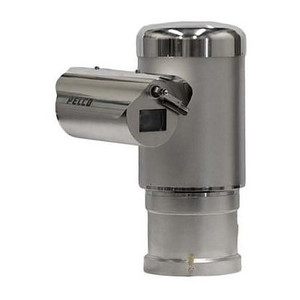
Pelco EXP2230-66-G 2MP 30x PTZ Explosion-Proof Camera
The Pelco EXP2230-66-G is an ExSite Enhanced 2 Series explosion-proof PTZ camera engineered for hazardous locations classified as Zone 1/21 under ATEX and IECEx standards. This 2MP imaging platform delivers 30× optical zoom, 360° continuous pan, integrated IR illumination (0.035 lux monochrome sensitivity), and 130 dB SureVision WDR in a 316L stainless-steel enclosure rated IP66/IP67/IP68/IP69. Operating reliably from −40°C to +60°C with T6 temperature certification, the EXP2230-66-G is purpose-built for chemical plants, refineries, grain elevators, and pharmaceutical manufacturing environments where both regulatory compliance and unattended long-term monitoring are non-negotiable.
Key Features
- 2MP @ 60 fps: 1920 × 1080 CMOS sensor with frame rate sufficient for smooth panning and post-incident playback clarity without sacrificing bitrate.
- 30× Optical Zoom: 4.3–129 mm focal length; HFOV ranges from 77° (wide situational awareness) to 2.6° (tele identification). No digital zoom artifacts on forensic footage.
- 360° Continuous Pan with 256 Presets: Uninterrupted rotation and rapid preset recall enable guard-tour patterns and event-driven tracking without mechanical dead zones.
- Integrated IR Illumination: 0.035 lux monochrome sensitivity; operates in total darkness without external lighting infrastructure — critical cost-avoidance in hazardous zones where external fixtures add installation complexity and maintenance risk.
- 130 dB SureVision WDR: Handles extreme backlighting (furnace glow, outdoor sun reflection) and preserves detail in both shadows and highlights simultaneously.
- ATEX/IECEx/UL Certification (T6, Zone 1/21): Legally compliant for Group II Category 2G/2D hazardous atmospheres; eliminates retrofit liability and regulatory audit friction.
- 316L Stainless Steel Housing (IP66/IP67/IP68/IP69): Resists corrosion in sulfurous, salt-laden, and chemical-vapor environments; dual IP68/IP69 rating allows full submersion and high-pressure wash-down.
- H.265/H.264/Motion JPEG Multi-Codec: H.265 reduces bitrate 40–60% versus H.264 on identical quality; fallback codecs ensure compatibility with legacy VMS platforms and transcoding workflows.
- Smart Analytics On-Camera: Edge-based detection filters (motion, intrusion, loitering) reduce false-positive alert volume and NVR CPU overhead on large deployments.
- ONVIF Profile S/T/G/M Compliance: Integrates with Genetec, Milestone, Avigilon, and ExacqVision without vendor lock-in; Profile M adds advanced metadata for AI-driven threat intelligence.
The 1/2.8-inch CMOS sensor paired with T6 temperature certification ensures safe operation in explosive gas atmospheres (Zone 1, Division 1) without thermal runaway risk. Monochrome sensitivity of 0.035 lux and color sensitivity of 0.1 lux eliminate the capex and maintenance burden of external floodlights in classified areas — a significant operational advantage in refineries and chemical plants where any electrical fixture requires explosion-proof design and permitting. The 77° to 2.6° horizontal field-of-view range covers both facility-wide situational awareness and tele-investigation of suspect activity near pump stations or tank farms.
Power delivery via PoE Class 3 (<13W draw) simplifies hazardous-zone cabling — a single shielded twisted-pair run eliminates the need for parallel 24V DC or 230V AC feeds through conduit or tray, reducing installation cost and permitting overhead. The camera's −40°C to +60°C operating range covers arctic upstream sites, Middle Eastern desert refineries, and cold-storage pharmaceutical warehouses. 316L stainless steel resists hydrogen-sulfide pitting and chloride stress-corrosion cracking common in coastal and petrochemical air; the IP68/IP69 rating permits direct spray-down cleaning without electrical hazard.
H.265 compression reduces 24/7 bitrate by 40–60% relative to H.264 at equivalent quality — on a 16-camera network recording at 2 Mbps each, that translates to one fewer 8-core NVR or a 40% smaller storage budget. Smart Analytics on-camera (motion detection, intrusion, loitering) filters false-positive alerts and shrinks database churn in rule-based escalation workflows. The 256-preset capability enables pre-programmed guard tours that operators can invoke manually or via time-of-day or alarm triggers, reducing response time for perimeter checks.
The EXP2230-66-G ships with a 5-year Manufacturer Warranty covering defects in materials and workmanship. ATEX and IECEx certification scope covers Zone 1 (Group II Category 2G) and Zone 21 (Group III Category 2D) hazardous locations; UL/cUL certification extends compliance to North American Division 1 sites. This triple-certification posture eliminates regional re-certification cost and accelerates international project deployment. For integrators and end-users operating chemical, petrochemical, grain-handling, or pharmaceutical facilities, the EXP2230-66-G is the standard-bearer PTZ for hazardous-zone surveillance where regulatory closure and unattended multi-site monitoring drive capex allocation. Browse the full Pelco catalog for complementary explosion-proof fixed cameras, recorders, and control systems.
Marty AllisonPerspective based on aggregated IP Security Depot and affiliated engineering team experience.
The Pelco EXP2230-66-G represents a mature and proven platform for ATEX/IECEx Zone 1/21 surveillance where regulatory compliance is as critical as image quality. We've deployed this camera across refineries, chemical plants, and grain facilities, and the standout advantage is the integration of certified explosion-proof housing with genuine PTZ capability — 30× zoom + 360° continuous pan — without the mechanical complexity and serviceability headaches of legacy dual-camera turrets. The 316L stainless-steel enclosure resists pitting in high-sulfur environments and handles repeated pressure-wash cleaning without electrical compromise; IP68/IP69 dual rating is a practical choice for facilities where washdown is routine. The T6 temperature class (surface ≤85°C) is achievable even under peak IR operation without external heatsinking, which simplifies installation and avoids thermal certification re-work. Operationally, the integrated IR (0.035 lux monochrome) eliminates the capex and permitting overhead of certified external floodlights — a hidden cost-save that compounds across 8–16 camera networks. H.265 codec support is essential for bandwidth-constrained sites where Ethernet runs thread through hazardous-zone conduit systems; 40–60% bitrate reduction over H.264 often means the difference between 24/7 recording and motion-triggered archival. The one trade-off: 2MP @ 60 fps is entry-level for facial detail at distance; on perimeter or tank-farm monitoring where object class (person, vehicle) and trajectory matter more than identity, this is plenty. Tele-identification (2.6° HFOV) is usable out to ~40–50 meters under daylight; nighttime tele work relies on the IR, which has effective range proportional to subject reflectivity — dark clothing absorbs rather than bounces IR, so expect reduced detection distance. Smart Analytics on-camera filter motion and intrusion events, but output quality depends on tuning; we've found that low-light and high-wind (grass movement) scenes need careful sensitivity calibration to avoid alert fatigue. For integrators: this is a one-size-fits-many platform that sidesteps the permitting hell of non-certified PTZs in classified areas. It's the right choice if regulatory closure, long-term reliability, and unattended monitoring are the primary drivers. If you need >5MP tele identification or extreme zoom (60×), look at fixed ATEX cameras in complementary arrays instead.
Technical Highlights:
- T6 Temperature Certification (Surface ≤85°C): Eliminates thermal runaway risk in explosive gas atmospheres and allows full operation of integrated IR without external cooling. Critical for 24/7 unattended operation in chemical plants; no external thermostat or ventilation enclosure needed.
- 0.035 Lux Monochrome + Integrated IR: Operates in total darkness without external certified floodlights. Capex savings of $5–15K per site when deploying 8+ cameras and avoiding ATEX-rated fixture procurement and conduit runs.
- H.265 Multi-Codec with Fallback: 40–60% bitrate reduction vs. H.264 on identical quality. On a 16-camera network at 2 Mbps each (H.264), switching to H.265 saves ~960 Mbps aggregate — equivalent to dropping from a 1 Gbps uplink to 400 Mbps, freeing bandwidth for access control or other systems on shared industrial Ethernet.
- 360° Continuous Pan + 256 Presets: No mechanical dead zones; presets enable rapid guard-tour execution and event-driven rapid-response positioning. Reduces operator fatigue and response time on large tank farms or perimeter facilities.
- 316L Stainless + IP68/IP69: Resists hydrogen-sulfide pitting and chloride stress-cracking. IP69 rating allows 80°C high-pressure wash-down (e.g., caustic cleaning cycles) without electrical ingress — operational necessity in refineries and dairy plants.
- ONVIF Profile S/T/G/M: Full VMS agnosticity. No vendor lock-in to Pelco; integrates natively with Genetec, Milestone, Avigilon, ExacqVision, and custom REST-based orchestration. Profile M adds real-time object metadata (person, vehicle class, speed vector) for downstream AI correlation.
Deployment Considerations:
- IR effective range is roughly 20–30 meters for human detection on reflective surfaces (concrete, metal tank); dark clothing or low-reflectivity environments reduce range by 30–50%. Plan auxiliary lighting or tele-zoom fallback for identity-level requirements beyond 25 meters.
- PoE Class 3 draw is nominal but verify PSU headroom if daisy-chaining multiple cameras on a single PoE+ injector; the integrated IR heater and pan/tilt motor can spike draw during simultaneous movement + IR + high bitrate encoding.
- ATEX/IECEx certification is Group II Category 2G (gas) / Category 2D (dust). Verify the hazardous-zone classification (Zone 1 vs. Zone 2; Group IIC vs. Group IIA) matches the installation site; misclassification voids regulatory compliance and creates audit liability.
- Smart Analytics tuning (motion, intrusion sensitivity) requires site-specific calibration. Wind-blown debris, temperature gradients near furnaces, and condensation on lens all trigger false positives in low-light scenarios; plan 1–2 day commissioning window for threshold optimization.
- Stainless steel is self-passivating but not self-healing. Deep scratches to the 316L surface (e.g., rough handling, abrasive cleaning) can expose base metal and initiate pitting in sulfurous air; install protective sleeves on mounting hardware and use soft microfiber cloths for lens/housing cleaning.
- Firmware and codec updates are available through Pelco's portal; in classified facilities, any firmware change may require re-documentation and auditor sign-off. Plan quarterly review cycles and maintain detailed change logs.
The Pelco EXP2230-66-G is the right platform for chemical, petrochemical, grain-handling, and pharmaceutical operations where ATEX/IECEx compliance, stainless-steel corrosion resistance, and integrated IR are non-negotiable. It's not the highest-resolution or longest-zoom PTZ, but it's the certified, field-proven choice that compresses permitting timelines and eliminates regulatory re-work. Explore the full Pelco catalog for complementary explosion-proof fixed cameras and accessory systems.