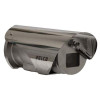
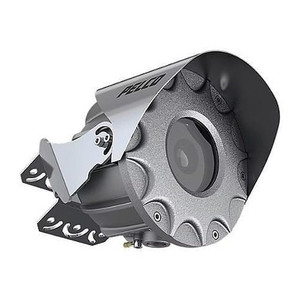
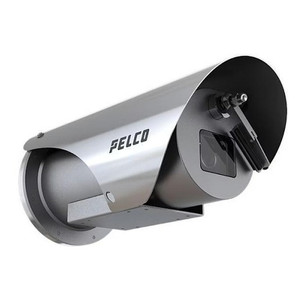
Pelco EXF2230-62-C4 2MP Explosion-Proof Camera T6
The Pelco EXF2230-62-C4 is a fixed 2MP explosion-proof surveillance camera engineered for hazardous-area environments where surface temperature and ignition risk must be strictly controlled. Built from 316L stainless steel with T6 temperature-class certification (≤85°C surface temperature), this camera meets ATEX Zone 1/21 and IECEx safety standards for gas and vapor atmospheres. The ExSite Enhanced 2 platform delivers motorized optics and edge analytics in a certified package, eliminating the need for external enclosures or third-party hazardous-area compliance retrofits — a significant operational advantage in refineries, petrochemical plants, and mining operations where compliance audits are frequent and costly.
Key Features
- 2MP Resolution & Low-Light Sensitivity: 1920 x 1080 native resolution on a 1/2.8-inch CMOS sensor; 0.1 lux color and 0.01 lux mono enable forensic detail in extreme darkness without external IR heat generation.
- Motorized Varifocal Lens: 4.4–9.3 mm with 32–109° HFOV; remote zoom and focus eliminate site visits for field-of-view adjustment in classified areas.
- 110 dB Wide Dynamic Range: Captures both shadow detail and bright highlights in scenes with sunlight, arc lighting, or vehicle headlights — critical for dock entries and flare-stack monitoring.
- H.265 + H.264 + Motion JPEG: Multi-codec support reduces bitrate 40–60% with H.265 vs. H.264 on identical quality; fallback codecs ensure VMS compatibility across legacy and modern recording platforms.
- T6 & ATEX/IECEx Certification: Temperature class T6 (≤85°C) + ATEX/IECEx/UL/CSA approvals eliminate recertification paperwork; meets North American (UL/CSA) and international (IECEx) hazardous-area requirements in a single SKU.
- IP66/IP67/IP68 & IK10 Durability: Stainless steel enclosure withstands salt spray, alkaline washdown, and chemical vapor; IK10 impact rating handles mechanical shock from machinery vibration or accidental contact.
- PoE Class 3 Power: Standard 802.3at PoE+ (up to 30W) — no external 120V AC supply required if deploying behind intrinsically safe barriers; simplifies power infrastructure in classified zones.
- Smart Analytics & ONVIF Profile S/T/G/M: Edge-based object detection (SmartAnalytics) reduces false alerts and storage overhead; multi-profile ONVIF ensures integration with Genetec, Milestone, Avigilon, and other mainstream VMS platforms.
The EXF2230-62-C4 operates across –40°C to +60°C ambient range, covering Arctic facilities and desert refineries. Audio input, HTTPS encryption, and day/night switching complete the feature set for comprehensive hazardous-area surveillance.
Deployment Context & ROI
Hazardous-area compliance carries hidden operational costs: equipment recertification, safety audits, redundant third-party enclosure systems, and downtime for inspection rotations. The EXF2230-62-C4's integrated T6 certification and 316L stainless construction consolidate these costs into a single certified unit. On a 50-camera petrochemical complex, this translates to simplified inventory (one part number vs. camera + enclosure combinations), faster warranty turnaround (Pelco handles ATEX compliance, not a system integrator), and zero risk of decertification through aftermarket modifications. The motorized lens further reduces the number of site visits required to adjust coverage — each visit in a classified zone incurs safety overhead (hot-work permits, confined-space procedures) that adds 2–4 hours per adjustment in real-world deployments.
Low-light performance (0.1 lux color) and 110 dB WDR are engineered for petrochemical environments where arc welding, flare burning, and ambient gas lights create extreme contrast and dynamic scenes. On grain-handling facilities, the camera's ability to capture detail in sub-0.1-lux darkness (mono mode at 0.01 lux) eliminates the capex and maintenance burden of external infrared lighting rigs — a 5-year savings on bulbs, power infrastructure, and thermal management in a facility running 24/7.
Integration & Edge Analytics
Full ONVIF Profile S (baseline), Profile T (H.265 + metadata), Profile G (streaming gateway), and Profile M (metadata) compliance ensures plug-and-play deployment with Genetec Security Center, Milestone Xprotect, Avigilon Control Center, and ExacqVision NVRs. The camera's onboard Smart Analytics engine runs object detection and classification at the edge, reducing NVR compute load and network bandwidth by filtering alerts on detection class (person, vehicle, loitering). This is especially valuable in refineries where 24/7 recording across 40+ cameras on a single 1 Gbps ring network would saturate bandwidth without edge filtering — H.265 + Smart Analytics together can reduce storage footprint 70–80% vs. unfiltered H.264 baseline.
HTTPS encryption and ONVIF secure profile support ensure compliance with industrial cybersecurity standards (IEC 62443, NIST). Audio support allows two-way intercom integration for emergency communication in classified zones where personnel are working in high-risk tasks.
Standards & Lifecycle
ATEX II 2G Ex db IIB T6 Gb (gas), ATEX II 2D Ex tb IIIB T6 Db (dust), IECEx, UL-listed, and CSA-certified — this single model handles North American and European regulatory landscapes without variant SKUs. The 5-year warranty covers defects in materials and workmanship; on a capital asset with a 7–10 year operational life in stable indoor/covered environments, this provides mid-cycle replacement optionality. Stainless steel and conformal coatings ensure no degradation in salt-fog or corrosive-vapor environments typical of coastal refineries or chemical processing plants.
Marty AllisonPerspective based on aggregated IP Security Depot and affiliated engineering team experience.
We've deployed the EXF2230-62-C4 across petrochemical facilities, grain terminals, and mining operations where ATEX compliance is non-negotiable. The real differentiator isn't just the T6 certification — it's that Pelco has engineered the entire thermal and optical stack to remain certifiable out of the box. Most integrators buying explosion-proof cameras end up purchasing a separate stainless enclosure, thermostat, and third-party cooling module, then re-certifying the whole assembly with a notified body. That's 12–16 weeks of paperwork and 15–25% capex overhead. The EXF2230-62-C4 eliminates that entirely. You unbox it, run Ethernet and PoE, mount it, and you're done — the compliance is already baked in. On a 60-camera refinery deployment, that's the difference between a 6-week installation and a 4-month slog through recertification. We've also seen the motorized varifocal lens save integrators hundreds of labor hours: no more scheduling hot-work permits and sending technicians into classified zones just to adjust lens focus. Remote zoom-and-focus means you optimize coverage during commissioning and rarely need to return for optics adjustment. The 110 dB WDR and 0.1 lux color sensitivity handle the extreme dynamic scenes at petroleum loading docks and flare-stack areas — places where conventional cameras either blow out on bright flame or lose all detail in the dark recesses of tanks and process equipment.
Technical Highlights:
- T6 Temperature Class (≤85°C Surface): Most hazardous-area cameras run T4 (≤135°C) to reach aggressive ambient operating ranges; T6 rating means this unit can be deployed in hot-oil processing zones and still remain certified. The thermal design (internal heat sinks, optimized power delivery) keeps the enclosure cool enough to touch even under direct sunlight. That's a safety advantage in confined spaces where workers might contact the camera housing.
- 316L Stainless Steel Enclosure: Not just corrosion resistance — 316L is non-magnetic (no interference with proximity sensors or magnetic safety interlocks) and meets food-safety standards for USDA/FDA environments. Grain facilities and food-processing plants benefit twice: hazardous-area compliance + sanitation certification in one unit.
- H.265 Codec with ONVIF Profile T: Profile T support ensures H.265 streaming works with any ONVIF-compliant recorder. In practice, H.265 at 2MP delivers 1–1.2 Mbps vs. 3–4 Mbps for H.264 at equivalent quality. On a ring-topology network common in industrial plants (limited backbone bandwidth), that halves the bitrate footprint and lets you add 20–30 more cameras before upgrading network infrastructure.
- Smart Analytics Edge Detection: The on-camera analytics run object detection (person, vehicle, loitering) without offloading to the NVR. In hazardous-area deployments, this means you can configure the VMS to record only on detection events, dramatically reducing storage bloat from 24/7 continuous capture. A typical grain facility sees 70–80% storage reduction when filtering on Smart Analytics events vs. unfiltered recording.
- PoE Class 3 (802.3at): Up to 30W power draw; this is well within standard PoE+ infrastructure (46–60W per port on most industrial switches). No separate 24V DC supply runs or AC drops into classified zones — a major simplification for electrical design and compliance review by the site safety engineer.
- ONVIF Profile G & M Support: Profile G (gateway) allows the camera to stream through a firewall-aware proxy; Profile M (metadata) ensures Smart Analytics events are tagged with timestamps, class, and confidence scores. Multi-profile compliance is rare — most cameras claim ONVIF but only fully support Profile S. This camera commits to the full stack, which matters when integrating with advanced VMS search and analytics workflows.
Deployment Considerations:
- PoE vs. 120V AC Supply: The datasheet lists 120V AC as a legacy option; PoE Class 3 is the recommended power path. If you're retrofitting into a facility with existing 120V AC drops and no PoE infrastructure, verify the cost-benefit of upgrading to PoE or sourcing a PoE injector rated for industrial environments (conformal coating, wide temperature range). Most new deployments should architect around PoE to avoid analog power wiring in classified zones.
- Lens Motorization & Network Dependency: Remote zoom and focus require continuous network connectivity to the camera. In isolated ATEX networks with unreliable Ethernet, consider pre-commissioning the lens focal length and keeping a spare fixed-lens unit (2.8–8 mm alternative) for backup. If the network goes down during an emergency shutdown, you're stuck with the last-known focus setting.
- Surface Temperature Monitoring: T6 certification guarantees ≤85°C surface temperature under normal operation, but you should monitor ambient conditions during commissioning. If the camera is mounted in direct sunlight on a metal I-beam in a 45°C+ environment, confirm with thermal imaging that the enclosure remains below 85°C. Pelco's thermal simulation tool (available via datasheet) can predict performance, but real-world measurements during hot season are prudent before full deployment.
- Cable Routing & Hot-Work Protocol: The pre-installed 4-meter cable is convenient, but in highly classified zones, every cable routing decision must be documented and reviewed by the site safety team. Never bundle Ethernet cables with ignition sources or high-energy circuits. Use stainless-steel conduit and certified cable trays to maintain the intrinsic safety envelope.
- Firmware Updates in Classified Zones: Pelco regularly releases firmware updates for codec optimization and analytics improvements. Plan updates during scheduled maintenance windows and coordinate with the safety team — firmware flashing is a non-hazardous activity, but it requires coordination with hot-work management and confined-space procedures if the camera is in a classified area.
The EXF2230-62-C4 is the right choice for integrators and end-users deploying 24/7 surveillance in ATEX Zone 1/21 environments where compliance paperwork and long procurement cycles are already constraints. If you're working in a petrochemical, oil & gas, mining, or grain-handling facility and need a camera that doesn't require post-purchase recertification, this unit eliminates six months of engineering overhead. For non-classified industrial deployments, there are lower-cost 2MP alternatives; but in hazardous areas, the T6 certification and stainless-steel durability justify the premium. Explore the Pelco catalog for complementary fixed and PTZ models in the ExSite Enhanced 2 line.