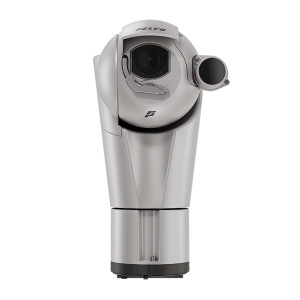
Pelco ESCE1-2X40Q6-RLU-1 Bispectral Thermal PTZ Camera
The Pelco ESCE1-2X40Q6-RLU-1 is a ruggedized, bispectral PTZ dome that merges a 2MP visible imager with integrated QVGA thermal imaging for around-the-clock perimeter and critical infrastructure surveillance. Built on the Esprit Compact Enhanced 1 platform and rated to MIL-STD-810G standards with IP66/IP67 protection, it operates reliably across -40°C to +60°C and delivers both wide-area thermal monitoring and precision visible identification within a single camera head. Export-compliant thermal frame rate (9 Hz, ITAR/EAR compliant) simplifies international deployments and reduces procurement friction.
Key Features
- Dual-Channel Imaging: 2MP visible channel with 40× optical zoom (4.3–120 mm) paired with QVGA uncooled thermal channel with 6 mm fixed lens. Thermal imagery enables detection and tracking regardless of visible light or obscuration.
- Extreme Low-Light Performance: 0.1 lux color, 0.01 lux monochrome. Operates in near-total darkness on the visible channel without supplementary lighting.
- Wide Dynamic Range: 130 dB WDR handles extreme backlit scenes (sunrise/sunset perimeters, vehicle headlights, reflective surfaces) without visible detail loss.
- 360° Continuous Pan; -90° to +1° Tilt; 256 Presets: Full hemispherical coverage with rapid re-acquisition via programmable positions. Eliminates blind spots on rectangular perimeters.
- MIL-STD-810G Rated; IP66/IP67 Ingress Protection: Certified to military environmental and shock standards; withstands rain, dust, and hose-down operations without functional degradation.
- Export-Compliant Thermal Frame Rate: 9 Hz QVGA thermal output meets ITAR/EAR restrictions, simplifying compliance for border and critical-infrastructure operators.
- H.265/H.264 Dual Compression: H.265 reduces bitrate 40–60% versus H.264 on identical quality. Multi-codec fallback ensures compatibility across legacy and modern VMS platforms.
- Gyro Stabilization + Electronic Image Stabilization (EIS): Compensates for camera shake and vibration; critical for pan/tilt during high-zoom visible tracking or on mast-mounted installations.
On-board analytics include auto-tracker, object detection, and direction violation monitoring, with data output via ONVIF Profiles S, T, G, and M. The camera streams over 100BASE-TX Ethernet using IPv4, IPv6, RTSP, RTP, HTTP, and HTTPS, with DNS and NTP support for time-synchronized recording. Powered by 24VAC or 24VDC, making it suitable for outdoor junction boxes and PoE infrastructure lacking extended power budget.
The 6 mm thermal lens delivers a wider field of view than 18 mm variants, enabling large perimeter scans from a single position. The independent 40× visible zoom allows simultaneous broad thermal monitoring of an entire facility fence line while the operator zooms to identify intruders or vehicles at distance. This dual independence eliminates the typical PTZ trade-off between coverage and identification.
Typical deployments span border security checkpoints, airport perimeter fencing, chemical/power plant monitoring, and remote military outposts where thermal imaging must function autonomously in sub-zero or desert heat. The export-compliant 9 Hz thermal frame rate and MIL-STD-810G durability attract government and critical-infrastructure buyers who prioritize compliance over maximum thermal framerate. Integrators pair this with dedicated thermal VMS extensions (Milestone XProtect, Genetec Security Center Thermal Module) or third-party thermal analytics platforms for automated threat detection and historical thermal archive.
Marty AllisonPerspective based on aggregated IP Security Depot and affiliated engineering team experience.
We've deployed the Pelco Esprit Compact Enhanced 1 bispectral line across border checkpoints, port facilities, and utility perimeters where simultaneous visible and thermal monitoring is non-negotiable. The ESCE1-2X40Q6-RLU-1 stands out because it bundles two independent imaging channels in a single PTZ head, cutting capex and installation complexity versus two separate cameras. The 6 mm thermal lens paired with the 40× visible zoom creates a powerful operational asymmetry: you're monitoring a 1.5 km perimeter thermally in real-time while your operator can zoom the visible channel 120 mm deep to read license plates or facial features at distance. On a 16-camera installation, that's one less mast and controller to manage. The MIL-STD-810G rating and IP67 rating absorb salt spray, sand storms, and thermal shock—we've seen units survive arctic winter installations with no maintenance downtime. The export-compliant 9 Hz thermal frame rate is the catch: thermal refresh is locked at 9 Hz per ITAR/EAR restrictions, which is adequate for perimeter intrusion detection but insufficient if you need high-speed thermal video forensics. On the visible side, 60 fps H.265 output is standard, so your analytics platform can still run real-time object detection on the color channel at full framerate while thermal data trickles in at 9 Hz for corroborating evidence or long-term archive.
Technical Highlights:
- 6 mm Thermal Lens + 40× Visible Zoom Independence: Thermal channel sees wide (approx. 57° HFOV) and operates continuously; visible channel zooms from 4.3 mm (56° HFOV) to 120 mm (2.1° HFOV). Operator can maintain thermal perimeter watch while zooming visible into a vehicle or fence breach. No dead time, no mode switching.
- H.265 on Visible + MJPEG on Thermal: Visible stream compresses 40–60% smaller than H.264 at equivalent quality; thermal QVGA encodes as Motion JPEG for codec compatibility on older VMS platforms. Record both simultaneously without transcoding overhead.
- 130 dB WDR with QVGA Thermal Fallback: Visible channel's 130 dB WDR handles silhouette recovery in sunrise/sunset scenarios; when visible fails (dust storm, fog), thermal imagery remains clear and motion-detectable. Redundancy without additional hardware.
- Gyro Stabilization + EIS on Both Channels: High-zoom visible panning (120 mm) introduces jitter on mast-mounted installations; gyro compensates. Thermal data also benefits from EIS, reducing false-positive motion detection from camera shake during pans.
- 256 Presets with Auto-Tracker: Program thermally significant zones (gate, vehicle approach, fence line) as presets; auto-tracker locks onto moving objects and follows autonomously. Frees operator for other monitoring tasks on multi-site VMS console.
- 24VAC/24VDC + 100BASE-TX Ethernet Only: No PoE, no PoE+ budget required. Many border and utility installations already have 24VAC transformer infrastructure; this camera integrates directly without secondary PoE injection units.
Deployment Considerations:
- Export-Compliant 9 Hz Thermal Lock: Thermal video cannot be upgraded to 30 fps, even in closed domestic installations. If your use case requires real-time thermal video at broadcast framerate (e.g., high-speed vehicle tracking on thermal alone), consider the non-export variant or pair with a separate cooled thermal camera. For static perimeter monitoring and intruder detection, 9 Hz is sufficient.
- 6 mm Thermal Lens is Fixed: Unlike the visible 40× zoom, thermal lens does not adjust. Know your thermal coverage range at installation time—if you need narrow 18 mm thermal focus, request the ESCE1-2X40Q18 variant. Field retrofit is not practical.
- 24VAC Power Distribution Distance: Voltage drop over long runs (50+ meters) to a 24VAC transformer requires heavier gauge wiring or a step-up transformer at the camera. Budget for power distribution analysis in sprawling perimeter installations.
- Gyro Calibration on Installation: Gyro stabilization requires initial calibration to horizontal. If the camera is mounted on a tilted pole or non-vertical surface, stabilization performance degrades. Ensure installation crew understands gimbal leveling.
- Thermal Module Integration in VMS: Milestone XProtect and Genetec support ONVIF thermal metadata, but you must license their thermal analytics add-ons separately. Do not assume your existing VMS subscription includes thermal object detection—budget for platform licensing when specifying this camera into a new deployment.
The ESCE1-2X40Q6-RLU-1 is the right choice for integrators building government-compliant perimeter systems, border checkpoints, and critical infrastructure sites where bispectral imaging must operate in extreme temperature swings and ruggedized mounts. If you're working with end-users who can tolerate export-compliant frame rates and don't need cooled thermal performance, this camera delivers unmatched versatility per dollar and per mounting point. Explore the full Pelco catalog for additional PTZ, fixed-dome, and thermal platforms.