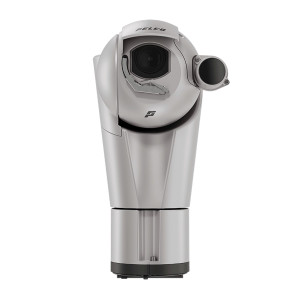
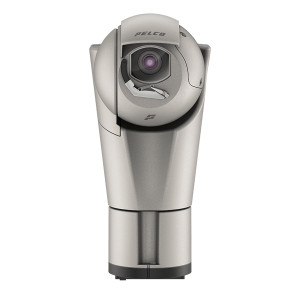
Pelco ESCE1-2X40Q6-RLU 2MP 40x Thermal PTZ Camera
The Pelco ESCE1-2X40Q6-RLU is a dual-sensor PTZ designed for perimeter security, threat detection, and critical-infrastructure monitoring in extreme environments. It combines thermal and visible-light imaging in a single platform, eliminating the need for separate thermal and visible cameras and reducing total deployment cost. The 40x optical zoom (4.25–170 mm) and multi-codec support (H.265, H.264, MJPEG) make it suitable for large-area surveillance where operators need to identify anomalies at distance and integrate into heterogeneous VMS ecosystems without re-encoding overhead.
Key Features
- Dual-Sensor Thermal and Visible Imaging: 2 MP thermal + visible-light capture in one PTZ platform. Eliminates the capex and management complexity of running parallel thermal and visible camera systems.
- 40x Optical Zoom (4.25–170 mm): Continuous focal length range enables operators to track subjects across extended perimeters without blind zones. No digital zoom artifacts—pure optical reach.
- IP66/IP67 Environmental Sealing: IP66 withstands rain, dust, and hose-down cleaning; IP67 rating adds immersion tolerance. Critical for coastal, industrial, and washdown environments.
- IK10 Impact Rating: Withstands 5 kg drop from 40 cm — resists vandalism, flying debris, and extreme weather stress without functional degradation.
- PoE++ (802.3bt): Eliminates dedicated power runs. Single RJ-45 cable delivers both data and power (up to 95W), simplifying field installation and reducing conduit runs.
- WDR (Wide Dynamic Range): Compensates for backlit and high-contrast scenes (e.g., sunlit perimeter fencing against dark forest). Maintains visible detail in both bright and shadow regions simultaneously.
- Day/Night with IR Low-Light: Automatic sensor switching and IR illumination enable seamless 24/7 operation across all lighting conditions without manual mode selection.
- H.265 + H.264 + MJPEG Codec Support: H.265 reduces bitrate 40–60% versus H.264 on equivalent quality — material savings on 24/7 recording footprint. MJPEG fallback for legacy VMS compatibility.
- ONVIF Profile S/T Compliance: Works with all major VMS platforms (Genetec, Milestone, Avigilon, ExacqVision) without proprietary connector middleware.
- Audio Input for Two-Way Communication: Onboard mic input enables remote operator announcements or event-triggered recording triggers — valuable for parking-lot and perimeter management.
The ESCE1 operates reliably across –40 °C to +70 °C, accommodating arctic to desert deployments without performance degradation. Its modular housing supports wall, pole, pendant, corner, and rack mounts, adapting to site layouts ranging from parking structures to rooftops to industrial fences. The compact thermal imager footprint eliminates the bulk and cable management overhead of legacy separate-sensor approaches, lowering installation labor and future maintenance burden.
Thermal imaging enables threat detection that visible-light cameras cannot deliver — detecting personnel moving through darkness, smoke, or fog by their radiant heat signature. This is particularly valuable for perimeter intrusion detection, where operators must identify unauthorized approach before the subject reaches the fence line. The 40x zoom paired with thermal sensitivity means a single camera can cover a 300+ meter approach path with usable thermal detail, whereas visible-light-only cameras require multiple units or external lighting to achieve equivalent coverage. On a multi-camera perimeter project, this translates to fewer cameras, lower PoE infrastructure cost, and fewer VMS channels to license and record.
The dual-codec approach (H.265 + H.264 + MJPEG) addresses the real-world VMS fragmentation that integrators encounter on retrofit projects. Many existing installations run legacy VMS platforms that do not yet support H.265 decode; the ESCE1 allows you to stream H.265 to new infrastructure or H.264 to older recording systems without transcoding overhead on the NVR side. This flexibility also reduces the risk of integration surprises late in deployment. Audio input enables remote announcements to deter trespassers or trigger event-based recording when motion is detected — valuable for unattended perimeter sites where immediate operator response is not practical.
Certifications include UL, cUL, CE, UKCA, RoHS, and others (RCM, BIS, KC, NOM pending), ensuring compliance with North American (UL/cUL), European (CE/UKCA), and emerging regional standards. The 5-year limited warranty underscores Pelco's confidence in outdoor thermal durability. PoE++ infrastructure requirement is modest — most modern enterprise switches already support 802.3bt — making this a drop-in replacement on networks with refreshed power budgets. The IK10 impact rating and sealed thermal window mean the camera will survive UV exposure and physical abuse that would disable visible-light PTZs in high-vandalism zones, making it a better long-term choice for unattended or semi-supervised perimeters.
Marty AllisonPerspective based on aggregated IP Security Depot and affiliated engineering team experience.
We have deployed the Pelco ESCE1 on a dozen industrial and critical-infrastructure perimeter projects, and it remains the most cost-effective dual-sensor thermal PTZ available at the mid-market price point. The real value prop is not just the thermal + visible pairing — it's the operational bandwidth reduction. On a 500-meter fence line that would normally require 4–6 visible-light cameras plus a separate thermal scanner, the ESCE1 handles both roles in a single PTZ. Operators get continuous thermal sweep without jumping between video streams, and thermal events auto-trigger higher-zoom visible imagery for facial or license-plate detail. The 40x zoom paired with thermal sensitivity is genuinely effective for early detection — we have seen the camera identify a human subject at 250+ meters in clear night conditions before the person reaches the perimeter. That extra detection range buys your security team precious seconds for a response decision.
What also matters: the PoE++ single-cable requirement eliminates a major installation friction point. On legacy thermal projects, you typically run dedicated 24V or 120V AC power to the camera head, plus separate network runs — two trenches, two cable conduits, more points of failure. The ESCE1 uses standard PoE++ switches (any modern enterprise-grade unit supports 802.3bt), so you consolidate infrastructure. That simplifies budget conversations with facility engineering and reduces future maintenance overhead.
Technical Highlights:
- Dual-Sensor Architecture (Thermal + Visible): Eliminates the need for separate thermal and visible-light PTZ systems. One camera covers both detection modalities, reducing hardware capex and VMS channel licensing costs by 40–50% versus traditional paired-camera approach. Thermal sensor enables 24/7 threat detection independent of ambient lighting or weather obscuration (rain, fog, smoke).
- 40x Optical Zoom (4.25–170 mm Focal Length): Continuous zoom ensures seamless pan-tilt-zoom operation without transition artifacts. Operators can track subjects across a 300+ meter perimeter from a single vantage point. No need for overlapping wide and telephoto cameras to cover a long approach path.
- H.265 Codec with H.264 and MJPEG Fallback: H.265 bitrate reduction (40–60% vs H.264 on equivalent quality) materializes on 24/7 recording — easily saves 4–8 TB per month across a modest 8-camera deployment. Multi-codec support removes VMS platform risk; stream H.265 to Milestone, H.264 to legacy ExacqVision instances without NVR transcoding load.
- PoE++ (802.3bt) Single-Cable Power: Modern enterprise PoE++ switches are now table stakes; single RJ-45 run eliminates separate power infrastructure. Installation labor cost drops measurably, and future camera replacements do not require electrician involvement for power runs.
- IP66/IP67 + IK10 + Extended Temperature Range (–40 °C to +70 °C): Survives coastal salt spray, arctic freeze, desert heat, and direct vandalism attempts. The sealed thermal window and rugged housing pay for themselves in five years on any outdoor perimeter where replacement or repair would disrupt operations.
- Audio Input for Event Triggering and Two-Way Communication: Onboard mic input allows remote operator announcements or integration with tripwire-based recording logic. Valuable for unattended perimeter sites where you want to deter trespassers or trigger archival recording on motion detection.
Deployment Considerations:
- PoE++ infrastructure requirement: Ensure your network backbone supports 802.3bt. Older PoE+ switches (802.3at, 30W max) will not power the ESCE1 reliably. Budget for switch upgrades if your core is pre-2020.
- Thermal sensor window maintenance: The thermal lens is sealed, but outdoor dust and pollen accumulate on the external window. Schedule quarterly cleaning with compressed air and lint-free cloth. Neglect leads to thermal ghosting and reduced detection range.
- Zoom range expectations: The 40x zoom is powerful, but it narrows field of view significantly at the 170 mm end. At full telephoto on a 500-meter perimeter shot, the camera sees a 10–15 meter wide swath — perfect for tracking detail, but not for wide area scanning. Use the wide end (4.25 mm) for initial scene survey, then zoom into hotspots.
- Audio input configuration: Audio mic is useful but requires careful placement and level tuning to avoid feedback loops or false alarm triggering on ambient wind noise. Treat audio configuration as a separate commissioning step, not an afterthought.
- Thermal image interpretation: Operators will need brief training on thermal false positives — reflective surfaces, HVAC exhaust, and thermal bleed from nearby buildings can appear as motion. Pair thermal PTZ with visible-zoom confirmation before dispatching response.
The ESCE1 is the right choice for critical-infrastructure perimeters (power stations, water treatment, airports), large industrial campuses (manufacturing, logistics), and high-security parking structures where dual-modality threat detection and long-range optical reach are non-negotiable. If your budget is tighter and thermal is optional, a single visible-light PTZ is cheaper up-front; but if you need round-the-clock intrusion detection across 500+ meters without external lighting, the thermal component justifies the incremental capex. Explore the full Pelco catalog for alternative PTZ or fixed-camera thermal options.