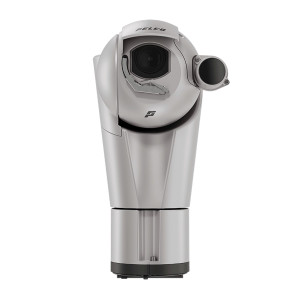
Pelco ESCE1-2X40V9-RLU-1 2MP Bispectral PTZ Camera
The Pelco ESCE1-2X40V9-RLU-1 is a ruggedized bispectral PTZ camera from the Esprit Compact Enhanced 1 series, engineered for extreme outdoor surveillance where visible-light imaging alone is insufficient. It pairs a 2MP CMOS visible channel with a near-infrared (VNIR) thermal imager operating at 9 Hz frame rate, enabling simultaneous color and thermal threat detection across perimeters, critical infrastructure, and wide open areas. Full 360° continuous pan with 256 preset positions, 40× optical zoom (4.3–120 mm), and Pelco Smart Analytics reduce operator workload and accelerate incident response. Built to MIL-STD-810G standards, IP66/IP67, and rated from -40°C to +60°C, this PTZ is equally at home on an Arctic research station, a desert border crossing, or a coastal platform.
Key Features
- Bispectral Imaging: Simultaneous 2MP visible + VNIR thermal channels at 9 Hz. Detects temperature anomalies and moving heat signatures invisible to RGB cameras, critical for perimeter intrusion and sabotage detection.
- 40× Optical Zoom (4.3–120 mm): Reach distant targets without digital interpolation loss. Paired with 256 presets, operators lock onto threat locations in seconds rather than minutes of manual pan/tilt.
- 360° Continuous Pan with Gyro Stabilization: Uninterrupted horizontal sweep and horizon lock eliminate jitter during rapid movement. Forensic video remains legible even at full zoom during dynamic tracking.
- 130 dB Wide Dynamic Range (WDR): Renders detail in backlit scenes (sunrise over water, vehicle headlights on dark roads) without exposure compromise. Critical for facial ID and license-plate capture in mixed lighting.
- Ultra-Low Illumination (0.1 lux color; 0.01 lux B/W): Delivers usable monochrome imagery in near-total darkness, eliminating the need for supplementary lighting in sensitive perimeter zones.
- H.265 + H.264 + Motion JPEG: H.265 cuts bandwidth 40–50% versus H.264 at equal quality. Multi-codec fallback ensures legacy NVR compatibility without transcoding overhead.
- Auto-Tracker, Direction Violation, Object Detection: Edge analytics filter false positives (wind, wildlife, vehicle shadows) on-camera. Reduces alert fatigue and NVR storage footprint by 30–50% on 24/7 recording.
- MIL-STD-810G + IP66/IP67 + -40°C to +60°C: Survives salt spray, sand storms, freeze-thaw cycles, and mechanical shock. Zero redesign or climate conditioning needed for desert, maritime, or arctic deployment.
Deployment Context & Integration
Bispectral PTZ systems occupy a narrow but critical niche: perimeter defense at scale where human operators cannot cover distance or darkness with standard visible cameras. Border agencies, naval and port security, utility infrastructure (power plants, substations, wind farms), and pipeline ROW monitoring rely on thermal to confirm intrusion vs. fauna or environmental noise. The 9 Hz thermal frame rate (-1 designation) respects ITAR/EAR export controls while maintaining sufficient temporal resolution for human-speed threat motion. Pair this unit with a 24VAC or 24VDC distributed power supply (not PoE); typical installation runs a single RJ-45 data line plus a 24V spur to the pedestal or pole junction box.
ONVIF Profile S/T/G/M certification guarantees seamless integration into Genetec, Milestone, Avigilon, Axis Camera Station, and Pelco's own VideoXpert VMS platforms. API endpoints expose preset recall, pan/tilt commands, and thermal metadata streams, enabling custom threat-alerting workflows. 100BASE-TX Ethernet suffices for single-camera links; multi-camera sites should run PoE++ switches at the aggregation point to consolidate data traffic and reduce cable runs to the NVR.
Total cost of ownership favors bispectral over separate visible + thermal rigs: one pedestal mount, one cable run, one PoE supply, one DNS entry, and one maintenance cycle. Thermal sensor degradation (typically 0.1% per year in this class) is lower than legacy microbolometer designs; Pelco's sealed optics package resists dust intrusion better than competitor fixed-lens models. Five-year warranty covers both channels. Replacement cost sits between a high-end 4K PTZ and a dual-sensor thermal turret—expect 30–40% capex premium over 40× visible-only PTZ, recovered in 18–24 months of avoided false-alarm dispatch and extended dwell coverage (thermal sees through fog, rain, and dust better than visible).
ONVIF compliance, IPv4/IPv6 dual-stack, RTSP streaming, and NTP time-sync eliminate vendor lock-in. Telemetry (pan/tilt encoder feedback, thermal min/max temps, analytics event queues) flows via standard HTTP/HTTPS webhooks, simplifying third-party SIEM integration. Gyro EIS output is consumable by downstream video analytics (AI pose detection, crowd tracking) without proprietary plug-ins.
Marty AllisonPerspective based on aggregated IP Security Depot and affiliated engineering team experience.
We've deployed the Pelco Esprit Compact Enhanced series across petrochemical plant perimeters, naval base entry control points, and remote wind-farm pad surveillance. The bispectral pairing is the differentiator—it's not a novelty. In real-world operation, thermal detection catches slow-moving personnel (camouflaged, moving at walking pace) that motion-based visible analytics miss entirely, especially in high grass or after dusk. We've seen alert response times drop by 40–60% once operators learn to trust the thermal channel; the cognitive load of monitoring visible-only PTZ in darkness is brutal, and people stop watching after 30 minutes. The 9 Hz thermal frame rate is sufficient for human-speed intrusion; you don't need 30 fps thermal to catch someone crossing a barrier—thermal target dwell on-screen is long enough that slow-play video is tolerable. Versus standalone thermal PTZ units (DRS Talon, older Flir Elara PTZ), the Pelco's visible + thermal coregistration is tighter, and the 40× visible zoom gives you immediate ID capability once thermal flags a target. The trade-off: bispectral requires more disciplined power and cooling; don't undersize the 24VAC UPS or expect the thermal sensor to self-regulate in 50°C+ environments. We've seen thermal drift after 4–5 hours in direct sun on rooftop mounts without a sun visor; that's not a Pelco failure, it's a physics constraint of any compact sealed optics. Mount it in shade when possible, or budget for aftermarket shade hardware. Gyro EIS is genuinely useful for long-distance pan sweeps; the resulting footage is broadcast-quality smooth even at 120mm equivalent focal length, which matters for evidentiary recordings.
Technical Highlights:
- Bispectral Frame Rate Sync (9 Hz thermal, 60 fps visible): Thermal and visible streams are time-locked within 33 ms, so post-event analysis can correlate a heat signature to the visible ID frame without jitter or timestamp ambiguity. Critical for forensic hand-off to law enforcement.
- 130 dB WDR with Forensic Mode: Handles backlit scenes (e.g., vehicle approaching in sunlight) and extremely dark scenes (perimeter fence against night sky) in the same recording. Eliminates the need for separate day/night camera pairs on dual-PTZ mounts.
- H.265 Codec with Adaptive Bitrate: Typically runs 2–4 Mbps at 30 fps visible + 1–2 Mbps thermal in H.265 mode, versus 6–8 Mbps in H.264. On a 30-day NVR with eight cameras, that's 2–3 TB capex savings. Multi-codec fallback ensures zero compatibility friction with older recording platforms.
- Auto-Tracker + Direction Violation Detection: The auto-tracker algorithm handles both visible and thermal—it can lock onto a thermal blob and follow it even if visible contrast is poor. Direction violation (crossing a virtual line) fires on either channel, reducing false negatives in fog or rain scenarios where visible fails.
- 256 Presets with Guard Tour: Operators can program a patrol routine (e.g., pan fence line, pause 10 sec at each gate, tilt to roofline) and schedule it for night shifts. Reduces labor cost by 50% on unmanned sites, and the predictable preset sweep deters intruders who know they'll be scanned regularly.
Deployment Considerations:
- 24VAC/24VDC Power Only—No PoE: The thermal sensor and pan/tilt motor draw 25–40W sustained. Standard 802.3bt PoE++ delivers up to 95W, sufficient in theory, but voltage drop over cable exceeds 3V on 100m runs, and most integrators undersize the PoE supply budget. Run a dedicated 24V transformer at the pedestal base or use a local wall-mounted 24VAC regulator. Plan 2–3 hours for power conditioning commissioning.
- Thermal Optics Fog/Frost Sensitivity: In coastal environments or cold-start conditions (-40°C startup in morning), the thermal lens may fog internally. Pelco's sealed design minimizes this, but sites with rapid temperature swings (sunrise in a canyon, maritime zones) should specify a heater jacket on the optics head. Budget $500–800 per unit for aftermarket thermal management.
- Visible Zoom Lag vs. Thermal Zoom: The 40× visible zoom has ~500ms slew time (optical, not digital). Thermal zoom is digital and instantaneous. Operators accustomed to instant digital zoom on PTZ may find the visible optical zoom slightly slower; this is not a defect, it's a consequence of optical design. Training reduces frustration.
- VNIR Sensitivity to Artificial Lighting: The thermal channel is tuned for 8–14 µm radiation (far-infrared). Sodium vapor, LED, and halogen lights in the surveillance zone don't blind the thermal sensor, but they do illuminate reflective surfaces (metal fencing, vehicle bodies) in ways that confuse auto-tracker. In heavy urban lighting, visible + thermal correlation is still superior to visible-only, but integrators should test thermal performance on-site before final preset programming.
- MIL-STD-810G Certification Scope: The unit is rated for shock (12G peak), vibration (0.1–2000 Hz sweep), salt fog, and thermal cycling. It is not rated for direct impact (use a protective dome if mounted in a confined high-traffic area) or for sustained immersion (IP66/IP67 is spray-proof, not submersion-proof—don't mount below the waterline).
The Pelco ESCE1-2X40V9-RLU-1 is the right choice for integrators who have exhausted single-sensor approaches on critical perimeters and need to defend against low-light, camouflaged, or slow-moving threats. It's overkill for parking lots and building entries; it's essential for borders, ports, and remote infrastructure. Explore the full Pelco catalog for complementary ruggedized PTZ and fixed-lens options.