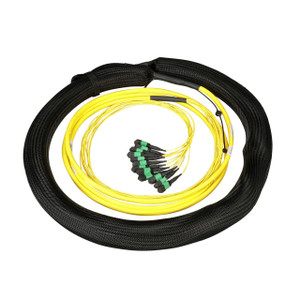
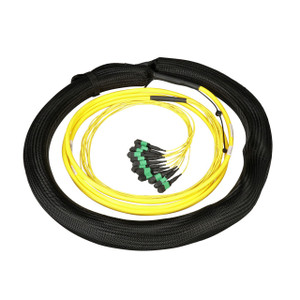
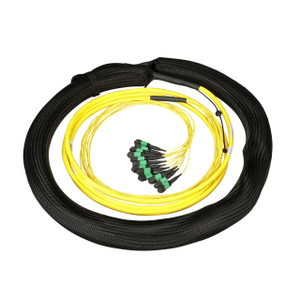
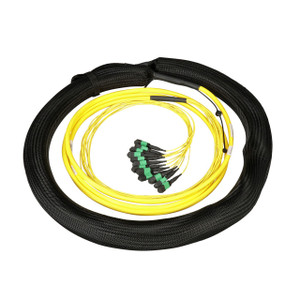
Panduit F8BNM5ENNAAM050 288-Fiber OS2 Singlemode MTP-to-Pigtail Trunk Cable Assembly
The Panduit F8BNM5ENNAAM050 QuickNet trunk cable delivers 288 fibers of singlemode OS2 connectivity in a single 50-meter factory-terminated assembly, bridging high-density MTP patch panels to individual LC pigtail breakouts for datacenter and enterprise backbone deployments. Method A polarity ensures plug-and-play compatibility with TIA-568 structured cabling standards, while LSZH Riser Euroclass Cca jacketing meets stringent fire and smoke requirements for in-building vertical pathways. Pre-terminated at the factory with insertion loss verification, this trunk eliminates field splicing labor and the performance variability that comes with on-site terminations, making it the go-to solution for mission-critical fiber backbones where downtime during installation or troubleshooting is unacceptable.
Key Features
- 288 singlemode OS2 fibers in one trunk assembly for maximum port density and minimal cable management burden
- Female MTP connector on one end, individual 900-micron tight-buffered pigtails on the other for flexible breakout to LC, SC, or ST patch panels
- Method A polarity mapping aligns with TIA-568-C.3 straight-through duplex channel convention—no adapters or crossover modules required
- LSZH Riser-rated Euroclass Cca jacket limits flame spread and toxic smoke emission in vertical building pathways per NEC Article 770
- Factory-terminated and tested to ISO/IEC 11801 and TIA-568-C.3 insertion loss limits (≤0.35 dB typical per mated pair), with test reports available
- 50-meter (164-foot) length handles typical datacenter floor-to-floor riser runs or horizontal backbone segments without mid-span splices
- Yellow outer jacket provides instant visual identification in mixed singlemode/multimode fiber installations
- Pull-eye termination on MTP end simplifies cable pulling through conduit, innerduct, and cable tray without damaging precision ferrules
- 9-micron core diameter OS2 fiber supports 10GBASE-LR to 40 km and 100GBASE-LR4 to 10 km per IEEE 802.3 standards
- QuickNet sub-brand backed by Panduit's warranty and North American technical support infrastructure
High-density fiber trunks like the F8BNM5ENNAAM050 solve the port-count explosion that accompanies 40G/100G/400G datacenter migrations and spine-leaf fabric architectures. Each 24-fiber MTP interface on a core switch or storage array can connect to twelve duplex LC ports on distribution switches via a single trunk pull, collapsing what would otherwise require twelve individual duplex fiber runs into one manageable cable assembly. The 288-fiber count in this trunk translates to 144 duplex LC channels or twelve 24-fiber MTP breakouts, making it ideal for core-to-distribution tier interconnects in Clos fabrics, SAN storage head-end connectivity where every RU of rack space counts, or inter-building campus backbone links. The OS2 fiber specification delivers 1 dB/km maximum attenuation at 1310 nm and 1550 nm wavelengths, supporting 10G transmission to 40 kilometers and 100G to 10 kilometers per IEEE 802.3ba without inline amplification, which future-proofs the physical layer even as transceiver technology evolves from SFP+ to QSFP28 to QSFP-DD form factors. Method A polarity—where transmit on one end maps to receive on the other in a straight-through fashion using the TIA-568 key-up-to-key-down orientation—matches the default configuration of enterprise Ethernet switches and Fibre Channel directors, eliminating the need for polarity-flipping Type B adapters or crossover trunk assemblies that add insertion loss, troubleshooting complexity, and material cost to the link budget.
Installation of pre-terminated trunk assemblies like this one cuts deployment time from hours to minutes compared to field splicing and eliminates the performance variability introduced by hand-polished connectors. The pull-eye design at the MTP end threads onto standard pull rope or fish tape for conduit and innerduct installations, protecting the precision multi-fiber ferrule endface from contamination, impact, and moisture during the pull—a critical consideration given that even a 5-micron particle on a singlemode ferrule endface can cause 0.5 dB or more of insertion loss and back-reflection that corrupts 10G and faster optical signals. The pigtail end fans out at a fiber breakout box, splice enclosure, or wall-mount termination panel, where each color-coded 900-micron tight-buffered fiber stub terminates in an LC, SC, or ST connector (depending on the specific build-out configuration ordered) for insertion into modular patch panels or direct connection to equipment ports. Because Panduit performs all connector terminations in a controlled ISO-certified factory environment with automated polishing equipment and interferometric endface inspection, insertion loss is tightly controlled to 0.35 dB or lower per mated connector pair, return loss exceeds 50 dB (equivalent to less than 0.001% reflected power), and endface geometry meets the sub-micron radius-of-curvature tolerances required for reliable 10G and 40G optical links. This factory precision eliminates the 0.75 dB worst-case field-termination loss allowed by TIA-568-C.3 and the re-work loops that arise when acceptance testing reveals high-loss or failing connections after cable has been dressed into overhead ladder rack and sealed into wall penetrations.
The LSZH (Low Smoke Zero Halogen) Riser Euroclass Cca jacket construction satisfies dual fire-safety regimes: National Electrical Code Article 770 for general-purpose riser cable (OFNR) in North American installations, and European Construction Products Regulation EN 50575 Cca classification for limited flame spread and smoke density in EU building projects. LSZH formulations produce 30–50% less smoke opacity than PVC during combustion and emit no hydrochloric acid or other corrosive halogen gases, which is critical in datacenters and telecom closets where fire-suppression activation or electrical faults can fill enclosed spaces with smoke that both obscures egress routes and corrodes sensitive electronics in adjacent racks. Riser rating permits installation in vertical shafts and floor-to-floor pathways that do not serve as air-handling plenums, covering the majority of datacenter and enterprise backbone routing scenarios without the cost premium of plenum-rated (OFNP) cable—though if your cable route traverses drop-ceiling return-air plenums or under-floor HVAC distribution zones, you must substitute a plenum-rated equivalent trunk to remain code-compliant. The yellow outer jacket follows industry color-coding convention for singlemode fiber (TIA-598-C), providing instant visual differentiation from aqua OM3/OM4 multimode trunks during installation and MAC (Moves, Adds, Changes) work, which reduces the risk of accidentally patching incompatible multimode transceivers into singlemode fiber infrastructure or vice versa—a common mistake that either fails to link or causes transceiver damage due to excessive receive power.
The 50-meter (164-foot) cable length is optimized for typical datacenter floor-to-ceiling heights of 4–5 meters and allows vertical riser runs spanning ten floors, or horizontal backbone segments crossing 40–45 meters of overhead cable tray with enough slack for proper cable management radius bends (10× cable diameter minimum per TIA-568) and future re-routes when racks are relocated or additional patch panels are inserted mid-span. For greenfield datacenter builds, this trunk length bridges main distribution area (MDA) fiber patch panels on the ground floor or basement level to intermediate distribution areas (IDAs) on mid-rise floors, or connects horizontally between rows of spine switches in large footprint server halls without requiring mid-span splice enclosures that add insertion loss, failure points, and labor cost. In retrofit scenarios where legacy Cat5e or Cat6 copper infrastructure is being ripped out and replaced with fiber to support 10G server uplinks and 40G aggregation switches, pre-measured 50-meter trunks eliminate the field measurement and cutting steps that slow down installation, and the factory-supplied pull-eye ensures your cable survives the pull through occupied conduit already packed with power feeders and legacy copper without snagging on burrs or conduit couplings.
Compliance with TIA-568-C.3, ISO/IEC 11801, TIA-604-5 (FOCIS-5) for MTP connector geometry, and Telcordia GR-409-CORE for optical fiber cable specifications ensures this trunk integrates into any standards-compliant structured cabling system and passes third-party acceptance testing required by datacenter operators, federal integrators subject to GSA or DoD procurement standards, and enterprise clients with corporate structured cabling standards mandating TIA compliance. The modular MTP-to-pigtail architecture gives you deployment flexibility: use cassette modules or breakout panels at the MTP end to convert the single 24-fiber MTP connector into twelve duplex LC ports, or fan out the pigtails directly into a splice enclosure where you fusion-splice to permanent backbone cable for ultra-low-loss interconnects in long-haul campus fiber rings. For integrators managing multi-building campus networks or hyperscale colocation datacenter builds where fiber counts in the thousands are routine, factory-terminated trunks eliminate the field labor bottleneck that occurs when your crew is hand-splicing and hand-polishing hundreds of connectors per day, and they eliminate the variability in craftsman skill level and environmental conditions (humidity, temperature swings, dust infiltration) that lead to acceptance test failures, re-termination loops, and project schedule slippage. This specific SKU is purpose-built for projects where you need maximum fiber density in a single pull, long-reach singlemode performance for 10G-to-100G links, standards-compliant Method A polarity, and the confidence that comes from a factory-tested assembly delivered with insertion-loss certification ready to pull, patch, and go live on day one.