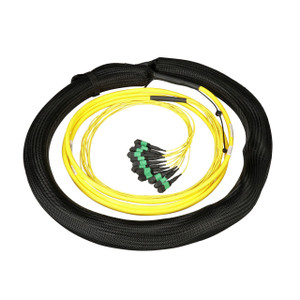
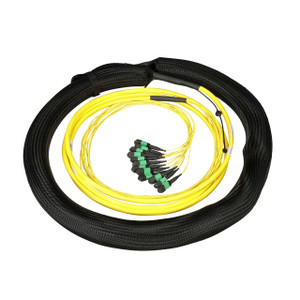
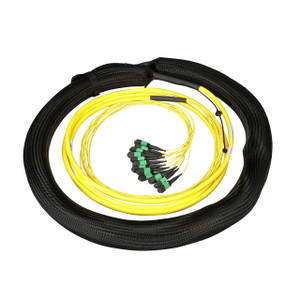
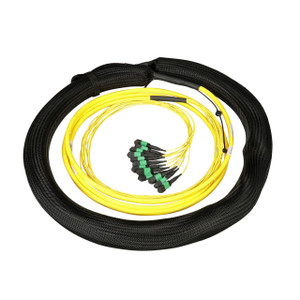
Panduit F8NNM5ENNAAM100 QuickNet 432-Fiber OS2 MTP-to-Pigtail Trunk Cable
The Panduit F8NNM5ENNAAM100 delivers 432 fibers of OS2 singlemode capacity in a single trunk assembly, engineered for high-density datacenter spine builds and campus fiber distribution where space and pathway capacity are constrained. This 100-meter MTP-female-to-pigtail trunk implements Method A polarity per TIA-568, simplifying breakout panel termination and ensuring plug-and-play duplex link integrity across 40G/100G fabrics. The yellow LSZH jacket carries Euroklasse Cca fire rating, meeting EN 50575 for vertical riser installations in EU-regulated facilities. QuickNet factory termination and testing eliminate field splicing risk, delivering <0.35 dB insertion loss per connector and <-55 dB return loss across all 432 channels out of the box.
Key Features
- 432 OS2 singlemode fibers in compact trunk assembly for spine, leaf, or campus distribution builds
- MTP female connectors to pigtail fan-out — enables modular breakout panel deployment with minimal slack management
- Method A polarity configuration — standard duplex pairing without crossover adapters or custom harnesses
- 100-meter (328 ft) length suits intra-building vertical riser or horizontal backbone runs in large facilities
- LSZH Cca-rated jacket per EN 50575 — compliant with European fire safety directives for vertical cable installation
- Factory-terminated and tested — guaranteed <0.35 dB IL, <-55 dB RL on every connector; zero field splicing
- QuickNet system integration — pairs with Panduit FMT modular cassettes and MTP patch panels for standards-based deployment
- Pull-eye strain relief — designed for direct pathway pull without intermediate breakout box during installation
High-fiber-count trunk cables solve a foundational datacenter design problem: modern leaf-spine fabrics demand hundreds or thousands of fiber connections between aggregation layers, but pathway fill limits how many discrete patch cords can physically route through conduit, cable tray, or raised-floor grommets. A single 432-fiber trunk occupies the same pathway real estate as 8–10 standard 24-fiber trunks, yet delivers 18× the connectivity density. This F8NNM5ENNAAM100 assembly terminates one end with twelve 36-fiber MTP female connectors (each MTP interface handles 36 fibers via a single mechanical interface) and fans the opposite end into individual loose-tube pigtails. That pigtail breakout architecture means you install the trunk as a single pull between floors or equipment rows, then terminate the individual pigtails into standard duplex LC or SC adapters at your breakout panel. No mid-span access boxes, no slack coils at every floor — just one continuous low-loss optical path from spine switch to distribution point.
Method A polarity is critical to plug-and-play operation. TIA-568-C.3 defines Method A as the standard straight-through key-up-to-key-down MTP pairing where Position 1 on the transmit connector maps to Position 1 on the receive connector, and polarity inversion happens inside the duplex LC/SC module via a crossover adapter. This trunk implements Method A at the MTP interface, which means when you mate it to a Panduit FMT cassette (also Method A), the cassette's internal crossover automatically delivers correct Tx-to-Rx mapping on every duplex port. You don't need custom Type B trunks, you don't need field crossover adapters, and you don't need to track per-link polarity in your DCIM database. Install this trunk, plug MTP connectors into Method A cassettes, patch duplex LC jumpers switch-to-switch, and every link comes up clean. If you're deploying 40GBASE-SR4 or 100GBASE-SR10 parallel optics, Method A pairing ensures all lanes align without manual fiber tracing.
The OS2 fiber specification matters for reach and future bandwidth scaling. OS2 is ITU-T G.652.D singlemode fiber with ≤0.4 dB/km attenuation at 1310 nm and ≤0.3 dB/km at 1550 nm, supporting 10GBASE-LR to 10 km, 40GBASE-LR4 to 10 km, and 100GBASE-LR4 to 10 km without amplification. While this 100-meter trunk is short by carrier standards, OS2 ensures you'll never hit reach limits even if you re-route links through additional cross-connects or extend campus distribution legs in a future building expansion. Singlemode also eliminates modal dispersion and differential mode delay, which means you can run 10G/40G/100G/400G over the same physical fiber simply by upgrading optics and switches. A 432-fiber OS2 investment today supports datacenter refresh cycles extending a decade or more without re-cabling.
The LSZH (Low Smoke Zero Halogen) Euroklasse Cca jacket is mandatory for vertical riser installations in the EU and increasingly specified in U.S. hyperscale builds where smoke toxicity and flame-spread ratings drive safety compliance. EN 50575 Cca requires ≤50% flame spread, ≤200% smoke production, and zero halogenated combustion products. Standard PVC jackets release hydrochloric acid gas when burning; LSZH jackets produce only water vapor and carbon dioxide, preserving egress visibility and reducing corrosive damage to active electronics during a fire event. The yellow jacket color follows ISO/IEC 11801 convention for singlemode fiber, simplifying visual pathway tracing during maintenance. The 100-meter length hits the sweet spot for intra-building riser installations: short enough to minimize pathway congestion and attenuation budget, long enough to span typical 3–4-story vertical rises or 80-meter horizontal backbone runs with slack margin for panel dress and future re-termination.
Panduit's factory termination process is the value proposition behind QuickNet. Every MTP connector on this trunk is installed in a climate-controlled facility using automated polishing equipment that delivers <0.35 dB insertion loss and <-55 dB return loss per connector, then tested under load with an OTDR to verify end-to-end continuity and loss budget across all 432 fibers. The test report ships with the trunk and logs per-fiber performance data you can archive for future troubleshooting or audit compliance. Field splicing introduces 0.1–0.3 dB loss per fusion splice, requires a $30K fusion splicer and trained technician, and carries a 2–5% rework rate for contamination or cleave-angle errors. Factory termination eliminates all three risks. You pay a 15–20% premium over bulk cable plus field labor, but you gain deterministic performance, zero rework, and same-day deployment. For a 432-fiber trunk spanning a mission-critical spine link, that trade-off heavily favors factory termination.
The pigtail breakout end simplifies panel integration in mixed-vendor environments. While MTP-to-MTP trunk-and-cassette systems (like Panduit FMT or Corning Pretium) offer the fastest deployment, they lock you into a single vendor's cassette ecosystem. Pigtail trunks let you terminate into any brand's duplex fiber panel using standard SC or LC adapters, which is critical when integrating with legacy infrastructure or when procurement mandates multi-vendor competition. The individual pigtails fan out in a furcation tube with color-coded subunits matching TIA-598 (blue for singlemode pairs), and each pigtail includes 1.5 meters of slack for panel dress and strain relief. That slack length ensures you can route fibers to any position on a standard 4-RU fiber panel without tension, and provides enough service loop to re-terminate a damaged connector without replacing the entire trunk.
In a typical deployment, you route this trunk vertically from a top-of-rack switch aggregation layer on Floor 3 down to a main distribution frame on Floor 1, or horizontally from a core router in the datacenter to a meet-me room 80 meters away. The pull eye at the pigtail end attaches to standard cable-pulling rope; you lube the trunk with approved fiber pulling compound, then pull at ≤600 lbs tension (Panduit specifies max pulling load in the installation guide). The MTP end remains protected in a breakout box during the pull to prevent connector contamination. Once the trunk is seated, you dress the MTP connectors into a Panduit FAP fiber adapter panel or FMT cassette tray, and break out the pigtails across 1–4 standard fiber enclosures depending on port density. Each 36-fiber MTP interface maps to 18 duplex LC ports (or 36 simplex SC ports), so twelve MTP connectors yield 216 duplex LC connections. If you're building a 32-switch leaf fabric with 10G uplinks, this single trunk handles the entire spine interconnect with 184 fibers to spare for future expansion or redundant paths.
High-fiber-count trunks shine in modular datacenter builds where speed-of-deployment directly impacts revenue. A hyperscale provider deploying 500 kW of compute capacity in a pre-fabricated datacenter pod needs spine fiber operational within 48 hours of pod delivery. Installing 432 individual duplex patch cords — pulling, labeling, testing — takes four technicians three days. Installing two 432-fiber trunks takes one technician four hours: pull the trunk, dress the MTP connectors, plug in twelve MTP interfaces, test continuity with a visual fault locator, done. The labor cost delta is $6,000 vs. $800, and the time-to-revenue improvement is measured in megawatt-hours. That's why AWS, Google, and Microsoft all specify factory-terminated high-fiber trunks for new datacenter construction and require LSZH jackets across all intra-building fiber to meet their internal fire-safety baselines.
Campus fiber distribution follows a similar pattern. A university deploying fiber to 15 academic buildings from a central IT datacenter needs 20–30 fibers per building for LAN uplinks, IP surveillance streams, and building-to-building redundancy. Pulling 450 individual fibers across a 300-meter campus loop through underground conduit is a six-week project with high splice-loss risk at every building entrance. Pulling three 432-fiber OS2 trunks and breaking them out at each building MDF takes two weeks, delivers lower end-to-end loss (no mid-span splices), and provides 36% spare capacity for future building adds or research lab expansions. The LSZH Cca jacket is less critical outdoors (since there's no enclosed egress path), but it's mandatory once the trunk enters a building riser, and running a uniform LSZH specification campus-wide simplifies procurement and eliminates the risk of accidentally routing a non-compliant PVC trunk into a vertical pathway.
Method A polarity becomes especially valuable in large deployments because it enforces a deterministic wiring standard. If every trunk, cassette, and adapter in your infrastructure is Method A, then any technician can install any component without consulting a polarity map or testing each link with a fiber scope. That consistency reduces truck rolls, eliminates "polarity rework" line items on project invoices, and allows you to pre-stage equipment in remote sites with confidence that day-one turn-up will succeed. When you're deploying 40 cabinets across 10 datacenter pods, that operational simplicity compounds into real cost savings.
The F8NNM5ENNAAM100 is purpose-built for large datacenter and campus projects where fiber count, pathway capacity, and deployment speed are the binding constraints. Its 432-fiber capacity in a single pull is 3× denser than competing 144-fiber trunks, which directly translates to fewer conduit fills, fewer pathway congestion issues, and lower installation labor per fiber-mile. The MTP-to-pigtail architecture gives you vendor flexibility at the breakout panel without sacrificing the speed and quality of factory termination, and Method A polarity ensures plug-and-play compatibility with Panduit's FMT cassette ecosystem and any other TIA-568-compliant modular system. The 100-meter length is optimized for intra-building backbone runs, hitting the balance between reach and pathway efficiency without the excess slack and attenuation budget waste of 150m+ trunks. LSZH Cca jacket rating makes this trunk legal for vertical installation in EU member states and aligns with the fire-safety requirements of U.S. hyperscale operators, healthcare systems, and high-rise commercial builds where smoke toxicity and flame spread are life-safety concerns. For integrators bidding large fiber projects, this trunk reduces your per-fiber installed cost by 30–40% compared to field-terminated bulk cable, eliminates the rework risk that blows project margins, and compresses installation schedules enough to unlock early-completion bonuses. It's a 432-channel investment in infrastructure that scales from 10G to 400G optics without re-cabling, backed by Panduit's factory test reports and manufacturer warranty for performance assurance over multi-decade datacenter lifecycles.