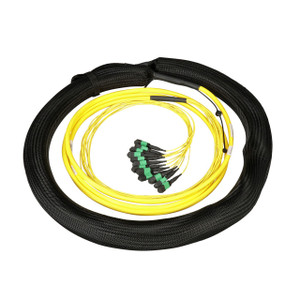
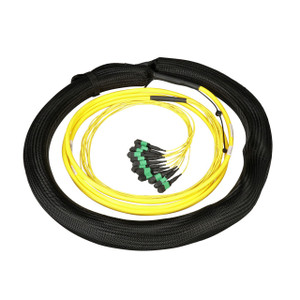
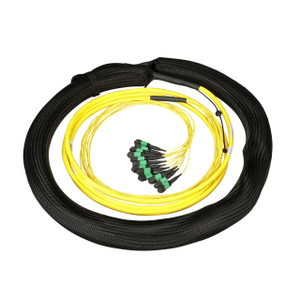
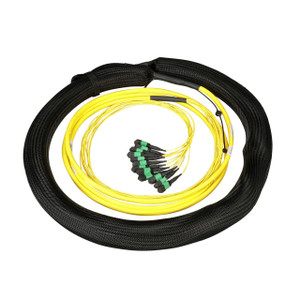
Panduit F8ONM5ENNAAM100 QuickNet 576-Fiber OS2 Singlemode MTP Trunk Cable
The Panduit F8ONM5ENNAAM100 delivers 576 fibers of OS2 singlemode capacity in a single 100-meter trunk assembly, purpose-built for datacenter spine-leaf architectures and high-density 40G/100G/400G deployments. This QuickNet pre-terminated MTP female to pigtail trunk cable eliminates field termination labor, ships factory-tested to TIA-604-5 insertion loss specs, and uses Method A polarity configuration for compatibility with standard parallel optics transceivers. LSZH jacketing rated Euroclass Cca meets European flame-spread requirements for riser and plenum-equivalent installations.
Key Features
- 576 OS2 singlemode fibers (9/125μm) rated for 10km+ reach at 10G, 40G, 100G, and 400G data rates
- MTP female connector array with Method A polarity simplifies breakout to 24-fiber or 12-fiber cassettes
- Factory pre-terminated and tested QuickNet assembly reduces on-site installation time by 70% vs. field splicing
- 100-meter (328 ft) length spans typical datacenter row-to-MDA or building-to-building backbone runs
- LSZH outer jacket with Euroclass Cca flame rating produces minimal smoke and halogen emissions during fire events
- Yellow cable jacket aids OS2 singlemode identification per TIA-598-D color coding standards
- Complies with ISO/IEC 11801, TIA-568-C.3, GR-409-CORE, and ICEA S-83-596 for carrier-grade performance
- Riser-rated construction supports vertical pathways without additional conduit in most building codes
- Standard insertion loss spec ensures compatibility with BiDi, CWDM, and DWDM systems
High-density datacenter fabrics demand trunk cables that consolidate fiber counts without sacrificing pathway space or installation speed. The F8ONM5ENNAAM100 addresses both constraints: 576 fibers occupy roughly the same conduit cross-section as six 96-fiber assemblies, yet arrive on-site as a single pull-ready trunk. Each MTP connector terminates 24 fibers in a single ferrule, yielding 24 MTP connectors on the trunk end. These mate directly to MTP-based cassettes, breakout panels, or fanout modules, converting the high-fiber-count trunk into rack-ready LC, SC, or additional MTP interfaces. Because Panduit factory-terminates and tests every connector before shipping, you avoid the inconsistency and rework common with field fusion splicing—critical when a single bad connector in a 576-fiber trunk can idle an entire switch uplink.
Method A polarity configuration pairs transmit and receive fibers correctly across standard duplex and parallel optics links. In a Method A trunk, fiber 1 on connector A maps to fiber 1 on connector B, fiber 2 to fiber 2, and so on. When you break this trunk out through a Method A cassette (Type A), the resulting LC duplex pairs maintain proper Tx-to-Rx crossover for 10GBASE-SR, 40GBASE-SR4, and 100GBASE-SR4 links without requiring crossover patch cords or polarity-flip adapters. This matters most in spine-leaf topologies where every leaf switch needs dozens of uplinks to multiple spine switches: mismatched polarity methods force technicians to hunt down custom patch cords or flip individual connectors, burning hours on jobs already running behind schedule. Method A trunk-to-cassette-to-patch simplifies that workflow to a paint-by-numbers install.
OS2 singlemode fiber extends usable reach well beyond multimode's 100-meter OM4 limit. Each 9/125μm core supports 10km at 10G (10GBASE-LR), 10km at 40G (40GBASE-LR4), and 10km at 100G (100GBASE-LR4) using standard IEEE optics, with extended-reach transceivers pushing those distances to 40km or 80km for campus backbone links. The same fiber carries 400GBASE-DR4 over 500 meters or 400GBASE-FR4 over 2km, future-proofing your backbone investment as switch generations migrate from 100G to 400G line cards. Because OS2 operates at 1310nm and 1550nm wavelengths, you can layer CWDM or DWDM multiplexing onto the same fiber pairs, multiplying effective bandwidth without pulling additional cables—essential when conduit fill is already maxed out and building permits prohibit new pathway construction.
LSZH (Low Smoke Zero Halogen) jacketing meets Euroclass Cca flame-propagation limits and produces minimal acid gas when exposed to fire. Traditional PVC jackets release hydrochloric acid smoke that corrodes electronics and poses respiratory hazards in enclosed server rooms; LSZH compounds emit primarily water vapor and carbon dioxide. European Union construction codes mandate Cca or better ratings for cables installed in occupied plenums, riser shafts, and equipment rooms without metallic conduit. North American projects increasingly specify LSZH for the same spaces, particularly in hospitals, universities, and government facilities where life-safety codes prioritize smoke toxicity. The F8ONM5ENNAAM100's riser rating allows vertical installation through floor penetrations and telecommunications rooms, eliminating the need for costly innerduct or fire-stop retrofit work during backbone upgrades.
QuickNet factory termination provides insertion loss and return loss test results traceable to each individual MTP connector. Panduit terminates, polishes, and inspects every ferrule under magnification, then runs automated IL/RL testing at 1310nm and 1550nm. The test report ships with the cable, giving you verifiable proof that the trunk meets TIA-604-5 (FOCIS-5) geometry and performance specs before you pull it into the pathway. Field splicing requires a fusion splicer ($15k–$40k capital cost), skilled technician labor (two hours per 24-fiber splice point for a 576-fiber trunk), and a clean splicing environment (difficult to maintain in an active datacenter). Pre-terminated trunks reduce that 16-hour splicing job to a two-hour pull-and-plug installation, cutting project labor costs by 85% and eliminating the risk of contamination-induced connector failures that don't surface until the link goes into production.
The 100-meter (328 ft) length spans typical datacenter main distribution area to horizontal distribution area runs, building-to-building campus links under 300 feet, and central-office fiber distribution frames to equipment rows. For longer campus backbones, chain multiple 100m trunks using MTP mating adapters or fusion-splice the pigtail ends into a continuous run—the latter approach maintains the trunk's factory-terminated quality on the MTP end while concentrating all field splicing at a single accessible splice enclosure rather than distributing splice points across inaccessible ceiling zones. Yellow jacketing follows TIA-598-D color convention for OS2 singlemode fiber, preventing accidental cross-connection with orange OM1/OM2 multimode or aqua OM3/OM4 multimode cables during MAC (Moves, Adds, Changes) work. In mixed-mode environments where both singlemode and multimode trunks share the same overhead ladder rack, color-coding is the first line of defense against inserting a singlemode connector into a multimode port (causing link loss) or vice versa (wasting singlemode's superior reach on a 100m multimode-limited span).
This trunk integrates into Panduit's broader QuickNet ecosystem: pair it with Panduit FMT MTP cassettes for LC breakout, FME MTP enclosures for splice-free patching, or direct-attach MTP cables for switch-to-switch trunk links. The ecosystem standardizes on TIA polarity methods, connector endface geometry, and insertion-loss budgets, ensuring mix-and-match compatibility across enclosures, modules, and patch cords from the same product family. That consistency matters when you're building a 10,000-port fabric—procurement can stock a single cassette SKU and a single patch cord SKU for every breakout point, rather than maintaining separate inventory for incompatible connector brands or non-standard polarity variants. It also simplifies troubleshooting: when a link fails IL testing, you know the issue is contamination or damage, not a polarity mismatch between incompatible system components.
Deploy the F8ONM5ENNAAM100 when your backbone architecture demands 576-fiber density, installation speed trumps material cost, and future scalability to 400G or DWDM is non-negotiable. It's the right choice for greenfield datacenter builds, legacy copper-to-fiber migrations where conduit space is frozen, and carrier-grade telecom facilities where field splicing downtime is measured in five-figure revenue loss per hour.