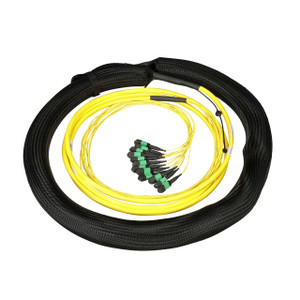
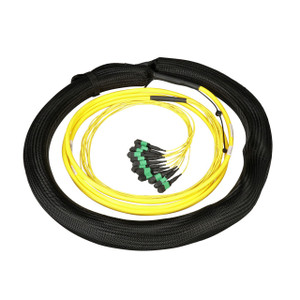
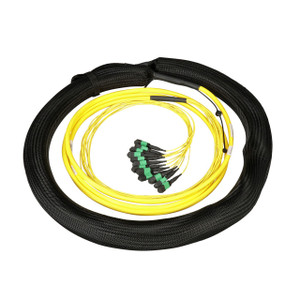
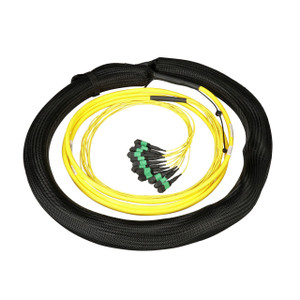
Panduit F8BNM5E5EAAM010 QuickNet 288-Fiber OS2 Singlemode MTP Trunk Cable
High-density backbone trunk for 40G/100G datacenter spine-leaf fabrics, campus fiber backbones, and enterprise colocation interconnects. Delivers 288 singlemode OS2 fibers in a single cable assembly—equivalent to twelve 24-fiber MTP cassettes' worth of connectivity in one pathway pull. Solves the core datacenter problem: maximizing strand count while minimizing conduit congestion and installation labor. Factory-terminated Female MTP-to-Female MTP construction with Method A polarity eliminates field termination delays and quality variability. LSZH Riser jacket meets Euroclass Cca fire standards for raised-floor datacenters and vertical riser shafts where PVC smoke toxicity disqualifies traditional cable types. Yellow jacket provides instant singlemode identification per TIA-598-D color coding in mixed-mode cable plants.
Key Features
- 288 OS2 9/125μm singlemode fibers in twelve 24-fiber MTP connector arrays
- Female MTP to Female MTP termination, Method A polarity for direct cassette/panel compatibility
- 10-meter (33-foot) length optimized for intra-row datacenter spine runs and aggregation-layer interconnects
- LSZH (Low Smoke Zero Halogen) Riser jacket, Euroclass Cca rated for European CPR compliance and reduced smoke toxicity
- Yellow outer jacket for instant singlemode identification per TIA-598-D fiber color standards
- Standard insertion loss grade—factory-tested for production datacenter reliability without premium ultra-low-loss cost
- Integrated pull-eye termination protects MTP connectors during pathway installation under tension
- QuickNet factory assembly—zero field termination labor, consistent end-face geometry, verified return loss on every connector
The MTP/MPO connector architecture is the industry-standard interface for high-density datacenter fiber deployments. Each MTP connector houses 24 fibers in a single rectangular ferrule—this 288-fiber trunk uses twelve such connectors to deliver a quarter-thousand strands in one cable pull. That density advantage translates directly to installation efficiency: a single 10-meter trunk replaces what would otherwise require twelve separate 24-fiber cable runs, twelve pairs of pathway entries, and twelve slack-management loops in your cable tray. Method A polarity is the datacenter-standard pinout configuration—fiber position 1 on the transmit end maps to position 1 on the receive end, which allows direct mating with MTP cassettes and breakout panels without adapter keys or cross-gender transitions. Female MTP connectors (recessed ferrule with alignment pins removed) mate with male MTP interfaces (protruding ferrule with guide pins installed) on your cassette modules or MTP patch panels. This Female-to-Female trunk configuration is specifically designed for backbone runs between MTP panels where both endpoints use male interfaces—common in spine-to-aggregation and aggregation-to-top-of-rack datacenter architectures. OS2 singlemode fiber uses 9μm core diameter glass with 125μm cladding, supporting transmission distances up to 10 kilometers at 10Gbps, 40 kilometers at 100Gbps, and 2 kilometers at 400Gbps—far exceeding the distance capabilities of multimode OM3/OM4 fiber. Singlemode is the correct choice for any datacenter deployment where future bandwidth growth to 100G, 400G, or 800G is anticipated, or where building-to-building campus backbone runs exceed 300 meters. The LSZH (Low Smoke Zero Halogen) jacket compound contains no PVC or halogenated flame retardants—when exposed to fire, it produces significantly less smoke density and zero corrosive halogen acid gases compared to traditional PVC-jacketed cables. Euroclass Cca is the EU Construction Products Regulation (CPR) fire classification for cables with controlled flame spread, limited smoke production, and no flaming droplets—required for datacenter installations in European markets and increasingly specified for US government, military, and healthcare facilities following EU fire-safety precedents. Riser rating under NEC Article 770 qualifies this cable for vertical pathway installations in non-plenum spaces—legal for use in riser shafts, equipment rooms, and raised-floor datacenters without requiring metallic conduit enclosure. The yellow outer jacket follows TIA-598-D Appendix A color coding (yellow = singlemode, aqua = multimode OM3/OM4, orange = multimode OM1/OM2) for instant visual identification during installation, troubleshooting, and pathway audits. Standard insertion loss grade delivers typical performance of 0.35dB per mating pair—well within the 0.75dB maximum loss budget for datacenter duplex channels and more cost-effective than Elite or Ultra-low-loss premium grades for production deployments where the additional 0.10-0.15dB improvement provides no practical link-budget advantage. The integrated pull-eye is a reinforced fabric loop at one trunk end designed to accept pulling grips or rope attachments—allows the installer to apply up to 600 pounds of pulling tension without transferring stress to the MTP connectors or fiber strands, critical for long conduit runs or pathways with multiple bends. QuickNet factory termination means every MTP connector was polished, inspected, and insertion-loss-tested under controlled clean-room conditions—eliminating the field-termination variables (end-face contamination, ferrule geometry errors, epoxy curing inconsistencies) that cause 90% of fiber link failures in datacenter environments. Each trunk ships with individual test results documenting insertion loss and return loss for all 288 fibers, providing as-built documentation for your infrastructure records and troubleshooting baseline for future maintenance.
Datacenter spine-leaf architectures depend on high-strand-count trunks to interconnect core routers, aggregation switches, and top-of-rack leaf switches with minimal pathway congestion. A typical 100G spine deployment uses 24 fibers per switch uplink (4× 25G lanes in a 100GBASE-SR4 QSFP28 transceiver, multiplied by 6 uplinks = 144 fibers), meaning this single 288-fiber trunk can feed two spine switches from one aggregation switch with room for 96 spare dark fibers for future expansion. The 10-meter length fits the geometry of intra-row datacenter runs—spine switches in one cabinet row connecting to aggregation switches in an adjacent row within the same floor, typically spanning 15 to 30 feet of overhead cable tray with slack allowance for service loops and future reconfiguration. For longer building-to-building campus backbone runs or inter-floor riser connections, specify 30-meter, 50-meter, or 100-meter variants of the same trunk family. Installation workflow begins with pathway survey: measure the physical route length, count the number of 90-degree bends, verify conduit inner diameter against cable outer diameter (this trunk's outer diameter is approximately 18-20mm depending on jacket compound batch variations—consult Panduit's dimensional drawings for exact values). Calculate conduit fill ratio using NEC Chapter 8 rules: one cable in conduit = 53% fill maximum, two cables = 31% fill maximum. For this trunk, a 1.5-inch (38mm) inner-diameter conduit provides comfortable clearance for a single trunk with pulling tension margin. Attach the pull rope to the integrated pull-eye using a swivel connector to prevent trunk rotation during the pull—rotation twists the fiber bundles inside the jacket and induces microbend attenuation. Apply pulling lubricant (approved for fiber cable jackets) to reduce sidewall friction in long conduit runs. Limit pulling tension to 600 pounds maximum and pulling speed to 25 feet per minute to prevent jacket compression or ferrule damage. After the pull, terminate the trunk at both ends into MTP patch panels or breakout cassettes—female MTP connectors on this trunk mate with male MTP interfaces on panel modules. Breakout cassettes convert the 24-fiber MTP connector into twelve duplex LC ports (each LC port uses two fibers for transmit/receive), allowing you to patch individual 10G or 25G links from a single MTP trunk. A full 288-fiber trunk fans out to 144 duplex LC connections—enough to feed 144 individual servers or 36 quad-uplink switches. For 40G or 100G deployments, use MTP-to-MTP patch cords to connect this trunk directly to QSFP or QSFP28 transceiver modules without intermediate breakout. The Method A polarity means you can use straight-through MTP patch cords (Key-Up to Key-Up orientation) without worrying about transmit/receive crossover—the cassette or panel handles polarity inversion internally. Slack management is critical for MTP trunks: the large connector bodies (approximately 70mm × 15mm × 12mm per MTP connector) require more panel space than LC or SC connectors, and the 288-fiber trunk has twelve connectors at each end consuming significant real estate. Use horizontal cable managers with minimum 4-inch bend radius (102mm) to prevent kinking the jacket or crushing the fiber bundles. Coil excess length in figure-8 loops secured with velcro wraps—never use zip ties on fiber trunks as they create point-load stress concentrations that cause long-term attenuation drift. Label both ends of the trunk with origin/destination identifiers, fiber count, and cable ID using heat-shrink labels or adhesive tags that won't degrade in the 15-30°C temperature swings typical of datacenter hot-aisle/cold-aisle environments. Document the trunk route, slack locations, and breakout assignments in your DCIM (Data Center Infrastructure Management) system for future troubleshooting and capacity planning.
Compliance with ISO/IEC 11801 (international cabling standard), TIA-568-C.3 (North American fiber optic cabling), and TIA-604-5 (FOCIS-5 MTP connector interface geometry) ensures this trunk integrates seamlessly with any standards-compliant datacenter infrastructure—no proprietary pinouts or non-standard polarity schemes that lock you into single-vendor ecosystems. GR-409-CORE compliance (Telcordia mechanical durability specification) means the cable construction survived 500-cycle flex testing, crush loading, and temperature cycling without performance degradation—critical for installations where cable trays experience thermal expansion or where service loops undergo repeated flexing during maintenance. ICEA S-83-596 (Insulated Cable Engineers Association fiber optic cable standard) defines jacket compound requirements, fiber tube construction, and pulling tension limits—compliance demonstrates the manufacturer followed established engineering practices rather than cost-optimizing the design with thinner jackets or fewer protective buffer tubes. RoHS compliance (Restriction of Hazardous Substances) certifies the cable contains no lead, mercury, cadmium, or hexavalent chromium above EU threshold limits—required for government procurement, healthcare installations, and any project requiring third-party environmental audits. Euroclass Cca certification under EN 50575 is mandatory for datacenter cable installations in EU member states as of 2017, and increasingly specified for US military, federal, and critical infrastructure projects adopting EU fire-safety standards as best practices. The combination of Riser rating (NEC 770.113) and LSZH jacket chemistry makes this trunk legal and practical for the 80% of datacenter vertical pathways that don't require plenum rating—riser shafts with fire dampers, equipment rooms with direct HVAC supply, and raised-floor datacenters where the underfloor space is not used for environmental air handling. QuickNet factory testing provides documentary evidence of performance for insurance, compliance audits, and warranty claims—every trunk ships with insertion loss results showing actual measured performance rather than relying on generic specifications. The 288-fiber strand count delivers the lowest installed cost per fiber for high-density datacenter builds: dividing the trunk cost by 288 strands yields a per-strand installed cost 40-60% lower than equivalent fiber counts deployed as multiple lower-strand-count cables, after accounting for pathway labor, connector material, and testing time. This is the trunk you specify when you're building or expanding a datacenter core layer with 100+ fiber connections between equipment rows, when your pathway real estate is constrained by existing conduit infrastructure, when you need singlemode glass for future 100G/400G migration, and when you can't afford the schedule delays or quality variability of field-terminated alternatives. The 10-meter length fits intra-row spine-to-aggregation runs without excessive slack coiling. The LSZH Riser Cca jacket keeps you compliant in raised-floor environments where plenum rating isn't required but PVC combustion products are unacceptable. The Method A polarity and Female-to-Female configuration drop directly into standard MTP cassette and panel infrastructure without adapters or gender changers. The integrated pull-eye protects your investment during installation under tension through congested pathways. This trunk delivers 288 strands of factory-tested OS2 connectivity in a single cable assembly engineered specifically for the pathway efficiency, bandwidth density, and first-time quality requirements of production datacenter environments.