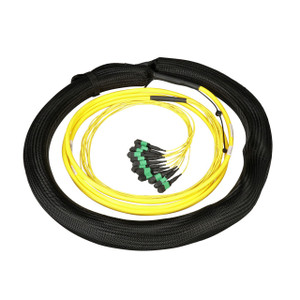
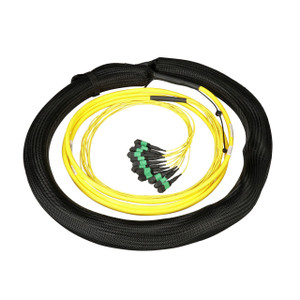
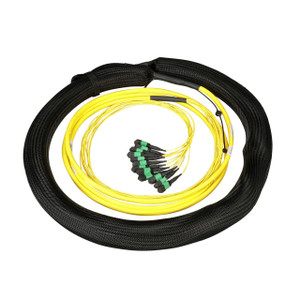
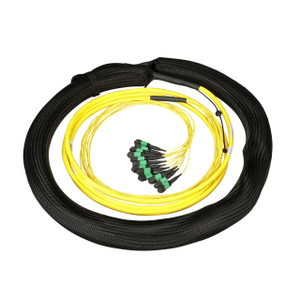
Panduit F8ONM5ENNAAM030 QuickNet 576-Fiber OS2 Singlemode MTP to Pigtail Trunk Cable Assembly
The Panduit F8ONM5ENNAAM030 is a factory-terminated 576-fiber singlemode trunk cable designed for high-density datacenter and enterprise fiber deployments where termination labor, polarity integrity, and rapid deployment are critical. This QuickNet assembly provides female MTP connectors on one end and factory-pigtailed breakouts on the other, supporting Method A polarity per TIA-568 standards. The 30-meter length, LSZH Riser jacket with Euroclass Cca fire rating, and OS2 singlemode glass make this trunk suitable for intra-building backbone links in both North American and European installations. Every connector is factory-polished, insertion-loss tested, and labeled, eliminating the field termination burden and polarity errors that plague job-built high-fiber-count assemblies.
Key Features
- 576-fiber capacity in a single trunk assembly reduces cable pathway congestion and simplifies documentation compared to multiple lower-count cables
- Female MTP (MPO) connectors on one end interface directly with cassette modules, panels, or male MTP equipment ports
- Factory-pigtailed breakout on the opposite end enables flexible termination to fusion splice enclosures, patch panels, or direct equipment connections
- Method A polarity configuration ensures straight-through pin mapping, compatible with TIA-568-C.3 structured cabling architectures
- OS2 singlemode fiber (9/125µm) supports 10G/40G/100G/400G transmission over multi-kilometer distances with low attenuation
- LSZH Riser-rated jacket meets ICEA S-83-596 and Euroclass Cca fire performance standards, suitable for vertical risers and horizontal pathways outside plenum spaces
- Yellow outer jacket provides immediate visual identification in mixed-mode fiber environments
- Standard insertion loss specification ensures reliable optical performance out of the box
- 30-meter length (98.4 feet) suits typical floor-to-floor datacenter rises or long horizontal runs within a single building zone
- Factory testing and labeling includes end-to-end insertion loss verification and fiber-by-fiber documentation
- QuickNet pull-eye termination on trunk end simplifies cable pulling through conduit and cable tray without damaging connectors
- RoHS compliant construction meets international environmental and material safety regulations
High-fiber-count trunk cables solve a fundamental datacenter problem: as port densities climb into the hundreds per rack, traditional field-terminated duplex and 12-fiber cables create unmanageable cable congestion, hours of termination labor, and a high probability of polarity errors. The F8ONM5ENNAAM030 consolidates 576 individual fibers—equivalent to 288 duplex LC pairs or 48 12-fiber MTP ports—into a single pre-terminated assembly. The female MTP end connects directly to cassette-based structured cabling systems or MTP equipment ports (such as high-density switches, DWDMs, or fiber channel directors), while the pigtail breakout end provides bare fiber for fusion splicing into existing infrastructure or terminating into breakout panels. This architecture is especially valuable in large enterprise campuses, colocation facilities, and hyperscale datacenters where rapid deployment, minimal downtime, and zero-error polarity are non-negotiable. Method A polarity—where fiber 1 on connector A maps to fiber 1 on connector B—is the TIA-568-C.3 standard and the most common configuration in North American structured cabling, ensuring compatibility with cassette modules, patch cords, and equipment that follow the same convention.
The OS2 singlemode fiber core (9µm diameter) and 125µm cladding provide the low attenuation and high bandwidth required for 10GBASE-LR, 40GBASE-LR4, 100GBASE-LR4, and emerging 400G and 800G optics over distances up to 10 kilometers or more, depending on transceiver specifications. Singlemode is the de facto choice for datacenter backbone, inter-building campus links, and any application where future bandwidth growth or reach beyond 300 meters is anticipated. The LSZH (Low Smoke Zero Halogen) Riser jacket meets ICEA S-83-596 flame test requirements for vertical riser applications and achieves Euroclass Cca fire performance, making this trunk compliant with both North American building codes (NEC Article 770) and European CPR (Construction Products Regulation) requirements. The yellow jacket color is the industry-standard identifier for singlemode fiber, simplifying visual inspection and reducing the risk of accidentally cross-connecting multimode and singlemode infrastructure. The 30-meter length is well-suited for floor-to-floor datacenter risers (typically 12–15 feet per floor), MDF-to-IDF backbone runs, or long horizontal pathways in warehouse-scale facilities.
Typical deployment scenarios include connecting high-density fiber distribution frames in main distribution areas to intermediate or equipment distribution areas, linking core routers or switches to aggregation-layer equipment across multiple racks or rows, and providing the physical layer for storage area networks (SANs) requiring hundreds of simultaneous fiber paths between compute and storage arrays. In colocation and cloud provider environments, the F8ONM5ENNAAM030 enables rapid customer provisioning by pre-installing trunk infrastructure between meet-me rooms and customer cage spaces, then activating individual fibers on demand via cassette modules or breakout panels. The pigtail end is particularly useful when integrating with legacy splice-based infrastructure or when splicing into outdoor-rated OSP cable for campus backbone extensions. Fusion splicing to pigtails allows the installer to maintain a clean, low-loss connection while preserving the factory-quality MTP end for the active equipment side.
Factory termination is the critical advantage: every MTP connector endface is polished to sub-0.25dB insertion loss, inspected under magnification, and tested across all 576 fibers before leaving the Panduit factory. This eliminates the time, tooling, and skill required to field-terminate 48 MTP connectors (or 576 individual LC connectors), removes the risk of contamination or damage during handling, and provides a manufacturer-backed insertion loss guarantee. The pull-eye feature on the trunk end is designed for safe cable installation through conduit, innerduct, or J-hooks without placing mechanical stress on the MTP connectors, and the ruggedized breakout boot at the pigtail end prevents individual fiber damage during handling and installation. For installations requiring fusion splicing at the pigtail end, the individual 900µm buffered fibers are clearly labeled and color-coded to match TIA-598-C standards, simplifying splice tray assignment and reducing the chance of fiber misidentification. The F8ONM5ENNAAM030 ships with comprehensive test documentation including insertion loss measurements for every fiber pair, ensuring traceability and simplifying acceptance testing and future troubleshooting. Panduit's QuickNet family is designed for interoperability with standards-compliant multi-vendor equipment, and this assembly meets ISO/IEC 11801, TIA/EIA-568-C.3, TIA-604-5 (FOCIS-5), TIA/EIA-568-C.1, GR-409-CORE, and ICEA S-83-596 telecommunications standards, providing long-term reliability and compatibility in mission-critical fiber infrastructure.