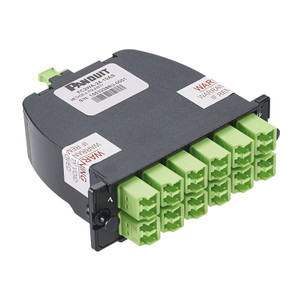
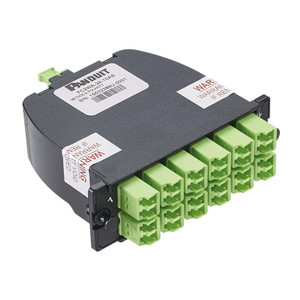
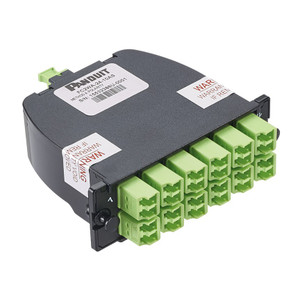
Panduit FC2WA-12-10AS OptiCom OM5 MPO-LC Fiber Cassette
The Panduit FC2WA-12-10AS is a factory-terminated 12-fiber cassette that breaks out a single MPO-12 trunk connection to six duplex LC ports, engineered for OM5 wideband multimode deployments supporting 100GBASE-SR4, 200G, and 400G Ethernet via short-wavelength division multiplexing (SWDM). Method A polarity ensures TIA-568 compliance in straight-through trunk architectures, eliminating field termination labor and polarity errors in high-density patch panel and enclosure installations. The OptiCom Ultra-Physical-Contact (UPC) LC connectors deliver <0.25 dB insertion loss per mated pair, and the ruggedized polycarbonate housing withstands repeated insertions in 1U cassette slots or modular enclosure frames.
Key Features
- OM5 wideband multimode fiber supports 100G/200G/400G SWDM over 50µm core, future-proofing datacenter spine and leaf architectures
- Method A polarity (key-up to key-down) simplifies trunk deployment with standard straight-through MPO cables in structured cabling systems
- Factory-terminated MPO-12 male and six LC duplex connectors eliminate field splicing, reducing installation time from hours to minutes per cassette
- OptiCom Ultra-PC polish on all LC interfaces guarantees <0.25 dB insertion loss and >50 dB return loss per TIA-568.3-D
- Black polycarbonate housing fits standard 1U sliding cassette shelves and Panduit modular fiber enclosures
- 12-fiber capacity in a single-cassette footprint maximizes port density in space-constrained equipment rooms and meet-me vaults
OM5 fiber represents the current endpoint in the multimode roadmap, extending the wavelength window from OM4's 850nm single-lane operation to four-lane SWDM across 850nm, 880nm, 910nm, and 940nm channels. This cassette's 50µm laser-optimized core supports 100GBASE-SR4 to 100 meters, 200GBASE-SR4 to 70 meters, and emerging 400G applications over distances that cover typical datacenter row-to-aggregation runs without the cost and power penalty of single-mode transceivers. For installations bridging 10G access layer switches to 100G core, the FC2WA-12-10AS enables a single trunk infrastructure to serve both current 10GBASE-SR links (using one LC duplex pair per uplink) and future 100G migrations (using four pairs in parallel via MPO breakout) without re-cabling vertical risers or horizontal trunk pathways.
Method A polarity is the TIA-568 standard for straight-through MPO trunking: position 1 on the transmit MPO maps to position 1 on the receive MPO, with transmit-receive flip handled by crossing within the cassette between the MPO pins and the LC duplex pairs. This cassette is designed to terminate a Method A trunk cable (typically a 12-fiber MPO-to-MPO cable with one end keyed up and the opposite end keyed down). When you plug a switch or server MPO transceiver into a Method A trunk, the far-end cassette automatically presents the correct LC port pairing for duplex equipment—TX on one fiber, RX on the paired fiber—without requiring Type B crossover trunks or field rewiring. In a structured cabling installation with multiple cassette shelves, all trunks remain identical straight-through cables, and polarity is deterministic: odd-numbered LC ports are consistently on one side of the duplex, even-numbered on the other. This consistency reduces labeling errors and simplifies troubleshooting when a technician traces a circuit from patch panel to equipment rack.
The factory-terminated MPO and LC connectors are built to OptiCom quality standards: each MPO ferrule is multi-fiber push-on style with a male (pinned) configuration, precision-aligned to <0.5µm across all 12 fibers, and each LC connector uses a zirconia ceramic ferrule polished to Ultra-PC (physical contact) geometry with <50nm apex offset. Insertion loss across the cassette, from MPO input to any LC output, is specified at ≤0.5 dB typical, and return loss exceeds 50 dB, both measured at 850nm per TIA-568.3-D Annex D test procedures. These performance parameters mean that in a typical three-interconnect channel (cassette at each end plus one mated connection in the middle), total link loss budget remains well within 10GBASE-SR's 2.6 dB allocation and 100GBASE-SR4's 1.9 dB allocation, leaving margin for connector degradation over the 20-year structured cabling lifecycle. Pre-terminated assemblies also eliminate the variability introduced by field epoxy-and-polish or mechanical splice terminations, where installer skill and environmental conditions (dust, humidity, cure temperature) directly affect optical performance.
The polycarbonate housing is a single-piece molded design, 4.5 inches wide and 0.67 inches tall, compatible with Panduit's FZC series cassette shelves, the FAP series modular enclosures, and third-party 1U sliding cassette trays that follow the industry-standard mounting footprint. The MPO adapter port is recessed in the rear of the housing with a snap-in retainer, and the six LC duplex adapters are arrayed across the front face in a horizontal line with 0.5-inch center-to-center spacing, matching the pitch of LC duplex patch cords and preventing accidental cross-connection during patching operations. The cassette's internal furcation tubing splits the 12-fiber ribbon into six 2-fiber legs, each protected by a 900µm buffer, and the bend-radius protection guides maintain a minimum 30mm radius to prevent macrobend-induced attenuation on the tight turns between the MPO entry point and the LC exit points. For installations in seismically active regions or high-vibration environments (near HVAC equipment or in mobile cell sites), the LC connectors use a push-pull latch mechanism rather than the older snap-in style, reducing the risk of accidental disconnection when adjacent cables are moved.
Deployment context: this cassette is the typical building block for enterprise datacenter and campus fiber backbones where structured cabling standards require a permanent link infrastructure separate from active equipment connections. In a representative installation, vertical riser trunks run as 12-fiber MPO-to-MPO cables between floor-level IDFs (intermediate distribution frames), terminating into cassette shelves at each floor. Each shelf holds multiple cassettes, and the LC duplex ports on the cassette fronts become the permanent cross-connect field, analogous to the RJ45 jack field in a copper structured cabling system. Technicians then use standard LC-LC duplex patch cords to connect the cassette ports to switch uplinks, server NICs, or horizontal cable runs serving equipment racks. When a switch is replaced or a server is moved, only the patch cords change; the permanent trunk and cassette infrastructure remains untouched, preserving the polarity design and the end-to-end optical budget. This separation between permanent link and equipment cord is a core requirement in TIA-606-B labeling and TIA-568.3-D testing, and it enables the 20-year depreciation period that finance teams expect from structured cabling investments.
For 100G deployment specifically, a single FC2WA-12-10AS cassette supports two independent 100GBASE-SR4 links (each consuming four duplex pairs) or six independent 10GBASE-SR links (each consuming one duplex pair). If you're migrating a legacy 10G network to 100G, you can initially use the cassette to break out six 10G uplinks, then reconfigure four of those LC ports to a single 100G MPO connection on the switch side by installing an LC quad to MPO breakout harness, leaving the trunk and cassette unchanged. This migration path avoids the forklift replacement of the entire horizontal cabling plant. Similarly, in a leaf-spine datacenter architecture where each top-of-rack switch has two 100G uplinks to redundant spine switches, a pair of these cassettes (one per uplink) can be fed by a single 24-fiber MPO trunk from the meet-me room, reducing cable pathway congestion and simplifying the labeling scheme.
The 10-pack carton quantity (UPC 61305632035) reflects typical project scale: a single equipment row with 10 racks, each requiring one trunk connection, or a five-floor building with two cassettes per floor for redundant A/B path routing. Panduit ships each cassette with dust caps on all unused LC ports and a protective cap on the MPO connector, both of which should remain in place until the moment of connection to prevent contamination of the ferrule end-faces. Optical fiber is intolerant of particulate contamination—a single dust particle <10µm diameter can cause 1 dB insertion loss or intermittent link flapping—so clean installation discipline is not optional. Prior to mating any MPO or LC connector, inspect the ferrule end-face with a 200x fiber microscope (Panduit part FQMM or equivalent), verify the absence of scratches, pits, or debris per IEC 61300-3-35 pass/fail criteria, and clean with a one-click cleaner or lint-free wipe dampened with isopropyl alcohol if contamination is visible. Never use canned air or blow on a connector; both methods deposit moisture and oils that degrade return loss.
This cassette is black to match the standard color code for multimode OM5 fiber (per TIA-598-D Annex A, OM5 is designated lime green for cable jackets, but enclosures and cassettes are vendor-specific; Panduit uses black for all OptiCom multimode cassettes regardless of fiber grade to maintain a uniform appearance in mixed OM3/OM4/OM5 installations). When labeling the installation, apply TIA-606-B identifiers to both the cassette housing (using a label maker with adhesive-backed polyester labels, not paper labels that degrade in humidity) and to each LC duplex port, indicating the far-end location, rack, and equipment port. A typical label scheme might read "FL3-R07-SW01-P01" (floor 3, rack 7, switch 1, port 1), with a corresponding label on the MPO trunk cable indicating the cassette shelf and slot position. This bidirectional labeling allows a technician troubleshooting a link failure to trace the path in either direction without referring to external documentation.
The FC2WA-12-10AS is intended for permanent indoor installation in controlled-environment spaces—datacenter white space, telecom equipment rooms, and IDF closets—where temperature remains within 0°C to 50°C and relative humidity stays below 85% non-condensing. It is not rated for outdoor, plenum, or direct-burial use; those applications require ruggedized enclosures with environmental sealing and different cable jacket ratings. The polycarbonate housing is UL 94 V-0 flame-rated, meeting NEC Article 770 requirements for optical fiber cables and raceways in non-plenum horizontal and riser spaces. For plenum installations (above drop ceilings or in air-handling spaces), the cassette itself can remain in the equipment room or IDF, with plenum-rated (OFNP) MPO trunk cables running through the ceiling space and terminating into the cassette at the room entry point, ensuring that no non-plenum materials reside in the air-handling pathway.
Panduit includes a manufacturer warranty covering defects in materials and workmanship; the cassette itself is a passive optical component with no active electronics or wear-prone mechanisms, so field failures are rare outside of physical damage or contamination-induced connector degradation. When specifying this cassette, verify that the rest of the channel components—the MPO trunk cables, the switch or server MPO transceivers, and the LC duplex patch cords—are also OM5-rated (50µm core, 4700 MHz·km effective modal bandwidth at 850nm per ISO/IEC 11801-1) and that the entire link is designed to the same polarity method (Method A throughout, not a mix of Method A and Method B, which will result in TX-to-TX connections and no link light). Panduit's OptiCom system is fully interoperable with other manufacturers' TIA-compliant OM5 components, but mixing polarity schemes or fiber grades within a single channel is the most common cause of field installation failures.