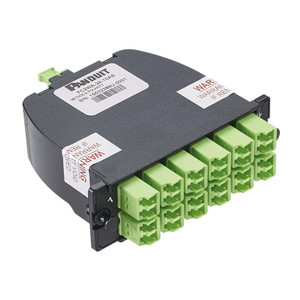
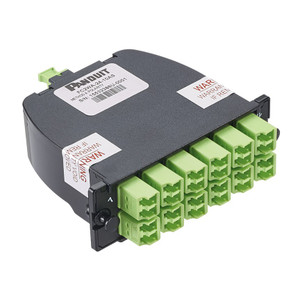
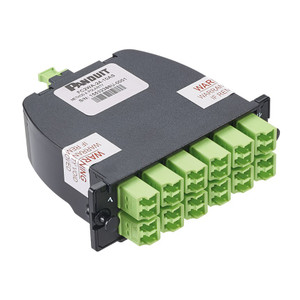
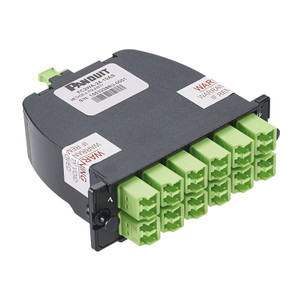
Panduit FC2WA-24-10B2 Opticom 24-Fiber OM5 LC to MPO-12 Cassette
The Panduit FC2WA-24-10B2 Opticom fiber cassette delivers 24-fiber LC duplex breakout from a single rear MPO-12 male trunk connection, purpose-built for high-density datacenter aggregation and 40/100/400 Gigabit Ethernet backbone deployments. This pre-terminated OM5 wideband multimode cassette eliminates field termination labor while maintaining sub-0.75 dB insertion loss per connection, critical for margin-sensitive 100GBASE-SR4 and emerging 400G short-reach applications. The polycarbonate housing integrates into Panduit FAP fiber adapter panels and competitive enclosures supporting the standard cassette form factor, enabling tool-free moves, adds, and changes at the LC duplex layer while preserving MPO trunk integrity during MAC events.
Key Features
- 24-fiber OM5 (50/125 µm) wideband multimode — supports dual-wavelength 100G transmission and 400GBASE-SR8 migration paths
- 12 LC duplex ports (front) to single MPO-12 male connector (rear) — reduces trunk cable count by 12:1 vs. individual duplex fibers
- Pre-terminated and factory tested — ships ready to install with documented insertion loss, eliminates field polishing and test labor
- Black polycarbonate chassis — withstands repeated insertion cycles, latches securely in 1U/2U/4U fiber enclosures
- Standard cassette footprint — drop-in compatible with Panduit FAP, Corning, and generic cassette-based patch panels
- Method B polarity (universal) — pairs with standard Method B MPO trunk cables for plug-and-play 40G/100G SR connectivity
OM5 wideband multimode fiber extends the usable spectrum beyond OM4's 850 nm single-wavelength operation to include 950 nm short-wave division multiplexing (SWDM), doubling effective fiber capacity for 100 Gbps transmission over duplex LC connections and enabling 4× 28 Gbps lane aggregation for 100GBASE-SR4 at distances up to 100 meters. This headroom matters in spine-leaf architectures where a single cassette fans out a 24-fiber MPO trunk into twelve 10 Gbps access links today, then migrates to twelve 25 Gbps links (or six 100 Gbps links via breakout) tomorrow without ripping out the physical layer. The FC2WA-24-10B2's OM5 rating future-proofs the structured cabling investment against IEEE 802.3cm 400GBASE-SR4.2 and parallel optics roadmaps through 2030, a material differentiator vs. OM3 cassettes locked at 33-meter 100G reach.
The LC duplex front interface provides per-port access for patch cord connectivity to switches, servers, and media converters while the rear MPO-12 male pinout consolidates all 24 fibers into a single trunk handoff — critical for maintaining under 1.5U rack height in 1U 144-fiber density panels. Duplex LC ports follow TIA-568 pinout (positions 1-2, 3-4, 5-6, etc.) with each pair mapped to the MPO array via Method B polarity, ensuring transmit-to-receive crossover when mated to a standard Method B MPO trunk cable. This polarity scheme eliminates the need for Type A/Type B cable stocking complexity; a single Method B trunk inventory supports all cassette-to-cassette and cassette-to-transceiver connections in 40GBASE-SR4 and 100GBASE-SR10 topologies. Installers deploying leaf-to-spine 100G uplinks simply plug the cassette into the FAP panel, run the MPO-12 trunk to the aggregation switch's MPO transceiver, and break out individual 10G/25G server connections via standard duplex LC patch cords at the cassette front — no polarity testing, no custom cable orders.
Factory termination and 100% insertion loss testing prior to shipment removes the variability and schedule risk inherent in field-terminated MPO assemblies. Each LC duplex port and the MPO-12 rear connector undergo automated IL measurement at 850 nm and 1300 nm, with results documented on the included test report; typical insertion loss runs 0.35-0.5 dB per mated connection, leaving 2+ dB margin on 100GBASE-SR4's 3.5 dB total loss budget over 100 meters. The pre-loaded LC adapters are keyed to prevent 1.25 mm / 2.5 mm cross-mating errors and rated for 500+ insertion cycles, sufficient for three hardware refresh cycles in a hyperscale row. The rear MPO-12 male connector uses a push-pull boot and MT ferrule with guide pins in positions 1 and 12, mating to standard female MPO trunk cables; the male orientation is deliberate — it prevents accidental contamination of the ferrule endface during storage and ensures the cassette can be pre-installed in the panel before the trunk cable arrives on site.
Black polycarbonate construction balances impact resistance with the flexibility needed to snap the cassette into FAP panel slots without cracking, a common failure mode in brittle ABS housings when installers force misaligned insertions. The chassis includes molded strain relief channels for the internal fiber fanout and a top-access cable management clip that retains the MPO trunk's boot to prevent kink-induced macrobend loss during service loops in crowded panel interiors. Total cassette depth is 5.8 inches including the MPO connector, fitting within the 6-inch depth budget of most 1U panels mounted in 12-inch or 18-inch relay racks; the black finish blends with standard black patch panels and trunk cables, maintaining visual consistency in customer-facing colocation meet-me rooms and on-camera datacenter tours.
The FC2WA-24-10B2 ships in cartons of 10 cassettes, each individually bagged with protective dust caps on all LC ports and the rear MPO connector. This pack quantity aligns with 240-fiber backbone builds — ten cassettes = 120 duplex LC ports = five 48-port leaf switches at full 100G uplink capacity — and reduces per-port cost vs. single-unit purchases while keeping total carton weight under 12 lbs for standard UPS Ground shipping. The cassette is compatible with Panduit's FAP1BUADSX (1U angled), FAP2WADLZ (2U straight), and FAP4WADLZ (4U straight) fiber adapter panels, as well as third-party enclosures adhering to the de facto cassette module standard (approximately 4.4" W × 0.7" H × 5.8" D). Integration into existing Panduit Unified Physical Infrastructure Manager (UPIM) or dcTrack documentation platforms is straightforward via the UPC barcode label on each cassette; scanning during deployment auto-populates the 24-fiber port map and MPO trunk ID into the fiber management database, maintaining as-built accuracy for future troubleshooting.
Deployment contexts for 24-fiber LC-to-MPO cassettes include: (1) Leaf-spine fabrics — break out 24-fiber MPO trunks from aggregation switches into twelve duplex 10G/25G server connections per top-of-rack leaf, then migrate to 100G server NICs by re-patching six LC duplex pairs to 100GBASE-SR10 breakout cables without touching the MPO backbone; (2) Storage area networks — fan out 24-fiber OM5 trunks running between SAN directors and storage arrays into individual 16G/32G Fibre Channel links at the array controller, preserving headroom for 64G FC upgrades; (3) Hyperconverged clusters — provide 12 duplex LC connections per 2-node cluster block, with each node consuming six duplex ports (2× 100G data + 4× 25G management/vMotion), and centralize the MPO-12 trunks in a single 2U panel serving a full rack; (4) Enterprise MDF-to-IDF backbones — reduce 24-strand riser count to a single MPO trunk pull between floors, then break out individual department uplinks via LC duplex at the IDF closet.
The Opticom sub-brand designation indicates compliance with Panduit's fiber optic component qualification program, including endface geometry per IEC 61755-3-31 (MPO) and TIA-604-10-D (LC), insertion/return loss per TIA-568.3-D, and flammability per UL 1666 riser rating. The cassette is RoHS compliant and ships with Panduit's standard manufacturer warranty covering defects in materials and workmanship, a baseline requirement for datacenter operators maintaining spares inventory for rapid MTTR on fiber infrastructure faults. For installations requiring LSZH (low smoke zero halogen) cable assemblies due to plenum or international fire code mandates, verify the MPO trunk cable jacket specification independently — the cassette itself is riser-rated but does not carry plenum certification.