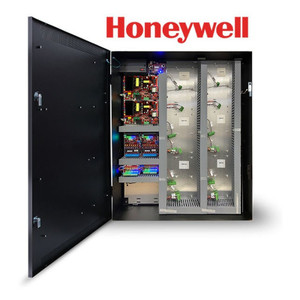
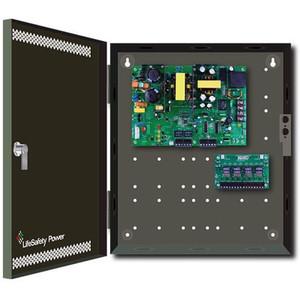
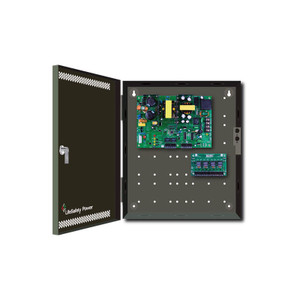
Lifesafety Power RGS150B-C8PD8P 150W Power Supply with Lock Control Outputs
Overview
The Lifesafety Power RGS150B-C8PD8P is a 150W power supply purpose-built for access control and security lock applications in commercial facilities. It delivers either 12A at 12VDC or 6A at 24VDC — enough headroom to support multiple electrically locked doors, card readers, and monitoring devices simultaneously without voltage sag. The unit integrates 8 Class 2 power-limited relay outputs dedicated to door locks or magnetic locks, plus 8 additional DC auxiliary outputs for supervision and signaling. Each relay output supports FAI (Fail As Is), failsafe, or failsecure modes, selectable per channel — critical for meeting local fire codes and access control logic on a per-door basis.
Key Features
- Dual Output Voltage Options: Choose 12VDC at 12A or 24VDC at 6A depending on your lock hardware and voltage-drop budget across cable runs. 24V is preferred for longer cable runs because it reduces current and resistive losses — a real factor when serving locks 50+ feet away.
- 8 Relay Lock Outputs (Class 2 Power-Limited): Each output rated at 2.5A max, sufficient for standard 12V or 24V solenoid locks and magnetic lock coils. Class 2 power limiting protects connected devices and simplifies code compliance without requiring external fuses on each lock circuit.
- FAI / Failsafe / Failsecure Selectable Per Output: Configure each relay independently. FAI (Fail As Is) holds the relay state on power loss; failsafe opens the door for egress during an alarm; failsecure locks the door to prevent unauthorized entry. Avoids the cost and complexity of separate failsafe/failsecure modules.
- 8 DC Auxiliary Outputs (Class 2 Power-Limited, 2.5A per output): Low-current outputs for door position sensors, lock status indicators, or secondary control signals. Selectable for Bus1 or Bus2 — allows segmentation of auxiliary circuits across two independent supervision buses.
- 150W Total Power Budget: Adequate for a typical 4–8 door access control installation with locks, readers, and keypads. Exceeding this requires load shedding or a second power supply on a dedicated bus.
- Compact Enclosure Design: DIN rail or wall-mount compatible for clean integration into electrical panels alongside other control electronics. Reduces installation footprint in crowded server rooms or security control cabinets.
Integration & Compatibility
The RGS150B-C8PD8P integrates directly with access control panels, door controllers, and hardwired security systems that accept 12V or 24V relay inputs. The bus-selectable auxiliary outputs work with systems using dual supervision networks (e.g., alarm signaling on Bus1, sensor monitoring on Bus2). No software drivers or network configuration required — it is a passive power distribution and relay switching device. Coordinate with your access control system integrator to confirm lock amperage per channel and total load to avoid exceeding 12A (12V) or 6A (24V) on the main supply.
When to Choose a Different Model
If you need battery backup or UPS capability, consider a Lifesafety Power supply in the same family that includes a battery charger and integrated backup circuit. If your installation requires more than 8 relay outputs or more than 150W, use multiple units or explore a higher-capacity model within the Lifesafety Power line.
Frequently Asked Questions
Q: Can the RGS150B-C8PD8P switch between 12V and 24V on the fly?
A: No. The output voltage is a fixed configuration at the time of supply selection or internal jumper setting. You order either the 12V version or the 24V version; do not attempt to reconfigure voltage in the field without consulting the manufacturer.
Q: What is the total current budget across all 8 relay outputs?
A: Each relay output is limited to 2.5A maximum. The 12A (12V) or 6A (24V) main supply current is the aggregate limit for all relay outputs combined — not 2.5A × 8. Plan lock loads so the sum does not exceed the main supply current rating.
Q: Do I need a separate fuse or circuit breaker for each door lock?
A: The Class 2 power-limited design means individual lock outputs do not require external fuses for code compliance. However, always consult your local authority having jurisdiction (AHJ) and your system designer for any additional overcurrent protection requirements.
Q: What is the difference between FAI, failsafe, and failsecure modes?
A: FAI (Fail As Is) holds the relay in its last state if power is lost. Failsafe opens the lock to allow emergency egress. Failsecure keeps the lock engaged to prevent entry. Choose based on door function: emergency exits should be failsafe; secure storage should be failsecure.
Q: Can the 8 auxiliary outputs power additional devices, or are they supervision-only?
A: The auxiliary outputs are Class 2 power-limited at 2.5A per output and are intended for low-current signaling and supervision (door sensors, status indicators, alarm circuits). Do not use them to directly power locks or high-current solenoids.
The Lifesafety Power RGS150B-C8PD8P addresses a specific integration pain point: multiple locks and auxiliary devices in a single cabinet without adding a forest of discrete 12V or 24V power supplies and relay modules. The ability to configure each of the 8 relay outputs independently for FAI, failsafe, or failsecure mode — combined with 8 additional Class 2 auxiliary outputs on separate bus channels — eliminates redundant hardware and cuts panel wiring by roughly 30 percent on a typical 4–8 door installation.
Technical Highlights:
- 12A at 12V or 6A at 24V Main Supply: 150W total is the right sweet spot for mid-scale access control. At 12V, 12A supports roughly 4–6 standard solenoid locks without derate; at 24V, 6A handles the same load with lower resistive loss over longer cable runs (important for door positions 50+ feet from the power supply).
- Per-Output Failsafe/Failsecure Logic: No jumpers, no module swaps — each relay output is independently selectable. Means you can configure exit doors as failsafe on outputs 1–3, secure storage as failsecure on outputs 4–6, all from one supply without external logic modules.
- Class 2 Power Limiting on All Outputs: Both relay and auxiliary outputs are inherently current-limited to 2.5A max, which satisfies code requirements for low-voltage device protection in most jurisdictions and eliminates the need for per-channel external fuses in most installations.
Deployment Considerations:
- Load Planning is Non-Negotiable: The 12A (12V) or 6A (24V) limit is a hard ceiling for the entire relay bank. If your total lock amperage (relay 1 + relay 2 +... + relay 8) exceeds the main supply current, you will experience voltage sag and lock chatter. Sum your lock specs before ordering.
- Cable Run Length Matters at 12V: If average cable run length exceeds 30 feet, seriously consider the 24V version to reduce voltage drop; at 12V and 10 amps over 50 feet of unshielded copper, expect 1–2V drop that could cause marginal lock operation.
- Auxiliary Output Bus Selection is a One-Time Configuration: Each of the 8 auxiliary outputs is selectable for Bus1 or Bus2, but this is typically a jumper or internal configuration choice made at installation, not field-adjustable. Confirm your system architecture (Bus1 for door sensors, Bus2 for alarm signals, etc.) with the access control integrator before powering up.
This unit is purpose-built for mid-market commercial access control in buildings with 4–8 hardwired controlled doors, such as server rooms, electrical closets, warehouse secure areas, and office suites. It is not a PoE power injector (no network intelligence) and does not include battery backup — those are separate concerns. Use it when you need deterministic, failsafe-capable, multi-door relay logic in a compact, DIN-rail-friendly form factor.