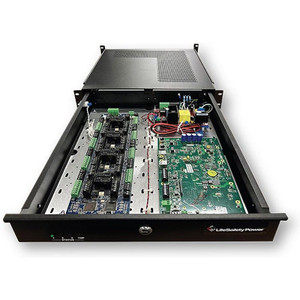
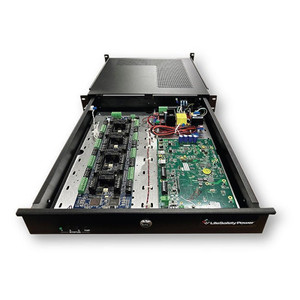
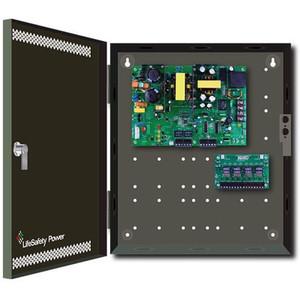
Lifesafety Power RGXM150B-C8D8P 150W Intelligent Power Supply with Relay & Auxiliary Outputs
The Lifesafety Power RGXM150B-C8D8P is a 150W power supply engineered for door control and auxiliary device management in commercial access control and security installations. It delivers either 12V DC at 12A or 24V DC at 6A from a single unit, eliminating the need for separate power supplies when mixing voltage requirements across your installation. This dual-voltage capability reduces inventory complexity and simplifies provisioning on mid-sized deployments serving multiple device types.
Key Features
- Dual-voltage output (12V@12A or 24V@6A): Configure the RGXM150B-C8D8P for either voltage without hardware changes — saves SKU overhead when your access control panel, strike locks, and mag-locks run on different standards.
- 8 relay lock control outputs, 3A fused per channel: Each relay is individually selectable for failsafe (de-energize to unlock) or failsecure (energize to lock) operation. Supports standard electromagnetic and solenoid door strikes, mag-locks, and gate operators. Fusing at 3A per output prevents a single locked door from dragging down the entire power rail.
- 8 DC auxiliary outputs (Class 2 power-limited, 2.5A max per output): Provision LED status indicators, sensor power, badge readers, or additional control circuits. Each output selectable to Bus1 or Bus2, allowing logical segmentation of auxiliary devices across two independent control groups. 2.5A per output ensures compliance with low-voltage power-limited Class 2 wiring standards — you can run these in conduit with communication cabling without isolation barriers.
- Adjustable secondary output module (5–18V, 4A max): The 12V secondary voltage module supports custom voltage requirements for specialized devices (sensor power supplies, interface modules, or legacy equipment). Class 2 power-limited throughout — integrates safely into low-voltage security networks.
- Professional form factor for DIN rail or wallmount: Sized for integration into standard electrical enclosures. Allows you to build a centralized power and control hub rather than daisy-chaining multiple smaller supplies.
- Relay and auxiliary supervision options: Configurable for loop supervision or direct control feedback, providing fault visibility on locked/unlocked state without a separate monitoring circuit.
Integration & Compatibility
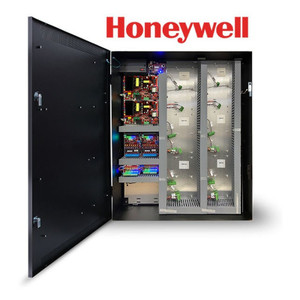
The RGXM150B-C8D8P serves as the backbone power supply for access control power supplies in small-to-mid-sized facilities. Pair it with compatible door strike locks and mag-locks rated for 12V or 24V DC operation. Its relay outputs integrate directly with standard access control panels (Salto, Honeywell, Bosch, HID, and others) without additional relays or interface boards. The dual-bus auxiliary output design accommodates segmented reader networks or multi-zone auxiliary device control.
When to Choose a Different Model
If your site requires battery backup (UPS function) during power loss, look for a comparable supply in the same family with integrated battery charger and transfer relay. If you need more than 8 relay outputs, consider a higher-capacity model with expanded output counts. For applications requiring remote monitoring or IP-based supervision, consult your access control vendor about integration with networked power supply management systems.
Frequently Asked Questions
Q: Can I run both 12V and 24V devices from the same RGXM150B-C8D8P?
A: No. The RGXM150B-C8D8P outputs either 12V or 24V as a single primary voltage. You configure it once at installation. The adjustable secondary module (5–18V) can supply a different voltage to a separate group of devices, but the primary rail is one voltage only.
Q: How do I know which failsafe/failsecure setting to use on each relay output?
A: Failsafe (de-energize to unlock) is the norm for emergency exits — if power is lost, the door unlocks. Failsecure (energize to lock) locks the door when powered. Your building code and access control plan dictate which is required for each door. Configure each relay independently on the RGXM150B-C8D8P.
Q: What's the difference between the relay outputs and the auxiliary outputs?
A: Relay outputs (3A, fused) handle high-inrush loads like mag-locks and solenoid strikes. Auxiliary outputs (2.5A, Class 2 power-limited) are for lower-power accessories like LED indicators, sensor power, or reader interfaces. Don't use an auxiliary output for a mag-lock.
Q: Can the RGXM150B-C8D8P supervise door lock status?
A: Yes, when you pair it with door position sensors or monitored strikes. The relay and auxiliary outputs support loop supervision — feedback from locked/unlocked microswitches can be wired back to your access control panel for real-time status.
Q: Is the secondary 5–18V adjustable output suitable for all sensor types?
A: At 4A maximum and Class 2 power-limited, the secondary module works for low-power sensors, interface boards, and powered readers. Check your device datasheet — some high-current sensors or legacy equipment may exceed 4A and require the primary relay rail instead.
The RGXM150B-C8D8P is a workhorse mid-tier supply for access control labs and security integrators managing 20–60 networked door points. The dual-voltage primary output eliminates the classic problem: provisioning a separate 12V supply for older mag-locks and a separate 24V supply for newer solenoid readers on the same panel. Single SKU, single enclosure slot, one UPS connection if backup is needed later.
Technical Highlights:
- Dual-voltage (12V@12A or 24V@6A): 150W total — easily covers 4–6 weighted-average mag-locks or a mix of solenoid strikes and reader power. Configurable at commissioning; no field modifications needed.
- 8 relay outputs at 3A each, individually fused: Failsafe/failsecure per relay means each door's power profile is isolated. A short on one strike doesn't kill the entire system — the 3A fuse on that relay pops, that door goes to its safe state, others keep power.
- Auxiliary outputs (2.5A Class 2): Dual-bus architecture lets you segregate status LEDs and sensor power from control circuits. Low-voltage wiring; no isolation barriers required if you run them in the same conduit as data cables.
- Secondary module flexibility (5–18V, 4A): Covers legacy readers, interface modules, or one-off devices without a second power supply. Adjustability in the field saves a truck roll if device voltage specs change or are ambiguous on the datasheet.
Deployment Considerations:
- The RGXM150B-C8D8P (often searched as RGXM150B C8D8P) is not a UPS — it has no battery charger or transfer relay. If your site requires hold-up time on power loss, you'll need to add external battery and charger, or upgrade to a battery-backed variant in the Lifesafety Power lineup.
- Fusing at 3A per relay is protective but means high-inrush devices (large solenoids, older mag-locks with poor conditioning) can nuisance-trip the fuse. Test load profiles at commissioning; use soft-start modules or higher-inrush-rated strikes if needed.
- Class 2 auxiliary outputs are ideal for reader networks and sensor power, but don't exceed 2.5A per output — a single powered badge reader drawing 1.5A is fine, but two in series on the same auxiliary line will overload.
Best fit: small office buildings, retail chains, or industrial facilities rolling out access control retrofits where 12V and 24V devices coexist and you want centralized power supervision without over-specifying a rack-mount UPS. For larger campuses or mission-critical sites demanding battery backup and remote diagnostics, step up to a networked power management supply.