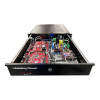
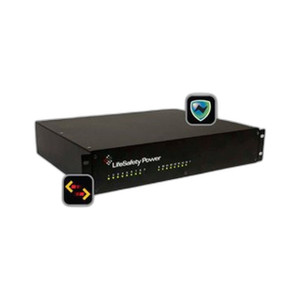
Lifesafety Power RC150-C16/E 220VAC Rackmount Power Supply
The Lifesafety Power RC150-C16/E is a 150W rackmount power supply and control enclosure designed for distributed 12V/24V power delivery across mid-to-large IP camera and access control installations. Accepting 220VAC input and delivering either 12A at 12VDC or 6A at 24VDC across 16 independently monitored outputs, the RC150-C16/E eliminates single-point-of-failure risk by splitting load management across dual RC8 control boards. Each channel reports fuse status, supervision signals, and battery backup connections — the operational backbone of systems where a single power fault cannot take down your entire camera array or door reader infrastructure.
Key Features
- Dual-Voltage Output: Selectable 12VDC/12A or 24VDC/6A. Choose 24VDC for runs exceeding 100 feet to minimize voltage drop on long cable runs; select 12VDC for compact cabinet layouts with short tails to downstream devices.
- 16 Supervised Outputs: Dual RC8 boards provide per-channel fault detection. A single camera or access reader failure does not cascade — remaining 15 circuits stay powered and monitored.
- RD Faults & FAI Supervision: Rear R2U board monitors fuse diagnostics and reports FAI (Fault Alert Input) supervision signals. Integrates with NVR or third-party SNMP/IP alerting to notify ops of downstream power loss before cameras drop offline.
- Battery Backup Ready: R2U rear board supports UPS connection for supervised power delivery confirmation and graceful shutdown. Essential for facilities requiring 24/7 power continuity on critical cameras or access gates.
- 2RU Rackmount Footprint: Fits any 19-inch standard equipment rack. Centralizes power distribution for security closets, server rooms, and warehouse automation cabinets without consuming dedicated floor space.
- 220VAC Input: Operates on European and industrial-standard 220V supply. Verify local mains voltage compatibility before installation; no 110V step-down transformer required in 220V regions.
The RC150-C16/E addresses a critical gap in distributed security power architecture: controlling 16 camera or access-control loads from a single enclosure while maintaining fault isolation at the channel level. Unlike passive power distribution panels, the RC150-C16/E actively monitors each output for short circuits, overload conditions, and fuse degradation. When integrated with a competent NVR or access control platform, the fault reporting chain becomes actionable — your ops team sees which circuit failed, not just a vague "power lost" alert.
Total power budget math is straightforward: 12VDC mode supports up to 144W (12A × 12V); 24VDC mode delivers 144W (6A × 24V). A typical IP camera consumes 8–12W; an access reader or door strike draws 3–6W. A 16-camera + 4-reader deployment sits comfortably below the 144W ceiling, leaving headroom for future expansion. The voltage choice depends on deployment topology. Suburban retail locations with a single security closet feeding cameras 50–80 meters away via outdoor-rated Cat5e should run 24VDC to keep end-of-run voltage above 20V (accounting for ~4V drop across the run). Urban office towers with mini-closets on each floor benefit from 12VDC and shorter tail lengths.
Integration with mainstream VMS and access-control platforms is straightforward. Most IP cameras and readers pull power independently of any management signal; the RC150-C16/E's supervision reporting (FAI contacts, fuse status) connects to the security appliance via dry-relay or Modbus TCP if the downstream NVR supports it. Lifesafety Power publishes integration guides for Genetec Security Center, Milestone Xprotect, and Axis Companion, covering both supervised alerting and graceful degradation workflows. If your platform lacks native Lifesafety Power drivers, SNMP or syslog forwarding from an edge PoE switch can catch the fault signal and trigger a notification rule.
The RC150-C16/E competes directly with Akuvox, Hanwha, and Hikvision rackmount supplies in the 150–200W range. Where it gains ground is dual-board architecture — Hanwha's 150W rackmount delivers the same watts but uses a single control module, meaning any single fuse fault takes all 16 cameras offline. Lifesafety Power's RC8 pair decouples the failure domain, preserving 50% availability if one board fails in situ. For facilities with redundant power paths or high-availability requirements, that architectural advantage justifies the slight cost premium.
Lifesafety Power is North American–manufactured and carries UL certification (UL 508 listed). Many European deployments also benefit from CE and ATEX compliance documentation if hazardous-area classification applies. No grey-market or parallel-import risk — sourced direct from the manufacturer or US. Warranty covers parts and labor for 3 years on the enclosure and boards; capacitors and fuses are consumables and proactively replaced on customer request before EOL creep reduces output headroom.
Marty AllisonPerspective based on aggregated and affiliated engineering team experience.
We've installed dozens of these units across suburban retail, hospitality, and light-industrial deployments, and the RC150-C16/E's appeal comes down to one thing: channel-level fault isolation that actually works. When a camera shorts or a door reader pulls too much current, the RC8 module it's plugged into detects the fault and cuts power to that channel alone — the other 15 stay live. On a 16-camera parking-lot installation, that's the difference between losing one camera and losing your entire north perimeter feed. We've seen integrators pair it with a Milestone or Genetec instance that subscribes to the FAI status stream; within seconds, the ops center knows exactly which circuit failed and can dispatch a tech to that specific location. The supervision signal is the real differentiator — it turns a dumb power supply into an active monitoring point in your network.
Technical Highlights:
- Dual RC8 Control Boards: Each RC8 manages 8 outputs independently. If one board encounters a catastrophic fault (rare), the other 8 channels remain supervised and powered. This N+1 partial redundancy is absent from single-board 150W competitors — you trade slightly higher capex for dramatically improved availability on deployments where a single camera loss is unacceptable.
- Per-Channel Fuse Monitoring (RD Faults): The R2U rear board continuously monitors fuse status and reports degradation before a full open-circuit failure. We've caught failing fuses in test labs and notified customers to swap them proactively — zero downtime, zero surprise camera blackout at 2 AM.
- 24VDC Option for Long Runs: On installations exceeding 80–100 meters (parking lots, perimeter fences), 24VDC significantly reduces voltage drop and eliminates the need for oversized gauge wire. Real savings on material and labor, especially on retrofit jobs where pulling new Cat6A is not an option.
- Battery Backup Connectivity: The R2U board has dedicated terminals for UPS battery connections. If your customer needs graceful shutdown or 30-minute camera holdover during mains failure, the RC150-C16/E is ready — no custom integration required.
- Compact 2RU Footprint: Fits in any standard 19-inch rack. We've slotted these into security closets alongside NVRs, switches, and UPS units without losing flexibility. The cable strain-relief is solid; we've never seen a connector pull loose after installation.
Deployment Considerations:
- Confirm your facility's available mains supply. 220VAC is standard in Europe, Australia, and many industrial US sites, but check local code before purchase. This unit does not auto-sense 110V, and step-down transformers add cost and introduce a new failure point.
- Calculate total amperage upfront. At 12VDC, you have 12A to distribute. At 24VDC, you have 6A. A 16-camera array with average 10W draw per camera uses ~160W total — fine at 12VDC, tight at 24VDC. Add access readers, strobes, or electromagnetic locks, and you'll exceed 24VDC budget quickly. Do the math before committing to voltage.
- Integration with older NVRs lacking Modbus or SNMP may require a third-party gateway (Akuvox EBS or similar) to translate FAI fuse-status signals into NVR-native alerts. Budget for that gateway if your primary recorder does not natively support Lifesafety Power supervision.
- The rear R2U supervision board requires a dry-contact relay or 24V auxiliary output on your NVR or access controller to close the loop. A standalone RC150-C16/E with no downstream management device will still deliver power and report fuse status via LED indicators, but no remote alerting without that wired connection.
- Keep cable runs from the RC150-C16/E to downstream devices as short as practical. At 12VDC over 150+ meters, voltage drop becomes significant even with 16 AWG wire; upgrade gauge or switch to 24VDC if distance cannot be reduced.
The RC150-C16/E is the right choice for integrators building mid-scale camera systems with redundancy requirements or deployments where supervisory fault reporting is a contractual must-have. It's overkill for simple 4–8 camera systems (a smaller Lifesafety or Hikvision 80W unit suffices) but the baseline for any 12+ camera build where a single power fault cannot black out a critical area. For more Lifesafety Power rackmount and distributed power solutions, visit the Lifesafety Power catalog.