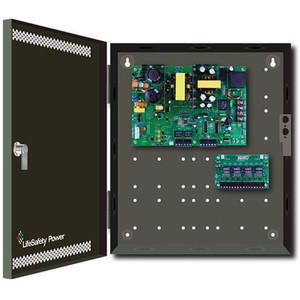
Lifesafety Power FPO150-C8D8PNLCE4M 150W Access Control Power Supply
Overview
The Lifesafety Power FPO150-C8D8PNLCE4M is a 150W distributed power supply designed for access control and life safety installations where independent relay control and auxiliary power distribution are essential. This unit addresses the core challenge of managing multiple door locks and auxiliary devices from a single, centralized supply: delivering 12V at 12A or 24V at 6A with eight independently configurable relay outputs for strike/mag-lock control and eight separate DC auxiliary outputs for sensors, readers, or indicators.
Whether you're integrating this into a medium-sized multi-door access control system or deploying it as part of a larger facility upgrade, the FPO150-C8D8PNLCE4M provides the voltage flexibility and output redundancy that prevents a single supply failure from cascading across your entire system.
Key Features
- 150W Capacity, Selectable Output Voltage: Choose 12V at 12A or 24V at 6A. The 12V/12A configuration supplies maximum current for systems with many locks or high-draw solenoids; the 24V/6A option reduces wire gauges and voltage drop over longer runs to remote doors or outdoor strikes.
- 8 Relay Lock Control Outputs, Fused at 3A per Output: Each relay is individually fused at 3A, protecting the power supply and downstream wiring if a strike or mag-lock shorts or draws excessive inrush current. Fusing prevents a single failed lock from disabling the others — critical in multi-door deployments where downtime costs money.
- Failsafe/Failsecure Selection per Output: Configure each of the eight relay outputs independently for failsafe (unlocks on power loss, used for emergency egress) or failsecure (remains locked on power loss, used for high-security doors). This flexibility eliminates the need for separate power supplies or external relays to achieve mixed fail modes across a single system.
- 8 DC Auxiliary Outputs, Class 2 Power Limited at 2.5A: Dedicated auxiliary outputs supply readers, motion sensors, request-to-exit buttons, or status indicators without competing with lock power. Class 2 power limiting protects connected devices and meets fire/life-safety wiring codes in most jurisdictions.
- Dual Bus Support (Bus1 and Bus2): Each auxiliary output selects either Bus1 or Bus2, allowing logical separation of auxiliary circuits for system redundancy or independent control schemes — useful when integrating with legacy panels or multi-zone access control architectures.
- 8-Output Relay Architecture Reduces External Relay Panels: Consolidating eight lock control relays into the FPO150-C8D8PNLCE4M eliminates the cost and wiring complexity of external 8-channel relay boards, lowering parts count and installation labor on medium-scale systems.
Integration & Compatibility
The FPO150-C8D8PNLCE4M integrates into access control systems via its relay outputs (wired directly to strike controller inputs or mag-lock drivers) and DC auxiliary outputs (connected to readers, sensors, and status devices). The independent fusing and selectable fail modes make it compatible with most access control panels and door controllers that accept 12V or 24V logic-level relay signals. Dual bus outputs allow assignment of auxiliary circuits to different control zones or integration with access control power supplies that supervise multiple independent bus structures.
What's in the Box
No package contents documentation is available for this product. Contact the manufacturer or an integrator for assembly, wiring, and configuration guidance.
Frequently Asked Questions
Q: Can I mix failsafe and failsecure outputs on the same FPO150-C8D8PNLCE4M?
A: Yes. Each of the eight relay outputs is independently selectable for failsafe or failsecure mode, allowing you to configure some doors to unlock on power loss (emergency egress) and others to remain locked (high-security areas) from a single supply.
Q: What's the difference between the relay outputs and the auxiliary outputs?
A: The eight relay outputs are rated at 3A per output and drive strikes, mag-locks, or other high-current devices. The eight auxiliary outputs are Class 2 power limited at 2.5A per output and supply readers, sensors, buttons, and indicators that require less current.
Q: Does the FPO150-C8D8PNLCE4M include battery backup?
A: No backup battery capability is documented in the available specifications. If battery backup is required, consult the manufacturer or integrator for external charger and battery integration options.
Q: What's the difference between 12V/12A and 24V/6A output modes?
A: Both deliver 150W total power. The 12V/12A mode supplies maximum current for systems with many high-draw locks. The 24V/6A mode reduces wire gauges and resistive losses in long cable runs to remote doors, making it preferred for distributed or outdoor installations.
Q: Can I control which auxiliary outputs use Bus1 versus Bus2?
A: Yes. Each of the eight auxiliary outputs is individually selectable for Bus1 or Bus2, allowing you to segregate power to different zones or integrate with multi-bus access control architectures without additional external equipment.
The FPO150-C8D8PNLCE4M (often searched as FPO150 C8D8PNLCE4M) is a workhorse for mid-scale access control installations where you need independent relay and auxiliary control from one supply. The architecture—eight fused relay outputs plus eight separate auxiliary outputs—eliminates the common integration headache of mixing high-current lock power with low-current sensor power on the same rails. That separation reduces noise, prevents voltage sag on reader circuits when a strike engages, and makes troubleshooting far simpler when something fails.
Technical Highlights:
- 8 Relay Outputs at 3A per Output: Each relay is independently fused, so a shorted strike or stuck solenoid on Door 4 won't cascade and take down Doors 1–3. In multi-tenant or distributed facilities, this isolation is worth the extra wiring complexity.
- Selectable Failsafe/Failsecure per Output: Avoid the expense of separate power supplies or external relay modules. Configure emergency egress on ground-floor exits and failsecure on server room or sensitive area locks—all from one unit.
- 12V/12A or 24V/6A Flexibility: The 24V mode is underrated for distributed systems. If your farthest door is 200 feet away, 24V cuts resistive losses roughly to one-quarter compared to 12V at the same current—meaningful if you have a 3A strike drawing full amperage on a long run.
- Dual Bus Auxiliary Outputs: The ability to assign each auxiliary output to Bus1 or Bus2 supports future expansion or integration with legacy multi-panel architectures without rewiring.
Deployment Considerations:
- No documented battery backup. If you need failover power or need the system to remain operational during mains loss, budget for an external charger and battery—this supply is AC-powered and not a uninterruptible source on its own.
- The 3A fuse per relay output is tight if you're driving high-inrush mag-locks on multiple doors simultaneously. Verify your lock specs and confirm that the sum of simultaneous inrush currents doesn't exceed 12A (for 12V mode) or 6A (for 24V mode) at the supply itself.
- Class 2 auxiliary outputs are code-compliant for most jurisdictions but not suitable for DC-powered hardwired panic buttons or 24V door holders in life-safety applications—reserve those for the relay outputs if isolation is required.
This supply is the right choice for a 4- to 8-door building or a larger facility with one main access control zone. It's compact, logically organized, and saves money compared to separate relay modules. If you have more than eight doors, cascade two units or step up to a larger panel-integrated access controller.