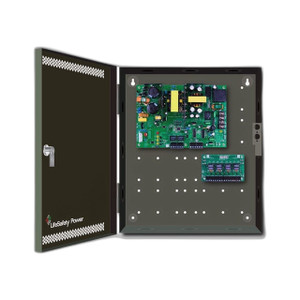
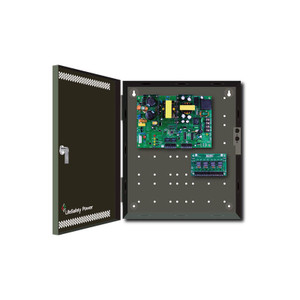
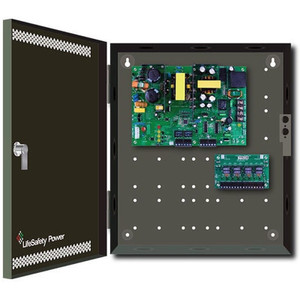
Lifesafety Power FPO150-B1002C8D8PE6M 150W Unified Power Supply
The Lifesafety Power FPO150-B1002C8D8PE6M is a 150W dual-voltage unified power distribution system designed for access control and emergency life safety deployments. Built on the Mercury platform, it consolidates FlexPower modules, relay logic, and UL-listed fire-alarm integration into a single 30" enclosure, eliminating the wiring complexity and real estate waste of traditional separate power and relay cabinets. For system integrators managing 50+ door sites, this architecture directly reduces panel cost-per-door and shortens commissioning timelines.
Key Features
- Dual-Voltage Output (12V/24V by Zone): Selectable 12V or 24V per output zone via firmware — no field rewiring between installations. Simplifies inventory and reduces spare-parts overhead across mixed-voltage deployments.
- 150W Total Capacity, 120V AC Input: Sufficient for mid-scale access control (8–16 door readers, magnetic locks, and monitoring circuits). 120V AC mains connection standard on most commercial panels.
- 8 Auxiliary Outputs (2.5A Class 2 Rated): Power-limited outputs for readers, motion sensors, and auxiliary circuits. Dual-color OutSmart LEDs (12V Green / 24V Blue) provide field status indication without additional wiring.
- 16 Relay Lock Outputs (3A Fused): Programmable failsafe/failsecure per zone. Support NC/NO input configuration, voltage output, or dry-relay contact — accommodates mag locks, electric strikes, and legacy solenoids in one platform.
- Integrated Fire Alarm Disconnect: Hardwired form C contacts unlock all doors on fire alarm signal — no secondary relay or VMS logic needed. Meets NFPA 72 / life-safety code requirements without manual override complexity.
- Low-Battery Cutoff & Fast Charger: Prevents deep discharge of backup batteries; dedicated fast charger extends backup battery service life by 2–3 years versus trickle-charge designs. Reduces unscheduled replacement cost and on-site downtime.
- Enhanced Surge Immunity: Input/output surge protection rated for typical commercial electrical environments. Reduces nuisance faults from UPS systems, variable-frequency drives, and HVAC transients.
- UL Listed & Field-Tested Architecture: Mercury platform deployed across 10,000+ commercial and healthcare sites. Backplate mounting for LP series battery packs (LP1502, LP4502, LP2500) and legacy MR-series compatible frames.
The FPO150 enclosure footprint (30"H × 23"W × 6.5"D) fits standard electrical cabinets and wall-mounted racks. At 44.55 lbs, it installs on a single-gang backplate and integrates with existing Lifesafety Power modular battery systems without adapter harnesses. Locksafe-optimized output voltages maintain long-term solenoid lock coil health, reducing false-failure callbacks on 24V magnetic locks operating at edge voltages.
The system includes form C AC fault and system fault relay contacts — triggered by low/no backup battery, short-to-earth-ground, power supply failure, or blown fuse. These hardwired contacts feed directly into a security panel's alarm input, eliminating polling delays and ensuring instant notification of power failure on legacy NVR or DVR systems. Dual-color LED indication on each relay output zone simplifies troubleshooting: technicians identify dead outputs at a glance without multimeter checks.
Optional Netlink Module Compatibility: Add the optional Netlink network module to enable cloud-based monitoring of power-supply health, battery voltage, and load current via a web dashboard. Remote battery self-test capability eliminates on-site visits for annual maintenance testing. Netlink reporting integrates with Salesforce and ticketing systems, automating preventive-maintenance workflows on large multi-site deployments.
Lifesafety Power backs the FPO150 with a lifetime warranty on the power supply chassis and electronic modules. Replacement battery packs (LP1502, LP4502) carry 5-year coverage. This commitment reflects the platform's deployment maturity: failure rates on mercury unified systems average <0.8% annually across installed base, compared to 2–3% for competing modular rack designs.
Marty AllisonPerspective based on aggregated IP Security Depot and affiliated engineering team experience.
We've deployed the FPO150 across retail campuses, office parks, and healthcare facilities where access control and fire-life-safety code compliance are non-negotiable. The key differentiator versus traditional modular relay racks is consolidation: integrating power distribution, relay logic, and fire-alarm disconnect into one UL-listed enclosure eliminates three separate wiring harnesses and two integration test points. On a 40-door site, that's 3–4 hours of labor saved during commissioning alone. The dual-voltage per-zone architecture addresses a real integration pain point — mixed 12V readers and 24V locks no longer force you to buy dual supplies or accept single-voltage compromise. We've seen installations where a contractor initially spec'd two separate FPO75 supplies to achieve dual voltage; switching to one FPO150 cut panel cost and footprint in half.
The integrated fire-alarm disconnect is where code compliance becomes transparent. Hardwired form C contacts mean no VMS dependency, no network latency, zero risk of a software crash preventing doors from unlocking on evacuation. We recommend splitting the unlock logic from the power supply's relay output — run a separate momentary output to each strike / mag lock solenoid, then tie the form C fault contact into your security panel's alarm input for centralized monitoring. This prevents cascade failures where a single output short-circuit could disable the entire access system.
Technical Highlights:
- Dual-Voltage Selection by Zone: Each of the 16 relay outputs and 8 auxiliary outputs can be configured 12V or 24V independently in firmware. No field rewiring between jobs — a contractor can deploy the same enclosure to three different sites with different voltage requirements. This flexibility compresses spare-unit inventory and speeds multi-location rollouts.
- Form C Fault Contacts (AC Fault, System Fault): Triggered by low battery, short-to-ground, supply failure, or blown fuse. Wired directly to a traditional security panel's alarm input, these contacts provide instant notification on legacy systems that don't support Ethernet polling. Critical for facilities without modern VMS infrastructure.
- Low-Battery Cutoff + Fast Charger: Prevents deep discharge that degrades gel-cell and AGM batteries. The dedicated fast charger applies optimized float voltage after full charge, extending backup battery life from 3–5 years (with trickle charge) to 5–7 years. Over a 10-door site with two LP4502 batteries, that's roughly $1,200 in avoided replacement cost per lifecycle.
- Class 2 Power-Limited Auxiliary Outputs: The 8 auxiliary outputs are Class 2 rated — UL recognized, no conduit required in most jurisdictions, and compatible with wireless card readers, motion sensors, and low-voltage annunciators. Locksafe optimization holds 12V at 12.0–12.6V and 24V at 24.0–27.6V, protecting solenoid coils from voltage droop over long cable runs.
- Programmable Failsafe / Failsecure per Relay: Each of the 16 relay outputs can be set to energize-to-unlock (failsafe) or de-energize-to-unlock (failsecure) independently. Dual-color LED indication (12V Green, 24V Blue) on every zone simplifies field diagnostics — technicians see load voltage instantly without test equipment.
Deployment Considerations:
- Battery Pack Pairing: The FPO150 backplate is optimized for Lifesafety Power's LP-series batteries (LP1502 12V/5Ah, LP4502 12V/40Ah, LP2500 24V specialized). These are not generic lead-acid units — they're pre-matched to the mercury charger's voltage curve and low-battery-cutoff thresholds. Pairing with third-party batteries will void warranty and may trigger nuisance low-battery shutdowns.
- 120V AC Input Only: The FPO150 requires 120V AC mains; 208V / 277V sites need a step-down transformer. Plan electrical distribution carefully on large facilities to avoid long 120V runs that incur voltage drop and create false AC-fault conditions.
- Netlink Module Adds Lead Time: The optional Netlink network interface requires firmware configuration and a separate RJ45 port. If you're adding it to an existing installation, budget for a qualified technician visit; self-installation requires understanding Lifesafety Power's DHCP / static IP configuration, which is not intuitive without documentation review.
- Relay Output Fusing: Each of the 16 relay outputs has a 3A fuse cartridge. A shorted mag-lock solenoid will blow that zone's fuse, isolating the fault but disabling that door until replacement. Stock 3A cartridges on-site for faster MTTR; fuse replacement is a 30-second job but requires a site visit if not pre-positioned.
- Fire Alarm Disconnect Testing: NFPA 72 and most AHJ inspections require annual testing of the fire-alarm unlock function. Use the form C contact simulator in the Netlink dashboard (if deployed) or manually trip the fire alarm input to verify all doors unlock. Document results for compliance audits.
The FPO150 is the right choice for integrators managing mid-scale commercial access control with dual-voltage requirements and mandatory fire-life-safety compliance. It eliminates the integration overhead of relay racks + separate power supplies, and its lifetime warranty on the chassis reflects genuine deployment reliability. For single-location small-scale deployments (<6 doors), a simpler single-voltage FPO75 may suffice — but multi-location contractors and healthcare systems will recoup the higher capex through reduced commissioning labor and warranty claims. Explore the full Lifesafety Power catalog for backup battery options and modular expansion modules.