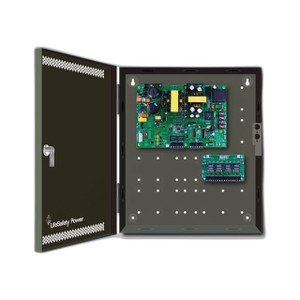
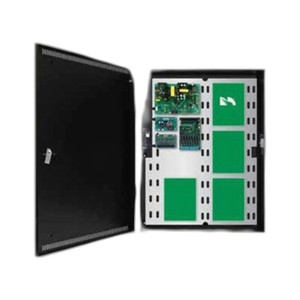
Lifesafety Power FPO150/250-2C8P2D8PE6M1 Mercury Unified Power System
The Lifesafety Power FPO150/250-2C8P2D8PE6M1 is a unified power distribution system designed for access control and life-safety applications requiring integrated battery backup, fire alarm coordination, and multi-zone voltage management. The Mercury platform consolidates FlexPower modules, relay outputs, auxiliary circuits, and battery charging into a single 30"H x 23"W x 6.5"D enclosure rated for 120V AC input and 400W total output. This architecture eliminates the need for separate power supplies and relay modules, reducing panel real estate, wiring complexity, and single points of failure in medium to large access control deployments.
Key Features
- Dual-Voltage Output (12V/24V): FPO150/250 designation supports simultaneous 12V and 24V circuits with independent buss control per zone. Eliminates the cost and complexity of purchasing separate voltage supplies for mixed-load environments.
- 16 Relay Lock Outputs (2 C8P modules): 2.5A Class 2 power-limited outputs, programmable per-zone for failsafe or failsecure operation. NC/NO input selection, voltage or dry relay output per relay — accommodates mag locks, electric strikes, and solenoids without external relay banks.
- 16 Auxiliary Outputs (2 D8P modules): 2.5A Class 2 outputs for status LEDs, door sensors, and low-current loads. Dual color OutSmart LEDs (12V Green / 24V Blue) provide real-time visual feedback on per-zone power status without external indicator wiring.
- Integrated Fire Alarm Disconnect: Form C contact output automatically unlocks doors on fire alarm trigger. Meets life-safety code requirements (IBC, NFPA 101) — no separate relay or logic controller needed.
- Battery Backup & Low-Battery Cutoff: Onboard charger and dual-buss support for battery strings. Low-battery cutoff prevents deep discharge damage, extending battery lifecycle and reducing replacement cycles on 24/7 emergency power draws.
- AC Fault & Systems Fault Monitoring: Form C contact outputs trigger on low/no battery, short to ground, power supply failure, or blown fuse. Direct integration with building automation or remote monitoring systems — no separate monitoring module required.
- Enhanced Surge Protection: Input/output surge immunity engineered for noisy electrical environments (parking garages, industrial facilities). Protects downstream access control hardware from transient damage.
- Optional Netlink Module (Network Ready): IP connectivity for remote battery testing, power-supply health monitoring, and event-driven alerting. Dashboard visibility into voltage levels, battery charge state, and fault conditions across multi-location deployments.
The FPO150/250-2C8P2D8PE6M1 is purpose-built for mid-to-large access control systems where centralized power distribution, life-safety compliance, and operational visibility drive ROI. Common deployments include multi-tenant office buildings, healthcare facilities with emergency egress requirements, data centers requiring redundant power feeds, and multi-building campus perimeters. The 400W total output supports 16-32 doors with mag-lock or solenoid hardware, depending on load profiles and backup runtime.
Integration is straightforward: the system accepts 120V AC single-phase input, routes dual-voltage outputs to programmable relay and auxiliary zones, and provides dry Form C fault contacts for connection to NVRs, building management systems, or standalone monitoring panels. ONVIF-compatible access control platforms (Genetec, Axis A1001 Network Door Controller, HID-integrated solutions) can query system state via Netlink, enabling conditional unlock logic based on network reachability and power status. FlexPower modules are field-swappable, so failing chargers or relay banks can be replaced without removing the entire chassis from the wall.
The system is UL 294 listed (electric lock controllers) and complies with NEC Article 700 (emergency power) requirements for code-mandated fire alarm coordination. Lifetime warranty on the enclosure and core modules reflects Lifesafety Power's manufacturing confidence; battery modules and power supplies follow industry-standard 3-5 year hardware warranties. Total cost of ownership is significantly lower than specifying separate power supplies, relay modules, chargers, and monitoring devices — and the integrated fire-alarm cutoff removes the need for a third-party interface relay.
Marty AllisonPerspective based on aggregated IP Security Depot and affiliated engineering team experience.
In our experience, the Mercury Unified Power system solves a recurring pain point on mid-sized access control retrofits: panel real estate and wiring overhead. On a typical office building upgrade involving 20-40 doors across multiple floors, specifying separate 12V and 24V supplies, dedicated relay modules, battery chargers, and manual fault monitoring quickly consumes an entire server rack or large wall-mounted enclosure. The FPO150/250-2C8P2D8PE6M1 consolidates all of that into one 30" chassis — and crucially, the fire-alarm disconnect relay is already there, eliminating the need to source and wire a separate interface module. We've installed this on healthcare campuses where life-safety code requires automatic door unlock on alarm trigger; the built-in Form C output means installation is faster and the failure mode is well-defined (NEC-compliant, UL-validated). The per-zone voltage selection is the second major differentiator. In real buildings, you'll have a mix of 12V solenoids on older strike systems and 24V on newer hardware; the FPO150/250 avoids the old workaround of stacking two separate power supplies and patch-cording zones manually. The OutSmart LED feedback on each output zone is a small touch but operationally valuable — a green or blue LED tells you at a glance whether that zone has power, without hunting for a multimeter or opening a door to test. On a 50-door system, that's quick diagnostics for maintenance crews. The optional Netlink module is worth the investment if you have 2+ buildings or 24/7 monitoring staff. Battery health trends and remote test capability (avoiding site visits for routine battery checks) add measurable value. One caveat: the 400W total output is fixed, so you do need to calculate your lock load upfront. A 20-door magnetic lock system at 6A per strike (peak) can draw 120W; add status lights, solenoids, and bell circuits, and you're in the 250-350W range fairly quickly. If your door count or amp budget scales beyond ~30 doors, you'll need a second unit or an external power source. Also, although the enclosure is UL listed, installation code varies by jurisdiction — always have your AHJ (Authority Having Jurisdiction) inspect the fire-alarm disconnect wiring and power routing before signing off.
Technical Highlights:
- 400W Dual-Voltage Output (12V/24V): The FPO150/250 module supports simultaneous dual voltage with independent fusing and monitoring per buss. This eliminates two separate power supplies and the associated control logic — one component, one set of breaker inputs, one monitoring point. Over a 5-10 year lifecycle, you're trading two power-supply replacements for one unified system replacement, lowering MTTR and parts inventory overhead.
- Fire Alarm Disconnect (Form C Contact): Hard-wired relay output that unlocks doors on fire alarm signal. Meets IBC 1008.1.9.3 and NFPA 101 Chapter 7 — code inspectors immediately recognize the output and validate the circuit without additional documentation. No firmware updates or controller changes required if fire-alarm logic changes.
- Per-Zone Programmability (Failsafe/Failsecure, Voltage Selection): Each of the 16 relay outputs is independently configurable for failsafe unlock (de-energize to unlock on power loss) or failsecure (energize to lock). The ability to assign 12V or 24V per zone within a single enclosure means retrofit scenarios where you're adding new hardware alongside legacy mag locks no longer require parallel infrastructure.
- Low-Battery Cutoff & Charger Integration: Onboard battery charger and cutoff logic prevent overdischarge on backup runtime. Lithium or lead-acid battery strings remain healthy longer, cutting replacement cycles from every 3-4 years to 5-7 years — meaningful savings on 24/7 emergency-power deployments.
- Netlink Network Module (Optional): IP connectivity to a cloud or on-premises dashboard provides battery voltage trending, charger status, and fault-event logging. Integration with building management systems (Tridium, Honeywell, Siemens) via standard APIs simplifies fault alerting and allows battery runtime predictions based on load and temperature.
- Form C AC/Systems Fault Contacts: Dry relay outputs for low/no battery, ground fault, supply failure, and fuse events. Direct connection to NVR syslog, building alarm panels, or email alerting systems — no intermediate controller needed, lower latency on critical faults.
Deployment Considerations:
- Calculate your total door lock amperage upfront (mag locks at 6A peak, solenoid strikes at 2-4A, status loads at 0.5-1A). The 400W budget is firm; oversized specs will require a second unit or external supply, adding cost and complexity. A quick rule of thumb: 20-30 doors with mixed mag-lock and solenoid hardware fits comfortably; 40+ doors requires load analysis and likely a second unit.
- Fire-alarm disconnect wiring must be reviewed by your AHJ and incorporated into the building's life-safety system drawings. The Form C relay output is only as good as the alarm input signal; ensure your fire panel has a monitored, dedicated output line routed to the FPO150/250 input — shared alarm contacts or polling logic introduces latency that violates code.
- The 120V AC single-phase input is non-negotiable. If your site has only 208V or 277V three-phase service, you'll need a step-down transformer — budget accordingly in the electrical design. Also verify breaker capacity; a 20A input circuit is typical, but local code may require dedicated circuits per the NEC.
- Netlink is optional but highly recommended for multi-building or 24/7-staffed sites. If you skip it, you lose remote battery testing and trend data — maintenance becomes reactive (you discover a bad battery when the system fails to backup) rather than proactive. Factor the Netlink cost into your 5-year TCO calculation.
- The system is compact but heavy: 50.8 lbs. Wall mounting requires studs or a DIN rail with secure backing. In retrofit scenarios, verify your chosen wall location has adequate structural support and is physically accessible for battery replacement (typically every 5-7 years on a 24/7 system).
The Mercury FPO150/250-2C8P2D8PE6M1 is the right choice for integrators and end-user security teams deploying 20-40 doors with mixed voltage requirements and mandatory fire-alarm life-safety coordination. If you're consolidating separate power, relay, and monitoring hardware, the unified architecture cuts installation labor and improves reliability. For larger campuses or single-building mega-projects (100+ doors), you'll likely scale horizontally with multiple units. Explore the full Lifesafety Power catalog for single-voltage variants and higher-capacity options.