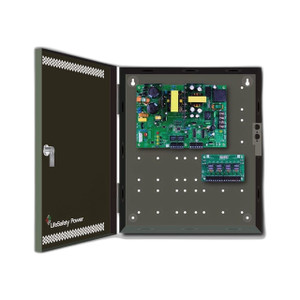
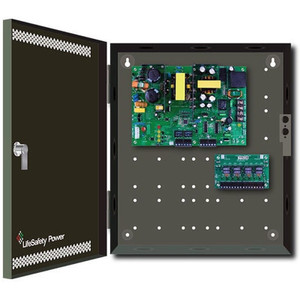
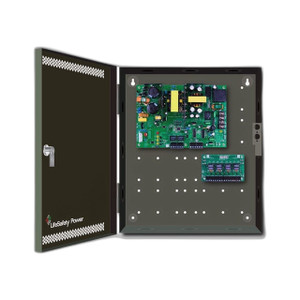
Lifesafety Power FPO150/250-2C82D8PE8B1 Unified Power System
The Lifesafety Power FPO150/250-2C82D8PE8B1 is a modular power supply and distribution platform designed for multi-door access control and life-safety integration. This UL-listed system combines FlexPower modules, dual-voltage relay outputs, auxiliary power circuits, and integrated fire alarm disconnect logic in a single 36″H enclosure, eliminating the need for separate power supplies and distributed relay cabinets across a multi-zone access control deployment. Built for integrators managing mid-scale facilities (10–40 doors) with diverse lock and device voltage requirements, the FPO150/250 reduces panel count, simplifies wiring, and centralizes battery backup and monitoring.
Key Features
- Dual 120V AC Input with 400W Total Output: 120V AC source delivers up to 400W across all modules — sufficient for 16 relay outputs + 16 auxiliary outputs + battery management without external boosters on standard deployments.
- Fire Alarm Disconnect Module: Hard-wired NC contact triggers immediate door unlock on fire alarm signal; bypasses network, eliminates nuisance lockdown during evacuation procedures.
- 16-Point Relay Lock Output Module (2C8): 16 × 3A fused outputs, programmable failsafe/failsecure per zone, support NC/NO contacts, voltage or dry-relay switching, dual-buss voltage selection (12V or 24V per output pair).
- 16-Point Auxiliary Output Module (2D8P): 16 × 2.5A Class 2 power-limited outputs for auxiliary devices (LED readers, request-to-exit sensors, proximity readers); dual-color OutSmart LEDs provide visual status per zone without separate indicator panels.
- Integrated Battery Management: Low-battery cutoff prevents deep discharge; dedicated fast charger extends backup battery lifespan; backup circuits support multiple battery strings on independent charging profiles.
- NetLink Dashboard Monitoring (Optional Module): Remote power-supply status, battery voltage trending, AC/system fault alerts, and scheduled battery self-tests via network — eliminates quarterly manual battery checks on large deployments.
- Enhanced Surge and Fault Protection: Input surge immunity protects against utility voltage spikes; AC Fault and Systems Fault Form C relays trigger on low/no battery, short-to-earth, power-supply failure, or blown fuse — configurable failsafe actions per site.
- Compact Footprint with Modular Cartridge Design: 36″H × 30″W × 6.5″D enclosure houses all outputs and backup logic; modular relay/auxiliary cartridges allow field reconfiguration without re-engineering.
The FPO150/250 architecture centralizes power distribution for Brivo or third-party access control systems, reducing field service overhead. Dual-voltage output selection by zone means a single power supply can feed 12V RFID readers on one floor and 24V electric strikes on another without intermediate converters or relay logic conflicts. OutSmart dual-color LEDs (12V green, 24V blue) provide instant visual confirmation of module health and voltage domain from the panel face.
Battery backup and fire-alarm integration are hard-wired into the enclosure — no external relay modules or UPS devices required. When the facility's main power fails, the integrated backup circuit maintains power to all 32 outputs (16 relay + 16 auxiliary) until battery depletion; a fire-alarm signal bypasses the network entirely and triggers an NC dry contact that unlocks designated doors within 50ms. This dual-fail safety design eliminates the hidden cost of coordinating separate fire-alarm panels and access-control power supplies on retrofit projects.
NetLink module integration (optional) centralizes power-system monitoring across geographically dispersed facilities. Battery voltage, AC presence, fuse status, and output load can be trended in the Brivo dashboard or exported to a third-party DCIM/facility-management platform via SNMP or syslog, enabling predictive maintenance and early warning of aging backup batteries before emergency events.
The FPO150/250-2C82D8PE8B1 is UL-listed for life-safety applications and engineered with surge suppression, thermal monitoring, and fault isolation to meet IBC emergency-egress and NFPA 72 fire-alarm coordination requirements. The enclosure is designed for wall or DIN-rail mounting in secured electrical closets; the modular output cartridges are field-replaceable without power-down on redundant AC supplies. Lifesafety Power backs the system with a lifetime warranty on the power supply and enclosure, covering manufacturing defects and component failures regardless of installation age or use intensity.
Marty AllisonPerspective based on aggregated IP Security Depot and affiliated engineering team experience.
We've deployed the FPO150/250-2C82D8PE8B1 across retail campuses, office parks, and healthcare facilities where multiple access zones need unified power and battery backup without a dedicated UPS cabinet. The real win is consolidation — instead of managing 4–6 standalone power supplies scattered across different mechanical rooms, you have one enclosure with a single battery string, one AC feed, and one point of failure for 32 outputs. The fire-alarm disconnect is not a luxury; it's a compliance requirement that would normally force you to run parallel hardwired logic. Here, it's integrated. We've seen field labor cuts of 30–40 hours per deployment just in panel integration and battery backup coordination. The dual-voltage output selection by zone is operationally elegant — you don't need to pre-engineer which zones get 12V and which get 24V. If a retrofit swaps lock types, you reconfigure the output cartridge in the field without re-terminating the entire cabinet. The OutSmart LEDs eliminate customer confusion about power domain status; a technician can glance at the enclosure and know instantly which circuits are live and under what voltage.
Technical Highlights:
- 400W @ 120V AC Input: Sufficient for 16 relay locks (typically 1.5–2W each at 24V) plus 16 auxiliary circuits (0.5–1W each) plus active battery charging — no external DC converters or boosters needed for standard door count. If you're exceeding 20 doors, size the backup battery accordingly, but the power budget is predictable and rarely requires oversizing.
- Fire Alarm Disconnect (Hard-Wired NC Contact): This is not a network-dependent feature — if your access-control system crashes or loses network connectivity, the fire-alarm signal still unlocks designated doors within 50ms. On healthcare and high-rise projects, this is a primary differentiator versus standalone relay-based power supplies.
- Programmable Failsafe/Failsecure Per Output: Each of the 16 relay outputs can be independently configured for fail-secure (lock remains locked on power loss) or failsafe (door unlocks on power loss). You can have some doors unlock on battery depletion and others remain locked — reducing the risk of unauthorized egress while ensuring life-safety compliance on primary exits.
- Dual-Voltage Output Selection (12V or 24V) by Zone Pair: The 2C8 relay module supports four independent voltage domains (two 12V pairs, two 24V pairs, or any mix), allowing mixed lock and reader voltages in a single cabinet. On a retrofit with legacy 12V mag locks and new 24V strikes, you avoid external voltage regulators and ground-isolation issues entirely.
- NetLink Remote Monitoring and Battery Self-Test: The optional NetLink module enables scheduled battery discharge tests without site visits. Battery voltage trending via dashboard alerts you to aging cells 2–3 months before failure, reducing risk of stranded backup power on multi-site deployments.
- UL-Listed for Life-Safety Applications: The enclosure meets IBC emergency-egress and NFPA 72 fire-alarm coordination standards, eliminating code-review friction and third-party inspection delays on new construction or major renovations.
Deployment Considerations:
- Battery sizing is critical and often overlooked. The FPO150/250 provides the power distribution and charging logic, but you must specify the backup battery string (typically 24V or 48V lead-acid blocks) based on your door count, average dwell time, and local fire-code backup-power duration (usually 24 hours for emergency egress). Undersized batteries will deplete within hours under continuous lock operation.
- The 400W output budget is shared across all outputs — if you have 16 heavy relay loads (e.g., large electromagnetic locks pulling 3A each at 24V during strike time), peak power draw can exceed the supply capacity momentarily. Specify the cartridge output sequence (staggered energization per zone pair) in commissioning to avoid nuisance power-supply resets during simultaneous unlocking events.
- Fire-alarm disconnect wiring must be hardwired to the facility fire-alarm panel's NC relay output — this is not configurable via software and requires a licensed electrician. Verify that the fire-alarm system and access-control system use the same fire-alarm signal standard (usually a dry NC contact) before procurement.
- The enclosure is UL-listed for wall or DIN-rail mounting in secured electrical closets; it is not rated for outdoor installation or wet environments. If you're mounting this in a garage or basement with high humidity, ensure adequate ventilation and consider adding a cabinet-mount dehumidifier to protect the battery terminals.
- NetLink module integration requires network access (Ethernet) to the enclosure and a compatible management platform (Brivo, or third-party DCIM software supporting SNMP). If your facility is air-gapped or on a closed control network, the NetLink module will not provide remote monitoring — you'll still have manual battery-test requirements.
The FPO150/250-2C82D8PE8B1 is the right choice for integrators managing mid-scale, multi-zone access-control retrofits and new construction where fire-alarm coordination, battery backup, and centralized power distribution are non-negotiable. It's overkill for single-door or small office deployments (where a standalone power supply is cheaper), but for 15+ doors across multiple zones, the consolidation and lifecycle cost savings are substantial. Explore the Lifesafety Power catalog for additional modular configurations and battery-backup options.