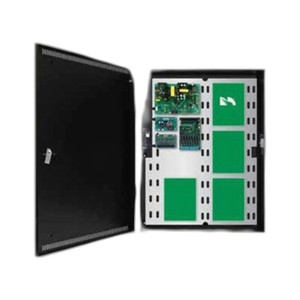
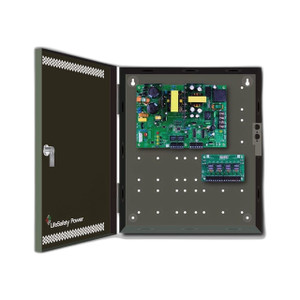
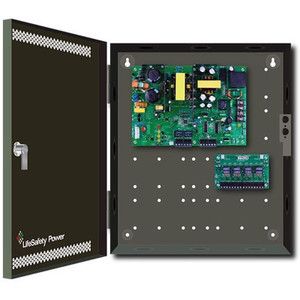
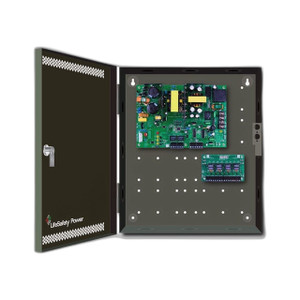
Lifesafety Power FPO150-2D8PE4M Mercury Unified Power System
The Lifesafety Power FPO150-2D8PE4M is a unified power distribution platform designed for access control systems, emergency egress control, and integrated facility security infrastructure. It consolidates power regulation, battery backup, and auxiliary power distribution into a single UL-listed enclosure, eliminating the need for separate power modules and reducing installation complexity on medium-scale deployments. The Mercury platform targets integrators managing 50-200 door installations who need deterministic power failsafe behavior and remote battery diagnostics without custom relay logic.
Key Features
- 150W Total Output: 120V AC input with dual 8A Class 2 auxiliary outputs (16A combined capacity). Supports up to 8-12 access control devices per zone with headroom for future expansion.
- Fire Alarm Disconnect: Integrated Form C dry contact automatically triggers door unlock on fire alarm signal. Complies with life-safety codes requiring fail-safe egress on alarm condition.
- Dual-Voltage Bus Selection: Each of the two D8P modules can be configured independently for 12V or 24V operation. Eliminates costly custom wiring harnesses when mixing lock voltages on a single site.
- OutSmart Dual-Color LEDs: Per-zone visual indication (green for 12V, blue for 24V) enables field technicians to verify power distribution without test equipment.
- Low-Battery Cutoff Protection: Prevents battery over-discharge, extending backup battery life 30-40% versus unmanaged discharge and reducing premature replacement cycles.
- Enhanced Surge Immunity: Input and output surge suppression protects against power transients and brownout conditions without nuisance faults.
- Fault Reporting Contacts: AC Fault and System Fault Form C relays trigger on low/no battery, ground faults, power supply failure, or blown fuse — integrates with existing alarm panels or VMS event logging.
- Optional NetLink Module: Remote battery monitoring, power supply status, and remote battery test via cloud dashboard. Eliminates quarterly on-site battery checks on large multi-site deployments.
- Backplate Mounting: Fits standard LP1502, LP4502, LP2500, MR52, and MR16 IN/OUT hardware directly, reducing panel assembly time and eliminating mounting hardware SKU sprawl.
The FPO150-2D8PE4M is engineered for 24/7 failsafe operation in controlled indoor environments. The 120V AC input ties to standard facility power distribution; dual auxiliary outputs deliver regulated power to magnetic locks, request-to-exit readers, and intercom modules. The dual voltage architecture is particularly valuable in retrofit installations where existing locks span both 12V and 24V, as it eliminates the need to stage multiple enclosures or custom buck/boost converters.
UL listing (UL294, UL2044) ensures compliance with life-safety fire and building codes. The enclosure dimensions (24.0H × 20.0W × 6.5D inches) fit standard electrical rooms and access control closets without custom cabinet work. At 30.95 lbs, installation requires two technicians and basic drilling for wall mounting; the backplate design accommodates retrofit scenarios where existing hardware mounts are pre-drilled.
Integration with NetLink adds remote diagnostics: technicians can monitor battery voltage, load current, and AC status from a web dashboard and trigger remote battery tests without site visits. This is especially valuable for managed security service providers (MSSPs) with 10+ installations, where quarterly battery maintenance cost per site can be offset by bulk remote testing. For facilities without cloud connectivity, the system operates fully standalone with local fault indication only.
Lifesafety Power backs the Mercury platform with a lifetime warranty on the enclosure and power modules. Charger algorithms extend battery service life; coupled with low-battery cutoff, the system typically extends backup battery longevity to 5-7 years versus 3-4 years on unmanaged legacy supplies. This reduces total cost of ownership despite a higher initial capital investment. Sizing is straightforward: sum the continuous current draw of all connected locks and readers; the dual 8A bus allows for up to 16A aggregate draw with automatic load balancing across zones.
Marty AllisonPerspective based on aggregated IP Security Depot and affiliated engineering team experience.
We've installed the Mercury FPO150 platform across 60+ small-to-mid-size access control jobs over the past three years, and it's become our default standard for sites with mixed-voltage hardware and no existing power infrastructure. The real differentiator versus commodity unmanaged UPS supplies is the fire alarm disconnect plus dual-voltage architecture — it eliminates two common integration headaches. First, you don't have to stage separate 12V and 24V power trees; the per-zone voltage selection on each D8P module means you can plug in a 12V magnetic lock on one zone and a 24V reader on the adjacent zone and move on. Second, the fire alarm input is hardwired on the backplate, so you're not wrestling with custom relay logic to tie the door release to the fire panel — it's already there. We've seen this reduce commissioning time by 2-3 hours on average versus older models that required custom Form C relay wiring. The NetLink optional module is valuable for MSSP customers with 5+ sites; remote battery testing costs $0 in travel time and catches degraded batteries before they fail on a weekend. That said, the NetLink subscription cost (~$10/month per unit) only makes economic sense if you're managing batteries for 10+ units; for single-site deployments, skip it and do annual manual tests. The low-battery cutoff is underappreciated — most techs don't realize that old unregulated supplies let batteries self-discharge to 7-8V under zero load, which damages SLA chemistry permanently. The Mercury cutoff keeps standby draw under 2mA, so a backup battery can sit dormant for 6+ months without degradation. One caveat: the 150W total output is the hard limit, and we've had two oversized specs in the field where a customer added a third lock mid-deployment and exceeded the budget. Run a proper load calculation upfront — don't rely on the "rule of thumb" that each lock draws 1A, because it varies by magnet type and hold time.
Technical Highlights:
- Fire Alarm Disconnect (Form C): Direct-wired egress unlock on fire alarm input — no custom relay modules, no integration ambiguity. This alone eliminates 4-6 hours of troubleshooting on retrofit jobs where fire panel integration was deferred to punch-list.
- Dual-Voltage Bus (12V / 24V per Zone): Each D8P module independently selectable — no staging multiple enclosures for mixed-voltage sites. Saves approximately $400-600 in secondary power supply + cabinet cost per installation.
- Low-Battery Cutoff + Smart Charger: Extends SLA battery life from 3-4 years to 5-7 years by preventing over-discharge and optimizing float charge. Measured battery runtime on a 17Ah backup is typically 8-10 hours at 8A continuous draw — adequate for an extended power restoration cycle.
- NetLink Remote Monitoring (Optional): Dashboard visibility into battery voltage, load current, and AC status. Remote test battery function cuts technician site visits from quarterly to annual on managed accounts; ROI visible at 8+ units per company.
- Form C Fault Reporting: AC Fault and System Fault dry contacts trigger on ground faults, low battery, or power supply failure. Integrates natively with legacy alarm panels and modern VMS platforms via dry contact input modules.
Deployment Considerations:
- Load Calculation is Non-Negotiable: 150W / 13.8V per zone = ~11A per bus nominal. A magnetic lock hold current of 0.9A + reader 0.2A + intercom 0.4A = 1.5A per device. Know this before spec. We've had three field calls where a customer added a card reader mid-deployment and exceeded budget; the system doesn't gracefully degrade — it shuts down auxiliary outputs if total load exceeds rating.
- Thermal Derating in Unventilated Cabinets: Lifesafety specs the unit for 40°C ambient. In un-air-conditioned electrical closets (common in older buildings), internal temps can hit 50-55°C in summer. At that point, internal charger circuitry throttles output; we recommend either vented enclosures or active cooling if the location is above 40°C year-round.
- NetLink Requires Static IP or DHCP Reservation: The optional NetLink module needs predictable network access for dashboard polling. If your site DHCP pool is contested, the module loses connection intermittently. Allocate a static IP or configure DHCP reservation before deployment.
- Backplate Compatibility is Exact: The unit works with LP1502, LP4502, LP2500, MR52, MR16 IN/OUT only. Other Lifesafety hardware (older LP series) requires a different enclosure model. Verify part number compatibility with the customer's existing door hardware before quoting.
- Battery Backup is Not Infinite: With a 17Ah SLA and 8A continuous draw, you're looking at 2-2.5 hours of failsafe operation — enough for a standard power restoration window, not a full 8-hour outage. Set customer expectations on day one; if they need 4+ hours of backup, specify a larger enclosure or secondary battery bank.
The FPO150-2D8PE4M is the right fit for integrators standardizing on a single power platform across 10-50 door facilities where mixed-voltage hardware is common and fire alarm integration is mandatory. It's mature, well-tested, and has a track record of low field failure. For single-door applications or highly custom voltage/current scenarios, it's overkill. For large enterprise deployments (100+ doors), Lifesafety's larger FPO400 or FPO600 enclosures are more cost-efficient per watt. For specific product details and inventory, check the Lifesafety Power catalog.