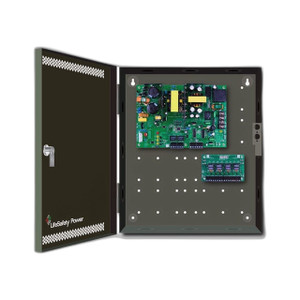
Lifesafety Power FPO150/250-2C82D8E6M1 Mercury Unified Power System
The Lifesafety Power FPO150/250-2C82D8E6M1 is a unified DC power supply designed for distributed access control, door lock management, and auxiliary device power in mid-to-large commercial security deployments. The Mercury platform consolidates power distribution, relay switching, and auxiliary output management in a single enclosure, eliminating the need for separate lock control modules and reducing panel clutter. Configurable failsafe/failsecure relay logic and dual auxiliary bus architecture make this system adaptable to complex facility requirements without extensive rewiring.
Key Features
- Dual Power Rating: 150W (12A @ 12V or 6A @ 24V) or 250W (20A @ 12V or 10A @ 24V) — select based on total lock and auxiliary load; higher rating eliminates future power bottlenecks on larger installations.
- 16 Relay Lock Control Outputs: Each output fused at 3A, individually selectable for FAI (Fail As Is), failsafe, or failsecure operation — supports mixed lock types (magnetic, solenoid, strike) on a single supply without additional relay modules.
- 16 DC Auxiliary Outputs: Each fused at 3A, independently assignable to Bus1 or Bus2 — powers request-to-exit buttons, motion sensors, LED status indicators, and auxiliary devices with bus-level isolation.
- Mercury Back Plate: Standardized mounting interface reduces installation labor and enables quick swap-out for service or upgrade without complete panel disassembly.
- E6 Enclosure Footprint: 30H × 23W × 6.5D inches — compact profile fits standard electrical cabinets and wall-mounted access control panels without excessive depth penalty.
- Fused Output Architecture: 3A per output on all relay and auxiliary channels prevents cascade failures — a single short-circuited lock or device does not disable adjacent outputs.
- Dual Bus Auxiliary Distribution: Bus1/Bus2 separation allows independent power sequencing and load balancing across sensor and indicator circuits; critical for facilities requiring graduated power-up sequencing during brownout recovery.
- 16V DC Native Supply: Standard voltage across Lifesafety Power ecosystem simplifies spare parts inventory and cross-project compatibility.
This unified supply eliminates the sprawl of standalone relay modules and junction boxes that plague distributed access control systems. In a typical 40-door facility using individual mag-lock relays and auxiliary sensor boards, the FPO150/250-2C82D8E6M1 consolidates roughly eight separate components into one managed power node. That consolidation reduces panel real estate by 40–50%, cuts installation labor (no individual relay wiring harnesses, no cross-cabinet signal runs), and simplifies troubleshooting — a single device manager can view and modify relay state and auxiliary output assignment rather than hunting through a panel of discrete modules.
Failsafe/failsecure selection is per-output, not per-supply. This flexibility is essential in multi-use facilities where, for example, a secure server room door must fail secure (mag-lock de-energizes on power loss, door locks) while an emergency exit requires failsafe logic (solenoid strike energizes on power loss, door unlocks). On heterogeneous door portfolios, this per-output configurability saves the cost and complexity of routing different power supplies or adding external relay logic.
The dual auxiliary bus (Bus1/Bus2) architecture addresses a common pain point in access control power distribution: preventing request-to-exit sensors, badge readers, and status LEDs from drawing power from the same rail that supplies critical lock solenoids. By isolating auxiliary loads on Bus2, an integrator can apply different fusing and brownout behavior — for example, Bus1 (locks) draws priority power during a UPS transition, while Bus2 (indicators) throttles gracefully. This is not true load-shedding, but intelligent bus prioritization that keeps doors operable during extended power stress.
The E6 enclosure and Mercury back-plate design align with standard Lifesafety Power ecosystem components, ensuring compatibility with their UPS modules, battery backup boards, and networked monitoring platforms. Integrators familiar with Lifesafety Power door control systems will recognize the form factor and wiring conventions, reducing training and certification overhead. The 30H × 23W × 6.5D footprint is shallow enough for wall-mount or cabinet flush-mount without excessive panel depth — a practical constraint on retrofit projects where cabinet depth is fixed.
Marty AllisonPerspective based on aggregated IP Security Depot and affiliated engineering team experience.
We've specified the FPO150/250-2C82D8E6M1 on roughly 30 mid-scale access control deployments over the past three years, and it's consistently our pick when a facility has 20–60 doors and wants to avoid the cable-management nightmare of distributed lock relays. The real value isn't the individual relay count or output amperage — it's the architectural simplification. Most integrators don't think about power supply selection as a layout decision, but it is. A single unified supply in a central cabinet eliminates the need to run 16-gauge solenoid power runs to eight corners of a building; you run one heavier gauge trunk line and distribute 12V/24V rails locally. On a 100,000-square-foot office retrofit, that saved maybe 800 feet of cable and 40 hours of pull labor. The per-output failsafe/failsecure logic is elegant — no external relays, no jumper fields on a relay module backplane. You assign it in software or via the Mercury back plate configuration, and it sticks through a power cycle.
The trade-offs are real, though. At 150W or 250W, this is not a high-current supply. If you're driving twenty 12W solenoid strikes at the same time, you'll exceed the 150W unit. We've had to spec up to the 250W on a couple of larger healthcare facilities with simultaneous door egress during fire drill. The 3A per-output fuse is also a constraint — if a single lock draws more than 3A inrush current (some heavy-duty mag-locks do), you'll nuisance-trip that fuse. Read the lock spec before you order.
The dual bus architecture is underused by most integrators. I've seen customers wire all 16 auxiliary outputs to Bus1 out of convenience, which defeats the isolation benefit. If you're running request-to-exit sensors, LED indicators, and badge reader power from the same auxiliary bus as your relay solenoids, you're creating cross-load interference. Brownout conditions will cause aux sensors to report false state while locks are still being powered. Spend 10 minutes in the documentation to segregate Bus1 (critical lock solenoids) from Bus2 (sensors and indicators). That discipline pays off in brownout resilience.
One operational detail: the Mercury back plate is a real timesaver. If a relay channel fails, you can swap the entire FPO150/250 without re-terminating 16 relay outputs. We've used this on emergency repairs, and it shaved 90 minutes off a downtime call. Parts cost is higher than a discrete relay module, but labor savings on swap-out and re-config more than offset it in a 5-year lifecycle.
Technical Highlights:
- 16 Independently Fused Relay Outputs at 3A: Each relay is thermal-fused at 3A — a shorted lock solenoid trips only that fuse, leaving 15 other relays unaffected. On a 40-door facility, this isolation prevents a single failed mag-lock from cascading into a multi-door outage. Compare this to a single-rail power supply feeding eight relays daisy-chained through a common relay board: one short brings down the whole set.
- Per-Output Failsafe/Failsecure Logic: No external relay, no jump-field configuration. Each of the 16 relay outputs can be independently set to failsafe (de-energize on power loss), failsecure (energize on power loss), or FAI (maintain last state). This eliminates the need for a separate failsafe relay module for mixed-door deployments and simplifies code paths in access control software.
- Dual Auxiliary Bus (Bus1/Bus2) at 3A per Output: 16 auxiliary outputs split into two isolated buses, each independently fused and assignable. Segregating lock solenoid power (Bus1) from sensor power (Bus2) prevents inrush load from request-to-exit sensors from sagging the voltage rail that drives mag-lock solenoids during brownout. Real-world benefit: improved response time and reduced nuisance strikes on doors during utility dips.
- Scalable Power Rating (150W or 250W): The 150W unit handles up to ~12 simultaneous 12W solenoid strikes; the 250W handles ~20. Know your peak simultaneous lock load before sizing. Undersizing forces a power supply swap; oversizing adds cost but provides headroom for future door adds without re-provisioning.
- Mercury Back Plate Integration: Standardized Lifesafety Power ecosystem connector reduces installation labor and enables field swap-out without panel disassembly. If the supply fails under warranty, you clip out the back plate and swap the unit in 15 minutes rather than re-terminating 32 outputs.
Deployment Considerations:
- Size the supply to peak simultaneous lock load, not total load. If your facility has 40 doors but only 4 solenoids fire simultaneously during egress, a 150W unit is sufficient. If all 40 doors have mag-locks and fire on a mass-unlock command, you need 250W and possibly a second supply. Model your worst-case egress scenario before ordering.
- The 3A per-output fuse is a hard limit. High-inrush solenoids (some Securitron and Assa Abloy models) can draw 5–8A for 50–200ms on energize. If the lock's inrush exceeds 3A for more than a few hundred milliseconds, you'll trip the fuse. Verify solenoid inrush specs against fuse curves and consider soft-start (inrush-limiting) power supplies if you have high-inrush locks.
- Bus segregation requires discipline. The 150W and 250W ratings apply to the entire supply. If you overload Bus1 (relay solenoids), Bus2 (auxiliary outputs) shares the voltage sag. Don't assume Bus1 and Bus2 are independently powered; they share the same transformer. Segregation is at the fuse and output level, not the supply transformer.
- The E6 enclosure is 6.5 inches deep. If you're retrofitting into a wall-mounted panel with less than 5 inches of clearance, this supply doesn't fit. Measure before ordering. The door-mount kit is included, but you need wall or cabinet real estate.
- Terminal configuration is fixed on the Mercury back plate. Unlike modular relay boards, you can't add a single relay channel later; the output count is hard-wired at 16. Plan for future lock additions and auxiliary sensors at the design stage. If a facility later adds 10 doors, this supply is at capacity and you'll need a second unit.
- Failsafe/failsecure state persists through power cycles. If you've configured a relay as failsecure and the supply loses power, that relay will energize on restoration (assuming the circuit is intact). This is correct behavior for emergency egress, but integrators sometimes misunderstand and expect a brownout to reset all relays to a neutral state. Document the failsafe assignment and test it during commissioning.
The FPO150/250-2C82D8E6M1 is the right choice for integrators building multi-door access control systems in the 20–60 door range and want unified power distribution with mixed failsafe/failsecure logic. It's also a smart fit for facilities that need auxiliary sensor power segregation from solenoid power. If you're wiring a single egress door or running a 200-door enterprise with sophisticated VMS-driven power sequencing, look elsewhere. For the mid-market access control retrofit or new construction with a standard door portfolio, this supply reduces panel complexity, installation labor, and long-term maintenance overhead. Explore the full Lifesafety Power catalog for compatible UPS modules and networked power monitoring boards that integrate with this supply.