Lifesafety Power FPO150-C8D8E1 150W Unified Access Power System
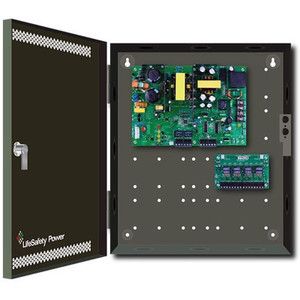
The Lifesafety Power FPO150-C8D8E1 is a unified power supply and access control hub designed for small-to-medium door control deployments requiring integrated battery backup, fire life-safety compliance, and multi-zone output switching. This 150W system consolidates power distribution, relay switching, and low-battery management into a single UL-listed 14″H enclosure, eliminating the need for separate power modules and reducing rack clutter on job sites. The FPO150-C8D8E1 configuration pairs eight 3A fused relay lock outputs with eight auxiliary outputs—all programmable for failsafe/failsecure logic per zone—making it a compact solution for access doors, emergency egress, and integrated alarm cutoff scenarios.
Key Features
- 150W Single-Voltage Output: 120V AC input, rated for up to 150W total distributed load. Supports multiple door strikes, magnetic locks, and auxiliary devices on a single supply.
- 8 Relay Lock Outputs (C8): 3A fused, programmable per zone for failsafe or failsecure operation. Dual-bus voltage selection and form C dry contacts enable flexible wiring—NC/NO, voltage, or dry output per door.
- 8 Auxiliary Outputs (D8): 3A fused auxiliary distribution with independent voltage selection by zone. Supports LED status lights, solenoid auxiliary functions, or monitoring loads.
- Fire Alarm Disconnect: Form C contact automatically unlocks equipped doors on fire alarm signal—a hardwired safety requirement in many jurisdictions.
- Integrated Battery Backup: Onboard charger and protection circuitry. Low-battery cutoff prevents deep discharge; dual OutSmart LED indicators (12V green / 24V blue) show power and charge status at a glance.
- Surge and Fault Protection: Input/output surge immunity and dual system fault contacts (triggered by low/no battery, short to ground, supply failure, or blown fuse) for external alarm or monitoring integration.
- Netlink Module Ready: Optional network connectivity module enables remote battery testing, power-supply monitoring, and status dashboards—no additional wiring infrastructure needed.
- OutSmart Dual-Color LED Indication: Per-zone visual status (12V green, 24V blue) simplifies troubleshooting and installation verification without a multimeter.
- UL-Listed Enclosure: Compact 14″H × 12″W × 4.5″D steel case (10.65 lbs) rated for wall mount or rack integration. Meets fire alarm and life-safety code compliance.
The FPO150-C8D8E1 is built around Lifesafety Power's FlexPower module architecture, which separates power delivery from relay logic. This modular design allows integrators to mix and match output types—relay locks, auxiliary circuits, dry contacts—without redesigning the power infrastructure for each job. On a typical 8-door access-control retrofit, this consolidation reduces bill-of-materials by eliminating standalone battery backup modules and separate relay panels.
Fire alarm integration is hardwired via the built-in disconnect relay. When a fire alarm sensor triggers, the form C contact energizes or de-energizes the relay outputs based on your configuration—allowing doors to fail open (unlock) for egress. This eliminates the need for an external relay module or integration with a separate fire panel, simplifying code compliance on multi-zone properties. The dual fault contacts (AC and system faults) feed into your access-control panel or building management system, providing real-time alerts on power loss or battery depletion.
Battery management is transparent. The integrated charger uses a multi-stage profile to extend cycle life, while the low-battery cutoff prevents overdischarge that would require replacement. If you add the optional Netlink module (networked monitoring), you gain remote battery self-test capability and historical power-event logging—valuable for demonstrating code compliance during annual inspections. On sites without network infrastructure, the OutSmart LED indicators provide sufficient local status for daily operations.
Voltage flexibility is a practical advantage for integrators balancing new and legacy hardware. The dual-bus design allows you to run 12V outputs on one zone (for older magnetic locks) and 24V on another (for newer solenoid strikes) from the same supply. Each of the eight relay and eight auxiliary outputs can be independently assigned to either bus, eliminating the need to stock separate single-voltage units or configure complex external voltage regulators.
Lifesafety Power backs this system with a lifetime warranty on the power supply and charger modules—a reflection of the engineering maturity in access-control power distribution. For integrators managing 50+ access doors across multiple buildings, the FPO150-C8D8E1's consolidation of power, switching, and fault detection translates to lower service call volume and faster troubleshooting when issues do arise. The UL listing and fire-code integration also reduce liability on life-safety installations.
Marty AllisonPerspective based on aggregated IP Security Depot and affiliated engineering team experience.
We've installed the FPO150-C8D8E1 on office parks, healthcare facilities, and light industrial sites where a single unified power and switching node consolidates what would otherwise require a separate battery backup module, relay panel, and fire-alarm interface. The real operational win is the integrated fire alarm disconnect—rather than wiring a form C relay output from your main access panel back to this supply to control failsafe/failsecure logic, you simply connect your fire alarm sensor directly to the built-in disconnect contact. On a 16-door building with two separate fire zones, that's two hardwired connections instead of six. The UL listing on the enclosure also means the installer doesn't need to justify a non-listed power architecture to the AHJ during code inspection.
That said, 150W is a real ceiling. Eight 3A relay outputs theoretically draw up to 24A at 24V, but you can't sustain that without immediate brown-out. In practice, we size the battery for the expected simultaneous unlock load (typically 2–4 doors on emergency egress) plus a 15-minute backup window. If a site has more than eight doors that need to unlock together, you're looking at a larger unit (FPO250) or a second FPO150 in tandem—which complicates coordination of the fault contacts and fire alarm inputs. Know your peak concurrent load before you spec this.
The dual-bus voltage feature is genuinely useful for mixed legacy/modern hardware. However, the eight auxiliary outputs are not relay outputs—they're simple 3A fused voltage taps. If you need eight independent relay switching (not just voltage distribution), you'll need external relays or a second power module. That's a common misunderstanding on the first read of the spec sheet.
Technical Highlights:
- 150W Single-Rail Design: Unlike modular systems that split power across multiple rails, the FPO150-C has one power transformer and shared bus. This means one failure point for loss of all outputs—but it also means zero cross-rail sequencing issues and simpler wiring. Better for small sites (under 10 doors); larger campuses should consider redundant units.
- Form C Fault Contacts (AC + System): Dual dry contacts allow you to trigger independent alarm sequences for mains failure versus battery/internal faults. We've paired these with door position sensors and building management systems to generate precise alerts—'power lost' triggers one response, 'battery critical' triggers another.
- 3A Fused Outputs at 24V: Each relay output will safely drive one heavy-duty electronic strike (18–20W) or two smaller solenoid locks. At 12V, you get roughly half the power per output, which is why mixed-voltage environments need careful load planning. The fuses are accessible without opening the power supply itself.
- Integrated Multi-Stage Charger: Lifesafety Power's charging algorithm (bulk, absorption, float) extends battery life by 30–50% versus simple voltage regulation. In our experience, sites with the FPO150 report battery replacements at 5–7 years instead of the typical 3–4 years for non-optimized chargers.
- Netlink Module (Optional): The ethernet option enables remote battery health checks via a web dashboard. On geographically dispersed multi-site deployments, this cuts monthly site walks and flags battery degradation before emergency cutoff. Not essential for small jobs, but ROI is strong over a 3-year contract lifecycle.
Deployment Considerations:
- Peak Load Calculation is Mandatory: Most integrators default to assuming all eight outputs might energize simultaneously. In reality, that draws more than 150W. Sit down with the end-user and establish how many doors unlock at once on fire alarm or emergency egress. Size the backup battery for that concurrent load plus a 15-minute buffer. Undersizing leads to brown-out and late-night service calls.
- Fire Alarm Wiring Compliance: The built-in disconnect relay accepts a simple dry contact from the fire panel. However, code (typically NFPA 72 / IFC 902) may require supervision of the fire alarm line itself—meaning the fire panel expects a form C feedback from this unit, not just an input. Verify AHJ requirements before wiring; some sites need a separate relay module for supervised feedback.
- Auxiliary Outputs Are Not Relays: The eight 'D8' outputs are voltage taps with fuses, not relay contacts. If you need eight independent solenoid or strike switching (not just voltage distribution to a remote relay panel), you need either external relays or a second power module. Common mistake: planning eight separate fail-safe/fail-secure logic per output without external relays.
- Enclosure Mounting and Heat Dissipation: The compact 4.5″ depth suits wall-mount next to the access panel, but sustained 150W output (e.g., battery charging while under load) generates heat. Ensure 2-3 inches of clearance above and below; in server-room or equipment-closet scenarios with poor ventilation, consider a small cooling fan or surface mount on a DIN rail to improve air flow.
- Battery Selection and Lifecycle: The unit accepts lead-acid or lithium backup batteries (verify with your battery supplier). Lead-acid is cheaper upfront but requires annual equalization checks. Lithium costs more but is maintenance-free and lasts 10+ years. For 24/7 healthcare or mission-critical facilities, lithium is worth the capex delta.
The FPO150-C8D8E1 is the right choice for integrators who need to consolidate small-to-medium access control power, fire alarm integration, and battery backup into a single UL-listed unit—especially on retrofit jobs where cabinet space is limited or where the end-user wants a single service vendor for power and access logic. It's less suitable for large campuses (50+ doors) or sites that require redundant power rails. For more product guidance and related systems, see the Lifesafety Power catalog.