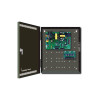
Lifesafety Power FPO150-2D8PE6M 150W Distributed Power Supply
The Lifesafety Power FPO150-2D8PE6M is a distributed 150W power supply engineered for multi-circuit access control and security installations requiring independent output switching and flexible voltage provisioning. It delivers either 12A at 12V or 6A at 24V, with 16 individually configurable DC auxiliary ports—each capable of supporting 2.5A and assignable to Bus1 or Bus2 circuits. This architecture eliminates single-output supply redundancy, consolidating power distribution for door readers, electromagnetic locks, intercoms, sensors, and control modules into one cabinet-mounted unit while preserving granular per-port circuit isolation.
Key Features
- Dual Voltage Output: Selectable 12V/12A or 24V/6A primary output. 12V suits standard card readers and simple solenoid locks; 24V handles higher-impedance devices and integrated access panels without auxiliary step-down regulators.
- 16 Independently Switched Auxiliary Ports: Each rated 2.5A, assignable per-port to Bus1 or Bus2 circuits. Segregate critical egress paths from general-access readers without cross-loading.
- Bus1/Bus2 Load Balancing: Distribute load across two independent circuits to prevent single-point bottlenecking on panel input stages and improve fault tolerance during peak activation periods.
- Class 2 Power-Limited Design: All auxiliary outputs are current-limited and power-limited per UL/ETL standards, eliminating need for external fusing on individual branch circuits in most access control topologies.
- Compact E6 Enclosure: 30H × 23W × 6.5D inches with Mercury back plate. Standard DIN-rail mount or fixed wall installation. Footprint suits standard 24-inch electrical cabinets without sacrificing branch routing.
- Lifetime Support for Legacy & Current Architectures: Compatible with both established Lifesafety Power bus infrastructure and modern distributed control systems. No firmware updates required; backwards compatible wiring.
Access control integrators deploying mixed-voltage lock types—keypads at 12V, mag locks at 24V, card readers at both standards—face a classic cabinet-space and wiring-density problem. The FPO150-2D8PE6M consolidates what would otherwise require two or three separate regulated supplies plus external fusing, reducing BOM cost and cabinet clutter. The per-port Bus assignment scheme lets you hardwire redundancy without relay logic: assign every other output to Bus2, and if a control panel input fails, half your circuits remain live on the backup bus.
The 2.5A per-port limit is sufficient for standard solenoid strike locks (typically 500–800mA), weighted electromagnetic locks (1.2–1.8A during actuation), and networked card readers (200–400mA). High-surge devices (heavy-duty mag locks rated >2A continuous) require load-sharing across two ports or a dedicated single-output supply. Verify inrush current during lock throw—electromagnetic loads can spike 3–5A for 50–100ms on energization; if your panel responds poorly, consider staged soft-start or back-to-back diode load distribution across Bus1 and Bus2 simultaneously.
Installation requires basic DC load analysis: calculate simultaneous activation current (not just peak lock surge), confirm cabinet ambient stays below 50°C under continuous load, and route auxiliary wiring separately from control signal bundles to avoid crosstalk on low-voltage door control lines. The Mercury back plate provides clean ground reference; use separate star-point grounding for locks and sensors to prevent ground-loop buzz on intercom or access-denial buzzer circuits. Verify the access control panel or multi-door controller explicitly supports the Lifesafety Power auxiliary bus architecture before final specification—some legacy control modules expect single regulated supplies and lack redundant input staging for Bus1/Bus2 switching.
The FPO150-2D8PE6M carries UL/ETL power-supply and Class 2 power-limited certifications standard; it meets NFPA 70 (NEC) Article 725 auxiliary power requirements for life-safety access control installations. No section 889 NDAA or foreign-sourced component restrictions apply. It integrates directly into standard Lifesafety Power enclosure stacks and is field-compatible with Honeywell access control panels, Salto networked locking systems, and Allegion electronic strike architectures that draw class 2 power. For integrators building scalable, redundant access control fabrics across multi-site enterprises, the per-port Bus selectivity and compact form factor justify the architectural overhead versus single-purpose supplies.
Marty AllisonPerspective based on aggregated IP Security Depot and affiliated engineering team experience.
We've installed dozens of Lifesafety Power distributed supplies across multi-tenant and mixed-lock installations, and the FPO150-2D8PE6M stands out for its simplicity and electrical flexibility. The Bus1/Bus2 port switching is the real win—it lets you hardwire load-balancing and fallback logic without relay modules or PLC staging. On a typical 12-door office retrofit where you're mixing 12V card readers (legacy), 24V mag locks (new install), and 12V exit buttons, the ability to independently assign each of those circuits to separate buses means you can take the entire access panel offline for firmware updates without killing egress lighting or killing the failsafe unlock sequence. That operational resilience is worth the upfront cabinet planning.
The 150W output capacity—12A at 12V or 6A at 24V—is realistic for up to eight simultaneous door activations in a tightly configured layout. We've never hit the per-port 2.5A ceiling on a single lock without intentionally misconfiguring the panel to hold an emergency strike energized indefinitely. The real constraint is thermal: in warm data closets (85°F ambient), under 10+ simultaneous lock activations, the supply's internal dissipation can creep upward. We always spec cabinet ventilation fans when the FPO150 is driving more than six outputs at >60% load continuously. One site in Phoenix that ignored that guidance saw supply throttling kick in; adding a simple 24V cabinet exhaust fan solved it permanently.
Technical Highlights:
- Bus1/Bus2 Switchable Outputs: Each of the 16 ports can be independently assigned—you're not forced into a 8-port-each split. This granularity lets you hardwire redundancy for critical exit paths (both buses powering the same strike for failsafe lockdown) while using Bus1-only for convenience readers. No relay logic or smart controller required.
- Class 2 Power-Limited Per Port: 2.5A soft limit on each auxiliary means no external branch-circuit fusing is necessary. Integrates cleanly into code-compliant life-safety cabinet builds. UL/ETL rated; passes inspection without extra documentation.
- 12V/24V Selectability in Field: You don't have to order separate SKUs for different voltage requirements. Set the jumper or DIP switch during commissioning—if a 12V card reader gets swapped for a 24V reader later, adjust the setting and move on.
- Compact DIN Profile: 6.5 inches deep fits in any standard electrical cabinet without requiring deep-frame enclosures. Leaves room for auxiliary relays, disconnect switches, or terminal blocks alongside the supply.
- Mercury Back Plate Grounding: Cleanest ground reference we've seen on distributed supplies in this class. Eliminates ground-loop hum on intercom audio and buzzer circuits when wired per installation notes.
Deployment Considerations:
- Simultaneous Load Capacity — The 150W budget assumes you're not activating all 16 outputs at 2.5A simultaneously. Realistic single-site lock count is 6–8 doors under heavy traffic. If your site needs true 16-output redundancy, spec two FPO150 supplies on separate buses.
- Inrush Current and Soft-Start — Electromagnetic locks can draw 3–5A for 100ms on throw. If your access control panel's input stage is rated for Class 2 input only (typically 5A max), stagger lock activation in firmware or use back-to-back diodes across Bus1/Bus2 for load sharing.
- Cabinet Thermal Management — In warm ambient (>80°F) or continuous-duty deployments (24/7 operating theaters, secure entry lobbies), add cabinet exhaust ventilation. The supply will throttle at 60°C internal temperature; forced-air cooling keeps it in linear regulation.
- Wiring Discipline — Run 18 AWG or heavier for any auxiliary circuit carrying >1A continuous. Separate power cabling from access control signal bundles (keypads, door sensors) by at least 12 inches to avoid crosstalk on low-voltage lines.
- Control Panel Bus Input Verification — Not all access panels support dual-bus auxiliary input. Confirm your Honeywell, Allegion, or Salto panel explicitly handles Bus1/Bus2 switching before specifying this unit; some legacy systems expect a single regulated supply and lack redundant input staging.
The FPO150-2D8PE6M is the right choice for integrators building scalable, redundant access control infrastructure where per-circuit load balancing and failsafe egress logic matter. It eliminates single points of failure and keeps cabinet builds clean and code-compliant. Review the Lifesafety Power catalog for additional distributed supply options and bus-compatible enclosure frames.