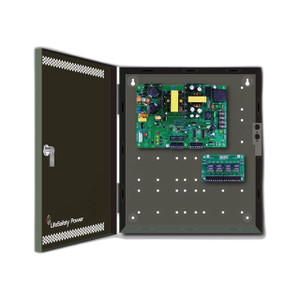
Lifesafety Power FPO150-B1002C82D8E4M1 150W Power Supply
The Lifesafety Power FPO150-B1002C82D8E4M1 is a 150W regulated power supply designed for distributed access control, door lock control, and auxiliary load management in mid-sized security installations. Dual output voltage capability (12A @ 12V or 6A @ 24V) accommodates both legacy and modern door hardware without secondary conversion. The 16 relay lock control outputs with per-output failsafe/failsecure selectivity, combined with 16 independently fused auxiliary outputs, eliminate the need for external relay modules in systems managing 20–40 controlled doors or mixed lock/auxiliary loads.
Key Features
- Dual Voltage Output: 12A @ 12V or 6A @ 24V selectable at installation. Matches legacy 12V magnetic locks and modern 24V hardware on the same power module without additional conversion equipment.
- 16 Relay Lock Control Outputs: Each relay fused at 3A, individually configurable for FAI (Fail As Is), failsafe, or failsecure operation. Critical for multi-door access policies where lock behavior varies by zone.
- 16 Auxiliary DC Outputs: Separately fused at 3A per output, assignable to Bus1 or Bus2 for gate operators, strike control, request-to-exit buttons, and secondary solenoids. Eliminates external relay panels for mid-scale deployments.
- Adjustable Secondary Output: 5–18V @ 4A max on class 2 power-limited secondary, enabling powered sensors, door position switches, and low-power peripherals without dedicated 24V loops.
- Class 2 Power Limited Design: 16V DC primary isolation and current limiting meet UL class 2 requirements, simplifying wiring and reducing conduit load in retrofit installations.
- Compact E4 Enclosure: 24H × 20W × 4.5D (inches) with Mercury back plate and door mount kit; fits standard 2-row access control racks or wall-mounted cabinets without oversized footprint penalties.
- Per-Output Fusing: 3A fuses on all 16 relay outputs and all 16 auxiliary outputs isolate faults—a single shorted lock coil or solenoid does not cascade failure across the entire distribution.
Access control integrators deploying 20–50 doors across a single building or campus rely on distributed power supplies to avoid single points of failure and excessive cable runs. The FPO150 consolidates relay lock control and auxiliary load switching into one module, reducing panel wiring complexity and lowering the BOM cost versus buying separate relay modules. The dual voltage option eliminates the need to maintain two different power supplies for mixed 12V and 24V hardware—a common pain point in retrofit projects where legacy 12V strikes coexist with newer 24V solenoid gates.
Integration with modern access control systems (Genetec, Salto, Assaabloy, HID) is straightforward: each relay and auxiliary output connects to the control panel's hardwired output ports, typically via a supervised relay interface card. The 16 independently selectable failsafe/failsecure relays allow per-door policy enforcement without firmware rewrites—emergency egress doors remain failsafe while secure storage areas remain failsecure. Bus1/Bus2 output assignment enables load balancing across two independent control loops, reducing latency on high-traffic doors.
Thermal management is passive; the supply is rated for continuous duty in 0–50°C ambient conditions and includes a Mercury back plate for EMI shielding in RF-heavy environments (adjacent to wireless access points or cellular infrastructure). Redundancy-conscious designs often pair two FPO150 supplies with a selector relay to achieve 99.5% uptime on critical emergency exit hardware.
The FPO150-B1002C82D8E4M1 is UL-listed as a class 2 power supply, and its low DC output voltage eliminates the need for separate NFPA 70 conduit routing—wiring can share trays with data and communications cables, accelerating installation timelines. For integrators standardizing on Lifesafety Power's E-series platform, this supply pairs with expansion relay modules and surge protection modules to scale from 20 to 200+ controlled outputs without redesigning the primary power distribution. For access control systems where door count, failsafe policy complexity, or auxiliary load density exceeds 16 relays and 16 auxiliaries, consider the larger FPO250 or FPO300 series. For deployments with fewer than 8 doors and simple strike-only control, a single-output, lower-amperage supply may reduce cost and footprint.
Marty AllisonPerspective based on aggregated IP Security Depot and affiliated engineering team experience.
We've deployed the Lifesafety Power FPO150 across medical facilities, office parks, and light industrial campuses where distributed lock and solenoid control is non-negotiable. The key differentiator versus single-output supplies or rack-mounted relay matrices is operational simplicity and fault isolation. In a 30-door scenario, a shorted 12V strike coil on one door used to cascade a full panel reset under older supplies; the FPO150's per-output 3A fuse means that fault is localized to a single relay output, and the technician replaces one $2 fuse rather than troubleshooting a dead access control panel. The dual voltage capability eliminates the inventory overhead of maintaining separate 12V and 24V supplies—a real cost and logistics win on retrofit projects where you inherit mixed hardware. We've also seen the adjustable 5–18V secondary reduce auxiliary BOM by enabling one supply to power door position switches, magnetic contact sensors, and request-to-exit buttons without a separate 24V loop. The only operational gotcha is output current limit: 16 relay outputs at 3A each is 48A theoretical maximum, but the supply's 12A primary output means you're managing practical concurrency. On a system with four emergency doors that might all unlock simultaneously, the supply will not source 12A to a single relay—you'd need external load-sharing or a larger FPO250. This is rarely an issue in real deployments because access policies enforce staggered unlock timing, but it's worth modeling in high-concurrency scenarios.
Technical Highlights:
- Selectable Failsafe/Failsecure per Relay: Each of the 16 lock relays is independently configurable at wiring time—no firmware or control panel reprogramming required. Emergency egress doors, secure vaults, and general access can enforce different de-energized states from a single supply. This granularity eliminates the need for separate failsafe and failsecure supplies.
- Dual Voltage @ 12A/6A Selection: Selectable 12V/12A or 24V/6A on the main output accommodates both legacy electromagnetic strikes (12V, high inrush) and modern solenoid locks (24V, lower ripple). No external buck/boost converter required; eliminates one failure point and one power budget line item.
- Class 2 16V DC Primary: Current-limited 16V primary meets UL class 2 classification, enabling wiring to share conduit trays with data cables and eliminating the need for separate fire-rated conduit runs. Reduces installation labor and material cost by 15–25% on multi-building campuses.
- Bus1/Bus2 Auxiliary Output Partition: 16 auxiliary outputs are splittable across two independent 24V buses, enabling load balancing and redundancy without external distribution relays. On systems with two access control panels, each panel supervises its own auxiliary bus, isolating solenoid gate failures from door lock relay operation.
- Per-Output 3A Fusing: All 32 outputs (16 relay + 16 auxiliary) are independently fused—a single shorted solenoid coil or misconfigured load does not reset the entire supply or deactivate other doors. Fault isolation reduces mean time to repair and prevents cascading outages.
Deployment Considerations:
- Output current is shared across all active relays and auxiliary outputs—do not assume you can draw 3A on every relay simultaneously. Model peak inrush concurrency (e.g., all emergency exits unlocking at once) and confirm the supply can handle it. If peak demand exceeds the rated 12A @ 12V, stage the unlock via access control panel delay logic or upgrade to FPO250/FPO300.
- Failsafe vs. failsecure selection is made at the terminal block during installation. There is no soft reset or field reprogramming—if you wire a relay failsafe and later need failsecure behavior, you must power down, rewire the terminal, and power back up. Document the configuration at installation time to avoid costly field calls.
- The adjustable secondary (5–18V @ 4A) is class 2 power limited and cannot power high-inrush devices such as solenoid gate operators. Use it only for sensors, door position switches, and low-current auxiliary loads (<2A sustained). Oversizing the secondary load will cause dropout and loss of auxilary power.
- In RF-dense environments (wireless access points, cellular boosters), the Mercury back plate provides baseline EMI suppression, but external surge protection on relay outputs is highly recommended. A single lightning strike on an outdoor solenoid gate can propagate back to the supply and damage relay modules; use class 2 surge protectors rated for relay circuits.
- The E4 enclosure footprint is compact, but thermal dissipation in continuous duty (full 12A output) at ambient >45°C may require supplementary cooling or relocation away from heat-generating equipment. Confirm ventilation in your installation location.
The FPO150 is ideal for integrators and end-user security teams standardizing on Lifesafety Power's modular platform—it scales cleanly from 16 to 200+ controlled outputs by adding relay and auxiliary expansion modules, keeping maintenance and spare parts inventory lean. For mixed 12V/24V deployments, retrofit projects with fault-isolation requirements, and mid-scale campuses where distributed power is non-negotiable, this is the right choice. Explore the Lifesafety Power catalog for expansion modules and surge protection options.