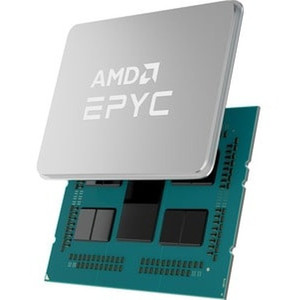
Lenovo 4XG7A63600 AMD EPYC 72F3 8-Core Processor for ThinkSystem SR645
Overview
The Lenovo 4XG7A63600 is an AMD EPYC 72F3 processor option for the ThinkSystem SR645 platform — an 8-core, 16-thread CPU clocked at 3.7 GHz base with a 4.1 GHz boost frequency. Designed specifically for server and workstation environments, the 72F3 targets workloads that benefit from high per-core clock speed over raw core count: database engines, EDA tools, per-core-licensed software stacks, and latency-sensitive compute tasks where fewer, faster cores outperform wider, slower configurations.
With a 256 MB L3 cache and Socket SP3 compatibility, this processor slots into the Lenovo ThinkSystem server SR645 chassis and brings AMD EPYC's memory bandwidth architecture with it — supporting DDR4-3200 for maximum throughput on memory-bound workloads. If you're specifying or upgrading an SR645 for a datacenter server deployment, the 4XG7A63600 is a focused choice for environments where per-thread performance is the limiting factor.
Key Features
- 3.7 GHz Base / 4.1 GHz Boost: The 72F3's high base clock means sustained performance under load — not just burst. For database transactions or per-core-licensed software (Oracle, SAP, VMware vSphere per-CPU), fewer cores at higher frequency translates directly to lower license costs and predictable throughput without thermal throttle risk on sustained workloads.
- 8 Cores / 16 Threads (Socket SP3): At 8 cores, this processor fits right-sized deployments where a 32- or 64-core part would waste licensed capacity or overspec a single-tenant VM host. SR645 supports dual-socket, so a two-processor SR645 config with dual 4XG7A63600 gives you 16 physical cores / 32 threads — enough for a dense VMware or Hyper-V edge node without burning datacenter power budget on unused cores.
- 256 MB L3 Cache: EPYC's large L3 cache — 256 MB on the 72F3 — keeps hot data resident and reduces main-memory round-trips. For analytics databases (PostgreSQL, MySQL, MSSQL) running moderately large working sets, this directly reduces query latency without needing to tune buffer pool sizes aggressively.
- DDR4-3200 Memory Support: The 72F3 runs memory at up to 3200 MHz, the fastest DDR4 speed tier. On the SR645 platform with its EPYC memory controller, this maximizes bandwidth for memory-bound workloads — video transcoding pipelines, in-memory analytics, real-time telemetry ingestion — without requiring exotic RDIMM configurations.
- 180W TDP (Configurable 165W–200W): The 180W nominal TDP is configurable down to 165W (TDP-down) for thermally constrained deployments — edge racks, telecom closets, or environments where cooling headroom is limited. The 200W TDP-up setting unlocks additional sustained frequency for workloads that can justify the extra thermal envelope and power budget.
- 64-bit Operating Modes: Full 64-bit support means no OS or hypervisor restrictions. Pair with any current Linux distribution, Windows Server, or VMware ESXi release without compatibility caveats.
- No Cooler Included: The 4XG7A63600 ships as a processor option only — the SR645 chassis supplies its own active cooling infrastructure. This is standard for server-grade CPUs; the platform's hot-plug fan modules are rated for the thermal requirements of the EPYC 72F3, so no third-party cooling solution is required when installing into a proper SR645.
Integration & Compatibility
The 4XG7A63600 is qualified for the ThinkSystem SR645 server platform. Socket SP3 is AMD's EPYC server socket (Naples/Rome/Milan generation), so this processor is not compatible with desktop AM4/AM5 boards or consumer platforms. Confirm your SR645 firmware level before installation — EPYC Milan-generation processors may require a UEFI update on earlier SR645 build revisions. DDR4-3200 RDIMMs or LRDIMMs are the appropriate memory pairing; check the SR645 memory configuration guide for validated DIMM populations at this speed grade. For network infrastructure planning in SR645 deployments, note that PCIe lane allocation and NIC selection remain governed by the SR645 platform spec, not the CPU SKU alone.
Frequently Asked Questions
Q: What server platform is the Lenovo 4XG7A63600 compatible with?
A: The 4XG7A63600 is designed for the Lenovo ThinkSystem SR645 server. It uses Socket SP3 and is not compatible with desktop or workstation platforms using AMD AM4, AM5, or TR4 sockets.
Q: Does the 4XG7A63600 include a heatsink or cooling solution?
A: No. This is a processor-only option. The ThinkSystem SR645 chassis provides its own active cooling infrastructure rated for the 72F3's thermal envelope. No additional cooler is required when installing into a standard SR645 system.
Q: What is the maximum memory speed supported by the EPYC 72F3 processor?
A: The AMD EPYC 72F3 supports DDR4-SDRAM at up to 3200 MHz. Consult the SR645 memory configuration guide for validated DIMM populations and channel configurations at this speed.
Q: Can the TDP be adjusted on the 4XG7A63600?
A: Yes. The 72F3 has a nominal 180W TDP with a configurable TDP-down of 165W for thermally constrained environments and a configurable TDP-up of 200W for maximum sustained performance where thermal and power budgets allow. This is configured via BIOS/UEFI settings on the SR645.
Q: Is the EPYC 72F3 a good fit for per-core-licensed software?
A: It can be, depending on licensing model. The 72F3 offers 8 cores at high clock speed (3.7 GHz base, 4.1 GHz boost), which suits workloads where fewer, faster cores reduce license costs compared to higher core-count EPYC options. Verify your specific software vendor's licensing terms before specifying.
Q: What is the L3 cache size on the AMD EPYC 72F3?
A: The EPYC 72F3 features 256 MB of L3 cache, which helps keep active working sets resident and reduces main-memory latency for database and analytics workloads.
The 4XG7A63600 is one of the more interesting EPYC processor options for the SR645 because of how it breaks from the typical 'more cores = more value' server procurement logic. At 3.7 GHz base and 4.1 GHz boost across just 8 cores, the 72F3 is purpose-built for workloads that can't parallelize efficiently — single-threaded database operations, legacy ERP engines, or any stack where per-core software licensing makes a 32-core part an expensive liability rather than an asset.
Technical Highlights:
- 3.7 GHz / 4.1 GHz Clock Range: Among EPYC SKUs, the 72F3 sits at the high-frequency end of the stack. Sustained base clock at 3.7 GHz means you're not gambling on boost availability under thermal load — workloads that run hot get consistent throughput.
- 256 MB L3 Cache: EPYC's chiplet architecture gives the 72F3 a disproportionately large cache for an 8-core part. Databases with hot working sets under 256 MB can effectively run from cache, cutting DRAM latency out of the critical path on repeated queries.
- Configurable TDP (165W–200W): The ability to dial down to 165W TDP-down is a real deployment lever for edge or telco environments where rack power is allocated in 200W slabs per U. Running the SR645 at TDP-down preserves headroom for NVMe drives and dual-port 25GbE NICs without tripping PDU breakers.
Deployment Considerations:
- No cooler is included — standard for this class. The SR645's fan infrastructure is already validated for the 72F3's 180W envelope, so don't spec an aftermarket heatsink; it won't fit and isn't needed.
- The Socket SP3 footprint is large and the 72F3 is a Milan-generation part. Verify SR645 UEFI firmware version before installing — early SR645 builds shipped before Milan support was added and will require a firmware update before POST completes successfully.
For an SR645 deployment running a heavily licensed Oracle or SQL Server workload where per-core licensing is the dominant cost driver, the 72F3 is the right call over a 32- or 64-core EPYC — you pay for 8 license units, not 32, and the 3.7 GHz base keeps individual query latency in check on OLTP workloads that can't spread across cores efficiently.