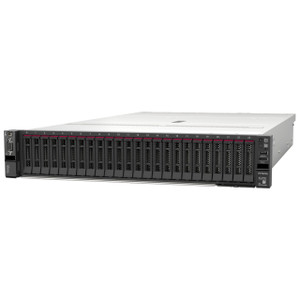
Lenovo 4XG7A63591 AMD EPYC 7443P 24-Core Processor Option for ThinkSystem SR645
Overview
The Lenovo 4XG7A63591 is a factory-configured processor option that installs the AMD EPYC 7443P into the ThinkSystem SR645 server platform. The 7443P is a 24-core, 48-thread chip built on AMD's 7nm process node — a generation step that delivers meaningful performance-per-watt improvement over prior EPYC families. At 2.85 GHz base with a 4.0 GHz boost, it handles both sustained multi-threaded workloads and latency-sensitive single-threaded tasks without requiring a separate high-frequency SKU. If you're sizing compute for a dense network video recorder backend, a VMS analytics server, or a virtualization host running parallel AI inference streams, this processor tier is worth a close look.
This is a Lenovo-factory option part — sourced factory-new to slot directly into the SR645 platform without compatibility guesswork. The 4XG7A63591 part number maps to a specific Lenovo bill-of-materials position, which matters for warranty alignment and firmware validation on the SR645.
Key Features
- 24 Cores / 48 Threads at 7nm: AMD's 7nm lithography keeps power density in check while delivering thread counts that sustain parallel analytics pipelines — relevant when your VMS is running simultaneous motion detection, object classification, and video transcoding across dozens of camera streams. More threads mean fewer queuing delays under peak load.
- 2.85 GHz Base / 4.0 GHz Boost: The 1.15 GHz headroom between base and boost gives the scheduler room to accelerate single-threaded bursts (codec decode, database lookups, API calls) without running the chip at full TDP continuously. For mixed workloads — batch analytics plus live streaming — this range is practical rather than just a spec-sheet number.
- 128MB L3 Cache: One of the defining characteristics of the EPYC 7003 family is the large on-die L3. At 128MB, working datasets for in-memory analytics, frame buffers, or database hot paths stay on-chip longer, reducing the latency penalty of reaching out to main memory. This matters in real-time inference workloads where cache misses accumulate into visible frame-rate drops.
- Octa-Channel DDR4-3200 Memory Interface: Eight memory channels at 3200 MHz yield a theoretical peak bandwidth of 204.8 GB/s — enough headroom to feed 24 cores without creating a memory bottleneck. For video analytics servers ingesting high-bitrate streams from many cameras simultaneously, memory bandwidth is often the constraint that limits camera-per-server density. This bandwidth ceiling is high enough that storage I/O typically becomes the bottleneck first.
- 200W TDP: The 200W envelope is on the upper end of single-socket EPYC configurations. Plan thermal and power delivery accordingly: the SR645 chassis and PSU are designed for this range, but cooler selection matters — this processor option does not include a cooler, so verify your SR645's thermal solution is rated for 200W TDP before deploying.
- Socket SP3 Platform: SP3 is the standard EPYC 7002/7003 socket, which means the SR645 platform can also accept lower-TDP or lower-core-count EPYC options if your workload profile changes. The socket stays constant; the processor option changes. This is relevant for lab or staging environments where you might prototype at a lower cost point before scaling.
- 64-Bit Operating Mode: Full 64-bit instruction support is table stakes for any modern server OS and hypervisor. Linux, Windows Server, VMware ESXi, and Proxmox all run without limitation. No legacy 32-bit compatibility constraints to manage.
Integration & Compatibility
The 4XG7A63591 is validated for the Lenovo ThinkSystem SR645 platform. Lenovo's option part system ties processor options to specific server generations — installing a non-validated processor introduces firmware and warranty risks on enterprise platforms. If you're deploying the SR645 as a compute server for security infrastructure — running Genetec Security Center, Milestone XProtect, Axis Camera Station, or similar enterprise VMS — the EPYC 7443P's thread count and memory bandwidth make it a reasonable match for mid-to-large camera deployments.
For teams building out a broader physical security infrastructure, pair the SR645 compute layer with appropriately matched NVR appliances or a software-defined VMS stack. The processor's 204.8 GB/s memory bandwidth and 24-core count support GPU passthrough configurations in virtualized environments, which matters if you're adding AI-accelerated analytics cards to the same chassis.
Storage architects integrating this platform into a network infrastructure stack should note that octa-channel DDR4-3200 leaves bandwidth headroom for NVMe storage controllers and RAID expansion without CPU-side memory contention becoming the limiting factor. Consult Lenovo's SR645 configuration guide for validated memory and storage option combinations.
Frequently Asked Questions
Q: Is the Lenovo 4XG7A63591 compatible with ThinkSystem SR645?
A: Yes. The 4XG7A63591 is a Lenovo factory option part specifically validated for the ThinkSystem SR645 platform. It installs the AMD EPYC 7443P processor into SR645 server configurations.
Q: Does the 4XG7A63591 include a CPU cooler?
A: No. This processor option does not include a cooler. Verify that your SR645 chassis is equipped with a thermal solution rated for the 7443P's 200W TDP before installation.
Q: What is the processor socket for the AMD EPYC 7443P in the 4XG7A63591?
A: Socket SP3 — the standard socket used across the AMD EPYC 7002 and 7003 processor families on enterprise platforms like the SR645.
Q: How many memory channels does the EPYC 7443P support, and what DDR4 speeds are validated?
A: The 7443P supports octa-channel (8-channel) DDR4-SDRAM at up to 3200 MHz, delivering a theoretical peak memory bandwidth of 204.8 GB/s.
Q: What is the TDP of the 7443P processor in this option kit, and does it affect PSU selection?
A: The 7443P carries a 200W TDP. The SR645 platform accommodates this power envelope, but ensure your power supply and data center power allocation account for it — particularly in dual-socket configurations or high-density rack deployments.
Q: What is the L3 cache size on the EPYC 7443P?
A: 128MB of L3 cache. This on-die cache capacity reduces main memory latency for analytics and in-memory database workloads common in VMS server deployments.
The 4XG7A63591 is one of those option parts that looks straightforward on paper but carries a few real-world implications worth flagging before you finalize a bill of materials. The EPYC 7443P's 128MB L3 cache is the spec I'd point to first — in analytics-heavy VMS deployments, that cache depth keeps decoded frame data and classifier model weights on-chip far longer than smaller-cache alternatives, which translates directly to lower inference latency per stream.
Technical Highlights:
- 24C/48T at 7nm: Thread density at this level supports 30–60+ concurrent camera analytics streams without the scheduler becoming a bottleneck — the number varies by codec and model complexity, but this is the processor range where software-defined VMS deployments stop being CPU-limited.
- 204.8 GB/s Memory Bandwidth: Octa-channel DDR4-3200 is meaningful for GPU-adjacent workloads. If you're adding an analytics accelerator card, the CPU won't be memory-starving the PCIe data path — the bandwidth ceiling is high enough that the GPU itself becomes the constraint.
- 4.0 GHz Boost Frequency: Single-threaded boost to 4.0 GHz handles the serial portions of video pipeline processing (demux, container parsing, session management) without requiring a separate high-clock SKU alongside a high-core-count part.
Deployment Considerations:
- No cooler is included with this option — this is an OEM-configured option part for the SR645 platform. Confirm the SR645 chassis thermal kit is already in place before ordering; adding a thermal solution post-order extends integration time.
- At 200W TDP, this is one of the higher-power single-socket EPYC configurations available for the SR645. In a fully loaded dual-socket SR645 build, both sockets at 200W plus memory, drives, and accelerators can push total system draw above 1kW — size PDU and UPS capacity accordingly.
For a security operations center deploying a software-defined VMS at scale — running Milestone XProtect or Genetec on bare metal with 64–128 cameras and AI-accelerated motion analytics — the EPYC 7443P's combination of thread count, cache depth, and memory bandwidth positions the SR645 as a capable single-chassis solution without requiring immediate scale-out.