Lenovo 4XG7A63595 AMD EPYC 73F3 16-Core Server Processor
Overview
The Lenovo 4XG7A63595 is an AMD EPYC 73F3 processor option for the ThinkSystem SR645 server platform — a 16-core, 32-thread chip built specifically for workloads that demand sustained high clock speed over maximum thread count. At a 3.5 GHz base and 4.0 GHz boost, the 73F3 runs faster per core than most EPYC variants in its tier, which translates directly into lower latency for per-thread-sensitive tasks: database query execution, VMS analytics engines, real-time video decoding, and license-server workloads that don't parallelize cleanly across dozens of cores.
For integrators and IT architects evaluating compute platforms for enterprise server deployments, this option makes the most sense when you need strong single-threaded throughput on the SR645 chassis rather than raw core density. The 73F3 is a deliberate tradeoff — fewer cores, higher clocks — and that distinction should drive your selection decision.
Key Features
- 3.5 GHz Base / 4.0 GHz Boost Clock: The 73F3 boosts 500 MHz above its base more aggressively than many EPYC 7003-series parts. For NVR and VMS server builds running Milestone, Genetec, or Avigilon software — where analytics decode pipelines and SQL query threads are often the bottleneck — higher per-core clock speed reduces frame-processing latency in ways that adding more slower cores cannot.
- 16 Cores / 32 Threads (7nm Lithography): TSMC's 7nm node gives the 73F3 a favorable performance-per-watt ratio relative to previous EPYC generations. At 240W TDP, you're powering 16 high-frequency cores — workloads that previously required two physical processors can now consolidate onto a single socket without the interconnect overhead of dual-socket configurations.
- 256MB L3 Cache: This is the 73F3's headline specification and the primary reason to choose it over higher-core-count alternatives. 256MB of on-die L3 cache means large working datasets — think analytics model weights, active database buffer pools, or high-channel NVR index tables — stay resident in cache far longer, cutting memory round-trips and keeping throughput consistent under sustained load.
- Socket SP3 (AMD EPYC): SP3 is the standard socket for AMD EPYC 7002 and 7003 series processors. On the ThinkSystem SR645, this means the 4XG7A63595 is a validated option kit for a platform with a defined support matrix — you're not adapting a generic part into a chassis; you're installing a Lenovo-qualified processor upgrade that has been tested within that server's firmware and power delivery ecosystem.
- Octa-Channel DDR4-3200 Memory Support: Eight memory channels running DDR4 at 3200 MHz yield up to 204.8 GB/s of aggregate memory bandwidth. For compute tasks that are bandwidth-bound — large in-memory datasets, video frame buffers across high-channel-count NVR installs, or AI inference pipelines — that bandwidth figure determines how fast the CPU can actually be fed with data. A processor with slow per-core clocks but wide memory channels is a different tool; the 73F3 delivers both.
- 64-Bit Operating Mode: Supports full 64-bit instruction execution, which is a baseline requirement for any enterprise OS and hypervisor stack (VMware ESXi, Microsoft Hyper-V, RHEL, Ubuntu Server). No legacy 32-bit constraints on memory addressability or instruction set compatibility.
- 240W TDP: At 240 watts, thermal planning matters. The SR645 chassis is designed to handle this, but no cooler is included with the 4XG7A63595 option kit — confirm that the target system either has the required heatsink already installed or that you're sourcing the appropriate Lenovo heatsink separately before deployment.
Integration and Compatibility
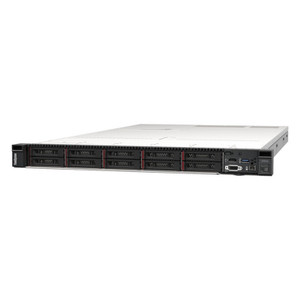
The 4XG7A63595 is a processor option kit designed for the Lenovo ThinkSystem SR645 server. Socket SP3 physically accepts AMD EPYC 7002 and 7003 series parts, but firmware-level compatibility is chassis-specific — do not assume cross-platform compatibility with non-SR645 SP3 systems without verifying Lenovo's compatibility matrix for that chassis. This processor supports datacenter compute platforms paired with DDR4-3200 registered ECC DIMMs across up to eight memory channels; memory modules are not included and must be ordered separately based on your capacity and channel-population requirements.
For security infrastructure deployments, the 73F3's clock-frequency profile makes it a candidate for single-socket video management servers handling high-channel-count analytics, particularly where per-camera deep learning inference tasks run as independent threads. Integrators building physical security compute stacks should validate VMS vendor server certification lists (Milestone, Genetec, Avigilon all publish these) against the SR645 platform before committing to this processor configuration.
Frequently Asked Questions
Q: What server platform is the Lenovo 4XG7A63595 compatible with?
A: The 4XG7A63595 is a processor option kit for the Lenovo ThinkSystem SR645. It uses Socket SP3 and is designed specifically for that platform. Verify compatibility with Lenovo's official SR645 options list before ordering for any other chassis.
Q: Does the 4XG7A63595 include a heatsink or cooler?
A: No. A cooler is not included with this option kit. You must confirm the ThinkSystem SR645 system has the appropriate heatsink installed or order one separately before installing this processor.
Q: What is the base and boost clock speed of the AMD EPYC 73F3?
A: The EPYC 73F3 runs at a 3.5 GHz base clock and boosts up to 4.0 GHz. This higher-frequency profile distinguishes it from higher-core-count EPYC options that run at lower clocks.
Q: How many memory channels does the 4XG7A63595 support, and what memory type?
A: The AMD EPYC 73F3 supports octa-channel (8-channel) DDR4-3200 memory, delivering up to 204.8 GB/s of memory bandwidth. Memory modules are not included and must be purchased separately.
Q: Why choose a 16-core EPYC 73F3 over a higher-core-count EPYC option?
A: The 73F3 trades core count for clock speed and a very large 256MB L3 cache. It is the better choice for workloads that are latency-sensitive or per-thread-bound — such as database engines, VMS analytics, or real-time decode tasks — rather than workloads that scale linearly with thread count.
Q: What is the TDP of the AMD EPYC 73F3 processor?
A: The processor has a 240W Thermal Design Power (TDP). Ensure the SR645 chassis and data center cooling infrastructure are configured to handle this thermal load before deployment.
The 4XG7A63595 is one of the more specialized processor options in the SR645 lineup — the 73F3's 256MB L3 cache is its defining characteristic, and it changes the calculus significantly for workloads where cache residency matters more than thread parallelism. If you're sizing a VMS analytics server or a database-backed access control platform, that cache figure is worth paying attention to before defaulting to a higher-core-count EPYC.
Technical Highlights:
- 256MB L3 Cache: At 256MB, the 73F3 holds substantially more data on-die than most server CPUs in its class. For NVR analytics engines or RDBMS workloads with large buffer pools, this keeps hot data resident and reduces memory controller pressure — measurable in query latency and frame-decode throughput.
- 4.0 GHz Boost / 3.5 GHz Base: The 500 MHz spread between base and boost is tight, meaning the chip sustains near-peak clocks under load rather than throttling back under sustained multi-threaded pressure. Single-threaded latency stays predictable — critical for transaction-heavy applications.
- 204.8 GB/s Memory Bandwidth (Octa-Channel DDR4-3200): Eight memory channels at DDR4-3200 give the processor enough feed bandwidth to keep all 16 cores from stalling on memory reads. This matters at scale when running multiple high-resolution video decode threads simultaneously.
Deployment Considerations:
- No heatsink is included — confirm the SR645 system has the correct Lenovo heatsink for a 240W TDP processor before scheduling installation. Installing without proper cooling will void performance guarantees and risk hardware damage.
- The 73F3 is the wrong choice if your workload scales with thread count (e.g., massively parallel transcoding or containerized microservices spread across hundreds of threads) — a higher-core-count EPYC at lower clocks will outperform it in those scenarios at equivalent TDP.
The 4XG7A63595 is the right fit for a ThinkSystem SR645 deployed as a latency-sensitive VMS analytics server or single-socket database host where per-core throughput and cache capacity drive performance — not for general-purpose high-thread-count compute workloads.