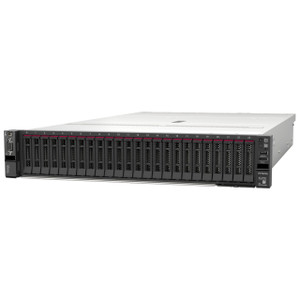
Lenovo 4XG7A63586 AMD EPYC 7453 28-Core Server Processor
Overview
The Lenovo 4XG7A63586 is the AMD EPYC 7453 processor option for the ThinkSystem SR645 server platform — a 28-core, 56-thread Milan-generation CPU built for memory-intensive workloads where core density, per-core throughput, and memory bandwidth all matter simultaneously. If you're configuring an SR645 for surveillance analytics, virtual machine consolidation, or high-density database workloads, the EPYC 7453 sits in a practical middle ground: more cores than the entry EPYC lineup, far more memory bandwidth than anything in the Intel Xeon Silver tier, and a 225W TDP that fits standard SR645 thermal envelopes without exotic cooling infrastructure. No cooler is included — plan for the server's standard heat sink kit or an appropriate third-party solution for your chassis configuration.
Key Features
- 28 Cores / 56 Threads (AMD EPYC 7453): 56 concurrent hardware threads let the SR645 run dense VM stacks or parallel analytics pipelines without thread contention. For a surveillance deployment running edge AI inference or a VMS with deep-learning analytics, that thread count means you're not sharing resources across workloads when it matters.
- 2.75 GHz Base / 3.45 GHz Boost: The 700 MHz boost headroom is useful for bursty single-threaded tasks — license-plate recognition frames, on-demand report generation, or index lookups in a database backend — without requiring you to tune the BIOS for performance mode on every chassis.
- 64 MB L3 Cache: 64 MB of shared L3 gives the EPYC 7453 substantially more on-die data residency than comparable core-count Intel options. In practice, working sets for active video streams or database hot pages are more likely to stay in cache rather than round-tripping to DRAM — measurable in sustained query throughput.
- Octal-Channel DDR4-3200 Memory Support: Eight memory channels at 3200 MHz translate to significantly higher aggregate bandwidth than quad-channel platforms. For NVR-scale workloads writing and reading simultaneous high-resolution streams, memory bandwidth is often the real bottleneck — octal-channel architecture directly addresses this.
- Socket SP3 Platform: SP3 is AMD's enterprise socket for the EPYC 7000-series. Deploying this processor into an SR645 means you're on a platform with validated firmware, BIOS microcode, and Lenovo XClarity support — not a consumer or workstation chipset pressed into server duty.
- 225W TDP (Configurable to 240W cTDP-up): The standard 225W TDP is within the SR645's thermal design, but the configurable 240W cTDP-up option gives you a performance ceiling when the workload justifies it and the chassis cooling supports it. Verify your rack's power delivery before enabling cTDP-up — at 240W, power draw on a dual-socket SR645 build adds up fast.
- 64-bit Processing Mode: Full 64-bit support is expected at this tier, but it confirms compatibility with modern hypervisors (VMware vSphere, Microsoft Hyper-V, KVM), 64-bit VMS platforms, and OS deployments without legacy constraints.
Integration & Compatibility
The 4XG7A63586 is a factory-configured processor option for the Lenovo ThinkSystem SR645 server — it is not a standalone retail CPU. It installs into the Socket SP3 ZIF socket on the SR645 motherboard and requires Lenovo-validated memory DIMMs (DDR4-3200, RDIMM or LRDIMM depending on configuration) to operate within spec. Memory channel population rules matter: to realize the full benefit of octal-channel bandwidth, DIMMs must be populated symmetrically across all eight channels per the SR645 memory population guide.
For network video recorder and surveillance server deployments, the EPYC 7453 pairs well with high-capacity storage configurations — the SR645 supports NVMe, SAS, and SATA drive bays depending on the backplane build. Pair it with adequate PoE switch infrastructure at the edge to feed camera streams reliably into the server layer. If you're building a VMS backend, verify your video management software licensing model accounts for the physical core count — some VMS platforms license per physical CPU socket or core count, and 28 cores per socket is a meaningful input to that calculation.
Lenovo XClarity Administrator and XClarity Controller are the standard management interfaces for the SR645 platform. The EPYC 7453's platform telemetry (temperature, power draw, core utilization) surfaces through XClarity and is compatible with SNMP and Redfish API management for integration into data center monitoring stacks. If you're running a datacenter server environment with existing Lenovo infrastructure, the SR645 with this processor slots into existing XClarity policies without additional configuration overhead.
Frequently Asked Questions
Q: Is the Lenovo 4XG7A63586 a standalone processor or a configured server option?
A: The 4XG7A63586 is an AMD EPYC 7453 processor option configured for the Lenovo ThinkSystem SR645 server. It is designed for installation into the SR645 platform and is not a generic retail CPU — it is validated and sourced for Lenovo's server ecosystem.
Q: Does the 4XG7A63586 include a CPU cooler?
A: No. According to the product specifications, no cooler is included. You will need to provision the appropriate heat sink — either Lenovo's standard SR645 heat sink kit or a compatible alternative — before installation.
Q: How many memory channels does the EPYC 7453 support, and what speeds?
A: The EPYC 7453 supports octal-channel (eight-channel) DDR4-SDRAM at up to 3200 MHz. To achieve maximum memory bandwidth, all eight channels should be populated symmetrically per the SR645 memory configuration guide.
Q: What is the TDP of the EPYC 7453, and can it be adjusted?
A: The standard Thermal Design Power is 225W. There is a configurable TDP-up option of 240W. Enabling cTDP-up requires verifying that your chassis, power supply, and rack cooling infrastructure can handle the additional thermal and power load — especially relevant in dual-socket SR645 configurations.
Q: Is this processor suitable for a surveillance analytics or VMS backend server?
A: Yes. The 28-core / 56-thread configuration with 64 MB L3 cache and octal-channel DDR4-3200 support makes the EPYC 7453 a practical fit for VMS backend workloads, AI-based video analytics, or VM-consolidated environments where memory bandwidth and parallel processing capacity are the primary constraints.
Q: What is the boost frequency on the 4XG7A63586?
A: The AMD EPYC 7453 has a base clock of 2.75 GHz and a maximum boost frequency of 3.45 GHz, providing headroom for bursty single-threaded workloads without manual tuning in most server configurations.
The 4XG7A63586 is one of those processor options that makes the most sense when you're sizing an SR645 for a workload that needs both parallel throughput and raw memory bandwidth — the EPYC 7453's octal-channel DDR4-3200 architecture is the spec I'd point to first, because most mid-tier server CPUs are constrained by four channels, not eight. At 28 cores and 56 threads, you're also not leaving capacity on the table for concurrent workloads the way you would with a lower-core-count option.
Technical Highlights:
- 64 MB L3 Cache: At this cache size, active working sets for analytics processes or database hot pages are far more likely to stay on-die — reducing DRAM round-trips and sustaining throughput under multi-tenant workloads.
- 2.75 / 3.45 GHz Clock Range: 700 MHz of boost headroom handles transient single-threaded spikes (inference frame processing, report generation) without requiring persistent performance-mode BIOS settings that inflate idle power draw.
- 225W TDP / 240W cTDP-up: The 15W configurable overhead is a useful tuning lever for chassis that can support it, but it's also a gotcha — at 240W in a dual-socket build, you're adding 30W of unplanned load relative to the standard TDP configuration. Account for it at the PDU level.
Deployment Considerations:
- No cooler ships with this SKU — order the SR645 heat sink assembly separately or confirm it's included in your server chassis BOM before scheduling installation. Missing this step is a common field delay on processor upgrade projects.
- Memory channel symmetry is non-negotiable for full DDR4-3200 bandwidth. Asymmetric DIMM population degrades to a lower effective channel count — validate the SR645 population matrix before finalizing your memory order.
For a VMS backend server running deep-learning-assisted analytics across a large camera count — 64 channels or more — the EPYC 7453 in an SR645 is a defensible platform choice: enough cores to handle concurrent stream processing, enough cache to keep hot data local, and enough memory bandwidth to sustain high-throughput storage I/O without the CPU becoming the bottleneck.