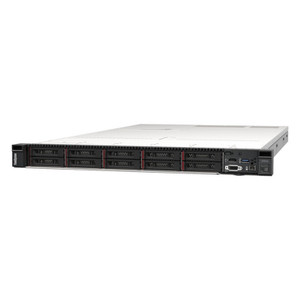
Lenovo 4XG7A63584 AMD EPYC 7443 24-Core Processor Option Kit for ThinkSystem SR645
Overview
The Lenovo 4XG7A63584 is an AMD EPYC 7443 processor option kit for the ThinkSystem SR645 platform — 24 cores, 48 threads, and a 2.85 GHz base frequency with 4 GHz boost headroom. If you're scaling out a surveillance analytics backend, a video management server, or a dense virtualization host and need a processor that can handle sustained parallel workloads without saturating memory bandwidth, this is the part number to spec. The EPYC 7443 sits in AMD's Milan generation (7nm), delivering a meaningful uplift in per-core throughput and memory bandwidth over previous EPYC generations on the same SP3 socket platform.
Key Features
- 24 Cores / 48 Threads at 2.85 GHz base, 4 GHz boost: For workloads that scale horizontally — concurrent VMS stream decoding, analytics inference, or multi-tenant VM hosting — 48 hardware threads means you can run significantly more parallel tasks before hitting CPU contention. The 4 GHz single-core boost matters when a workload has a serial bottleneck, such as database query processing or codec transcoding for a single high-resolution stream.
- 128 MB L3 Cache (Milan-generation): This is one of the headline advantages of EPYC Milan architecture. 128 MB of L3 cache keeps hot working sets — video frame buffers, analytics model weights, VM memory pages — closer to the execution units, reducing latency-sensitive round-trips to DRAM. In practice, this translates to lower CPU utilization at equivalent throughput versus processors with smaller cache footprints.
- 204.8 GB/s Memory Bandwidth: Octa-channel DDR4-3200 delivers 204.8 GB/s of aggregate memory bandwidth. For video surveillance platforms processing dozens of simultaneous 4K or multi-megapixel streams, memory bandwidth is often the first bottleneck — not compute. This bandwidth envelope gives the SR645 headroom to sustain high-throughput ingestion without throttling.
- Octa-Channel DDR4-3200 Memory Support: Eight memory channels at 3200 MHz maximize throughput across a wide memory bus. Configuring the SR645 with full channel population (filling all eight channels) unlocks the full 204.8 GB/s ceiling — partial population leaves bandwidth on the table, which matters for memory-intensive workloads.
- 200W TDP: The EPYC 7443 runs at a 200W thermal design power envelope. This is within the SR645's supported processor TDP range, but it is not a low-power SKU — plan rack power and cooling budgets accordingly. In dense rack configurations, this processor's thermal output is a real capacity planning factor.
- 7nm Lithography: Built on AMD's 7nm TSMC process, the EPYC 7443 delivers better power efficiency per core than previous 14nm EPYC generations. At data-center scale, efficiency per watt directly affects total operating cost over a multi-year deployment lifecycle.
- Socket SP3 — Platform Continuity: The SP3 socket is shared across AMD's EPYC Naples, Rome, and Milan generations. On the SR645 platform specifically, Milan processors are the supported generation; this matters for procurement teams standardizing on a single socket platform across server refreshes.
- 64-bit Operating Mode: Full 64-bit instruction support is table-stakes for any modern server OS or hypervisor, but it confirms compatibility with current Linux distributions, Windows Server, and VMware ESXi deployments without legacy 32-bit constraints.
Integration and Compatibility
The 4XG7A63584 is a Lenovo option kit designed and validated for the ThinkSystem SR645 server platform. Processor option kits from Lenovo are validated through Lenovo's system compatibility matrix — installing this part in a non-SR645 chassis, even one using the SP3 socket, is outside the validated configuration and not supported for enterprise warranty purposes. The SR645 is a dual-socket 1U/2U platform; the 4XG7A63584 can be installed as a primary or secondary processor depending on your base configuration. If your SR645 shipped as a single-processor system, adding this kit as the second processor enables full octa-channel memory bandwidth across both CPU domains.
For network video recorders and enterprise VMS deployments, pairing the SR645 with this EPYC 7443 option provides the core density and memory bandwidth to handle large-scale video ingestion and analytics workloads. Integrators building out IP camera infrastructure at scale — 100+ channels with analytics — should evaluate CPU thread count and memory bandwidth as primary server sizing inputs, not just raw GHz. The EPYC 7443's 128 MB L3 cache is particularly relevant for Milestone XProtect and Genetec Security Center deployments running analytics plugins, where keeping model data in cache reduces per-frame inference latency.
This processor requires a cooler — none is included in the 4XG7A63584 option kit. Verify that your SR645 chassis has the appropriate heatsink for a 200W TDP processor before installation. Lenovo's SR645 configurator and option compatibility tool should be consulted to confirm heatsink pairing for your specific chassis airflow configuration.
Frequently Asked Questions
Q: What server platform is the Lenovo 4XG7A63584 compatible with?
A: The 4XG7A63584 is validated for the Lenovo ThinkSystem SR645. It uses the AMD SP3 socket and is a Milan-generation EPYC processor option kit. Install only in SR645 systems — compatibility with other SP3-socket servers is not validated by Lenovo for this option kit.
Q: Does the 4XG7A63584 include a heatsink or cooler?
A: No. The 4XG7A63584 processor option kit does not include a cooler. You must verify and separately procure the appropriate heatsink for a 200W TDP processor in your SR645 chassis configuration before installation.
Q: How many memory channels does the EPYC 7443 support, and what speed?
A: The AMD EPYC 7443 supports octa-channel (8-channel) DDR4 memory at up to 3200 MHz, delivering up to 204.8 GB/s of aggregate memory bandwidth when all channels are populated.
Q: What is the TDP of the EPYC 7443 in the 4XG7A63584 kit?
A: The AMD EPYC 7443 has a 200W Thermal Design Power (TDP). Factor this into rack power budgeting and ensure your SR645's cooling configuration supports a 200W processor before installation.
Q: Can the 4XG7A63584 be used as a second processor in a dual-socket SR645?
A: Yes. The SR645 is a dual-socket platform. If your base system shipped with a single processor, the 4XG7A63584 can be installed as the second CPU, which also enables full dual-processor memory channel configuration for maximum bandwidth.
Q: What is the boost frequency of the AMD EPYC 7443?
A: The EPYC 7443 has a base frequency of 2.85 GHz and a maximum boost frequency of 4.0 GHz. The boost applies to single-core or lightly threaded workloads where the processor can allocate thermal headroom to a single core.
The 4XG7A63584 puts AMD's EPYC 7443 — 24 cores, 48 threads, 128 MB L3 cache, and 204.8 GB/s of memory bandwidth — into the ThinkSystem SR645 platform. That combination is worth looking at carefully if you're sizing a server for a high-channel-count VMS backend or a dense analytics workload where memory bandwidth is the binding constraint, not raw clock speed.
Technical Highlights:
- 128 MB L3 Cache: Milan's large cache is a genuine architectural advantage for analytics-heavy deployments. Keeping inference model weights and video frame buffers in cache — rather than evicting and reloading from DRAM — meaningfully reduces per-frame processing latency at sustained throughput. This is where the EPYC 7443 distinguishes itself from earlier EPYC generations on the same SP3 socket.
- 204.8 GB/s Memory Bandwidth: Octa-channel DDR4-3200 is the right memory architecture for parallel video stream processing. At 100+ camera channels with analytics enabled, memory bandwidth exhaustion shows up as elevated CPU utilization and dropped frames before compute is actually saturated — the EPYC 7443's bandwidth headroom keeps this from becoming a bottleneck at scale.
- 4 GHz Boost Frequency: The 2.85 GHz base handles sustained multi-threaded load, but the 4 GHz boost is relevant for lightly threaded workloads — codec transcoding for a single high-bitrate stream, database query processing, or management API calls in a VMS. Having both sustained throughput and single-core headroom in one SKU reduces the need to compromise.
Deployment Considerations:
- No cooler is included — confirm your SR645 chassis has a validated 200W heatsink before ordering. A processor TDP mismatch with the installed heatsink will throttle performance or trigger thermal shutdowns under sustained load.
- Populate all eight memory channels to realize the full 204.8 GB/s bandwidth figure. Single-channel or partial-channel memory configurations on an octa-channel processor leave substantial bandwidth unused — a common misconfiguration in budget-constrained builds that shows up immediately under production load.
The EPYC 7443 in the SR645 is a solid fit for a centralized VMS server handling 100–200 camera channels with edge analytics offloaded to the server tier — large retail deployments, campus security operations centers, or warehouse automation environments where the server is doing real work, not just storing streams.