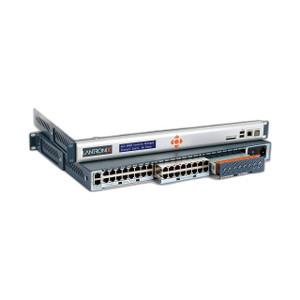
Lantronix SLC80322201S SLC8000 32-Port Console Server
The Lantronix SLC80322201S is a 32-port console server designed for out-of-band management of network infrastructure in data centers and network operations centers. This unit provides dedicated serial console connectivity to switches, routers, firewalls, and other managed devices — ensuring access to critical equipment when primary network paths are compromised or unavailable. The SLC8000 platform consolidates console access across dozens of devices into a single management point, eliminating the need for serial terminal servers scattered throughout the rack or reliance on in-band network connectivity for emergency troubleshooting and lifecycle operations.
Key Features
- 32 RJ-45 Serial Console Ports: Direct serial connectivity to network infrastructure devices. Supports standard DB-9 to RJ-45 adapters for legacy equipment without requiring individual console port access cards.
- Out-of-Band Dedicated Management: Isolates console traffic from production networks. Ensures administrators can access equipment for firmware updates, password resets, and emergency recovery even during network outages or service degradation.
- Dual AC Power Supply: Redundant power inputs provide continuous operation during single-phase failure. Critical for always-on infrastructure where console access cannot be interrupted.
- Centralized Device Access: RJ-45 connectivity integrates with standard network infrastructure — no proprietary cabling or specialized adapters required beyond DB-9 console cable adapters.
- Managed Platform: Enables remote administration of console sessions, user authentication, and audit logging across all 32 ports from a single management interface.
- Rack-Mount Form Factor: Standard 19-inch rack mounting fits into existing data center infrastructure without footprint overhead or deployment complexity.
- Enterprise Device Compatibility: Works with Cisco, Arista, Juniper, Palo Alto Networks, Dell, HP, and any vendor exposing a serial console interface — no driver installation or OS-specific configuration required.
- 2-Year Warranty: Manufacturer warranty covers defects and supports rapid replacement in multi-device environments.
The SLC80322201S addresses a fundamental operational requirement in infrastructure-heavy environments: how to maintain hands-on access to network backbone equipment independent of the network itself. In a typical data center deployment, an outage that disables primary network connectivity would also block in-band remote management tools (SSH, SNMP, Telnet). Console access via the SLC8000 remains available, allowing engineers to diagnose boot failures, reset credentials, interrupt startup routines, and recover equipment without physical presence or out-of-band IP connectivity. This decoupling of management traffic from production data paths is a security and reliability mandate for tier-1 hosting, financial services, and telecom environments.
Deployment models vary by operational structure. High-availability data centers often position the SLC8000 on a dedicated out-of-band management subnet — either segregated via VLAN or physically isolated on a separate switch fabric — ensuring that network security incidents or misconfiguration never block console access. Multi-site enterprises extend console reach via secure tunneling (SSH, VPN, or IPSEC) back to a central NOC, consolidating hundreds of remote devices' console streams into a single pane of glass. The managed platform's user authentication and session logging satisfy compliance auditing requirements (SOC 2, ISO 27001) by proving that only authorized personnel accessed device consoles and timestamping all interactive sessions.
Integration with standard infrastructure simplifies procurement and training. RJ-45 ports connect directly to any managed switch or out-of-band Ethernet segment using commodity cabling. Device console ports (almost universally DB-9 or DB-25 serial) connect via off-the-shelf DB-9-to-RJ-45 adapters, available from networking suppliers for under $10 per unit. No proprietary software, SNMP agent installation, or OS patching is required on target devices — the console server operates purely at the physical serial layer, making it immune to software vulnerabilities or OS-version dependencies that plague in-band management tools.
Total cost of ownership favors the SLC80322201S in environments managing 20+ network devices. A typical alternative — individual serial-to-Ethernet adapters per device — costs $800–$1,500 per device, scales poorly, and fragments management visibility across multiple vendor platforms. Consolidating 32 device consoles into a single managed server eliminates adapter sprawl, reduces power consumption (single chassis vs. 32 individual units), and cuts training overhead by centralizing authentication and logging. Dual AC power and rack mounting are standard, avoiding hidden costs for separate UPS circuits or mounting hardware.
The SLC80322201S is sourced as genuine factory-new equipment, backed by manufacturer warranty. Deployment in data centers, telecom operations centers, cloud infrastructure environments, and enterprise multi-site networks requiring unified console access to dozens of mission-critical devices. For further information and integration guidance, visit the Lantronix catalog.
Marty AllisonPerspective based on aggregated IP Security Depot and affiliated engineering team experience.
We've deployed the SLC80322201S across mid-to-large data centers, and it consistently solves a real operational pain point: the moment your primary network fails, in-band management becomes useless. SSH, SNMP, Telnet, and cloud-based management dashboards all vanish — which is precisely when you need to touch your equipment most. A dedicated console server forces you to solve this dependency problem upfront, not at 3 a.m. during an outage. The 32-port density means you're not daisy-chaining serial adapters or spreading console access across multiple vendor platforms. One device, one management interface, one audit trail. We've also seen it shine in compliance-heavy environments where auditors demand timestamped proof of who accessed what device and when. The managed platform's session logging and authentication audit meet SOC 2 and PCI-DSS requirements without requiring a separate logging system.
Technical Highlights:
- Out-of-Band Isolation: Console traffic never traverses production network paths. A misconfigured ACL, DDoS attack, or wholesale network shutdown cannot sever your access to devices. In practice, this means your MTTR (mean time to repair) on critical infrastructure drops dramatically — you're never locked out waiting for network recovery.
- Dual AC Power Supply: Redundancy is built in. One power phase fails, the unit keeps running. In a data center where every minute of console access unavailability cascades into customer impact, this is table stakes, not an option. Size the power delivery accordingly (dual circuits from separate PDUs).
- 32 Ports in One Chassis: Scales management without multiplying complexity. Compared to 32 individual serial-to-Ethernet adapters, you get a single management endpoint, single power footprint, single shelf space, and unified logging. The math favors consolidation at 20+ devices.
- RJ-45 Serial Connectivity: Standard Ethernet cabling. You're not hunting for legacy serial wiring or specialized connectors. DB-9 adapters are commodity parts ($5–$15 each). Every network admin knows how to run Cat6.
- Managed Platform with Authentication: User roles, session logging, and remote administration. You can grant console access to specific users, specific devices, and audit every command. Beats an unmanaged serial-to-Ethernet bridge that logs nothing.
Deployment Considerations:
- Dedicate the SLC8000 to a true out-of-band network segment — either a physically separate switch or a secured VLAN with no production traffic. If the console server shares bandwidth with production workloads, you've defeated the purpose. Size your out-of-band infrastructure separately.
- DB-9 to RJ-45 serial adapters are NOT included; budget $5–$15 per port depending on build quality. We recommend shielded adapters and quality cable to minimize bit errors on long console runs (data center to remote office via secure tunnel).
- Power the unit from at least two separate UPS circuits. Single-point-of-failure power defeats the redundancy of the dual AC supply. One circuit failure should never take down console access.
- Console server placement matters. Position it physically close to the out-of-band switch (short, direct Ethernet run). Long Ethernet cable runs to the SLC8000 introduce latency that end-users notice in interactive console sessions.
- Plan for SSH or VPN tunneling if NOC access is remote. The SLC8000 itself doesn't encrypt console streams — you tunnel the management session or the serial-over-IP stream. Treat console access as privileged and protect it accordingly.
- Firmware updates are rare for mature console servers, but verify compatibility with your management platform's authentication system (RADIUS, TACACS+, LDAP) before deployment. Most environments can standardize on a single auth backend for both network devices and the console server.
The SLC80322201S is the right choice for organizations running 20+ pieces of critical network infrastructure and treating console access as a non-negotiable operational requirement. It eliminates the false economy of scattered adapters and forces you to build a proper out-of-band management fabric from day one. For infrastructure teams betting on reliability and compliance, this is foundational. Explore the full Lantronix catalog for complementary management appliances and secure remote access solutions.