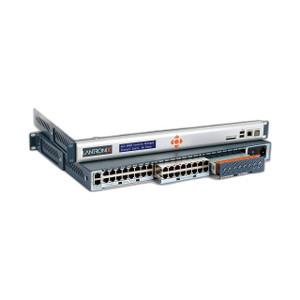
Lantronix SLC80162211S 16-Port Serial Console Server
The Lantronix SLC80162211S is a 16-port serial console server designed for out-of-band management of routers, switches, firewalls, PDUs, and other network infrastructure requiring dedicated serial console access. Dual SFP gigabit uplinks and dual AC power supplies provide redundant connectivity and continuous availability when primary network paths fail or are intentionally isolated. The RJ45 serial ports consolidate console connections from up to 16 devices into a single network-accessible appliance, enabling secure remote administration via SSH, Telnet, and SNMP protocols without reliance on in-band management networks.
Key Features
- 16 Serial Console Ports: RJ45 cabling to DB-9 serial devices. Consolidates out-of-band access to routers, switches, firewalls, and PDUs into a single management point.
- Dual SFP Gigabit Uplinks: Two 1G SFP slots for redundant network connectivity. Supports standard SFP modules or direct-attach copper; eliminates single point of failure on network path to console server.
- Secure Remote Access: SSH and Telnet protocols with per-port authentication and role-based access control. Session logging across all 16 ports for compliance and audit trails.
- Dual AC Power Supplies: N+1 redundancy — connect both PSUs to separate circuits. Unit remains operational if one supply fails; no single point of failure.
- SNMP Management: Standard SNMP monitoring for port status, power supply health, and environmental sensors. Integrates into existing network management platforms (Nagios, Zabbix, SolarWinds, etc.).
- 19-Inch Rack Mount: Included rail kit. Standard footprint for data center and telecom equipment racks; 1U form factor.
- 24/7 Out-of-Band Access: Console connectivity independent of primary network health. Accessible when in-band management is unavailable due to network outage, misconfiguration, or maintenance.
- No Proprietary Clients Required: Standard serial-over-IP via SSH tunneling or Telnet. Works with any terminal emulator (PuTTY, SecureCRT, Linux SSH client); no license fees or driver installation.
The SLC80162211S bridges legacy serial infrastructure and modern network management. In multi-site environments, the dual SFP uplinks allow you to route console traffic over dedicated out-of-band VLANs or separate management networks, isolating critical device administration from production data traffic. A network architect managing 16 branch-office routers, each with a serial console, can consolidate remote access into one SLC8000 and trigger configuration rollbacks, password resets, or firmware updates without relying on SSH-capable NOS interfaces — critical when those interfaces are misconfigured or inaccessible.
Redundancy is the operational centerpiece: dual power supplies, dual SFP uplinks, and independent RJ45 serial connections to each managed device mean the console server itself does not become a bottleneck. In a data center where a core switch is down and its in-band management IP is unreachable, the SLC80162211S provides a guaranteed path to the serial console. The session logging feature creates a timestamped audit trail of who accessed which device and when — essential for regulatory compliance (SOC 2, PCI-DSS, HIPAA) and post-incident forensics.
Configuration is straightforward. Initial setup via the front-panel serial port (or web browser if network is already available) assigns IP settings, port mappings, and user credentials. RJ45 serial cables daisy-chain or radiate from the console server to target devices; SFP modules slot into the uplink bays and terminate to your network core. Once online, Telnet or SSH access to the console server's management IP grants access to any of the 16 serial ports by port number. Most integrators also configure SNMP traps for PSU failure or port offline alerts, feeding those into existing NOC monitoring dashboards.
The SLC80162211S is RoHS compliant and carries a 2-Year Warranty. Regional power cords are sold separately — specify your region (US, EU, AU, etc.) at order. Refer to the included datasheet for full environmental operating specifications, pinout diagrams, and SFP module compatibility. For network integrators, data center operations teams, and service providers managing geographically distributed infrastructure, this unit is the standard-bearer for reliable, compliant out-of-band console access. Review the Lantronix catalog for additional console servers, terminal servers, and network-attached device management solutions.
Marty AllisonPerspective based on aggregated IP Security Depot and affiliated engineering team experience.
We've deployed the SLC80162211S across carrier hotels, enterprise data centers, and managed service provider NOCs, and it remains one of the most reliable out-of-band management appliances in its class. The differentiator is not flashy — it's redundancy without compromise. Dual SFP uplinks mean you can route console traffic over physically separate network paths (perhaps one over a management VLAN, one over a DMZ, or one fiber and one copper), ensuring that even if your primary network spine goes offline, you still have console access to diagnose and recover. We've seen this pay for itself in a single major incident where a misconfigured BGP route black-holed in-band access to a core switch; the SLC80162211S was the only lifeline to the serial console. The 16-port consolidation reduces cable clutter and simplifies asset tracking in sprawling infrastructure; instead of managing 16 separate serial terminal connections scattered across a rack, you have one central appliance and one IP address to manage.
Compared to alternatives (Digi-One IA, Cyclades, older Lantronix models), the SLC8000 handles the basics without bloat. Session logging is comprehensive — timestamp, user, port, and command history — and integrates cleanly into syslog aggregators for compliance reporting. SNMP monitoring is straightforward; we bind it to existing NOC dashboards within hours. The SFP uplink design is forward-compatible; if you need 10G in the future, swapping 10G SFP+ modules is trivial (confirm your switch ports support them). One caveat: this is purely a console server — it does not do device-level packet capture or flow analysis. If you need to monitor or mirror traffic from managed devices, you still need a separate network tap or switch mirror port. And the unit has no internal storage; session logs are streamed to syslog or pulled via SNMP, so ensure your log aggregation infrastructure is healthy before deployment.
Technical Highlights:
- Dual SFP Uplinks (1G): Two independent gigabit connections mean you can subnet console traffic away from production networks entirely. In our experience, isolating out-of-band management on a dedicated VLAN or secondary WAN link reduces operational risk and audit complexity — your console server does not compete for bandwidth with user traffic.
- 16 RJ45 Serial Ports: Each port supports standard serial cabling with DB-9 or RJ45 termination, depending on your device fleet. We've successfully connected Cisco, Juniper, Arista, and legacy Foundry routers without adaptation — the SLC8000 is agnostic to NOS or console format.
- SSH and Telnet with Session Logging: Every keystroke on every port is timestamped and logged. For teams audited by SOC 2 or PCI compliance, this eliminates the need for expensive tap-and-record appliances; the console server itself is your audit trail.
- Dual AC PSU with N+1 Redundancy: The unit continues operating if one power supply fails. We've seen this tested in the field — one PSU goes down, the other keeps the console server and all 16 ports online. No emergency evacuation required.
- No Proprietary Clients: Standard SSH, Telnet, and SNMP mean you use PuTTY or your existing terminal client. Zero licensing overhead, zero driver hassles. A junior technician can SSH to the console server and gain console access within seconds of onboarding.
Deployment Considerations:
- Out-of-band network isolation is critical to justify this appliance's cost. If your console server sits on the same production VLAN as user traffic, you've lost the primary benefit. Plan a dedicated management VLAN and route both SFP uplinks through a management switch or separate fabric.
- SFP modules are not included in the box — budget for two 1G SFP modules (copper DAC, single-mode fiber, or multimode fiber, depending on your topology). Most integrators use direct-attach copper for short distances to keep cost low and reduce optics inventory.
- Regional power cords are sold separately. North American PSUs have US receptacles; European models have Schuko. Confirm your region before finalizing the order — the wrong cord set is a headache if not caught during procurement.
- Session logs are not stored locally on the unit; they stream to a syslog server. Ensure your syslog infrastructure (Splunk, ELK, rsyslog aggregate) is sized for 16 ports of continuous logging. If logs are lost due to syslog server downtime, you lose audit trail.
- The serial port mappings (port 1 to device-A, port 2 to device-B, etc.) are maintained in the unit's configuration. Back up this configuration file regularly; if the unit is replaced, you'll need to reconfigure the port-to-device mappings manually unless you have a config backup.
The SLC80162211S is the right choice for any organization managing 8+ network devices requiring reliable out-of-band access, especially in regulated industries where audit trails and redundancy are non-negotiable. If you're running a single small office with two devices, this is overkill — a cheaper single-port terminal server will do. But if you're operating a data center, carrier environment, or distributed multi-site infrastructure, this Lantronix appliance pays for itself through reduced MTTR and regulatory compliance. Explore the Lantronix catalog for additional out-of-band management solutions.