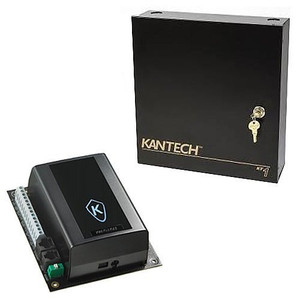
Kantech KT-1-M Single-Door IP Access Controller with Cabinet
The Kantech KT-1-M is a dedicated single-door IP access control processor engineered for integrators and IT architects deploying networked door control systems in enterprise facilities. This complete system combines the KT-1-PCB controller logic board with the KT-1-CAB-M wall-mounted cabinet enclosure, delivering a ready-to-deploy solution that integrates into existing IP security infrastructures without requiring proprietary gateways or standalone converters.
Key Features
- Single-door IP-based control: Dedicated PCB-based controller provides independent relay and I/O logic for one door, eliminating the need to share processing resources across multiple access points — critical when you require deterministic lock actuation timing or need to isolate one door's event log from others for compliance or audit purposes.
- Native TCP/IP connectivity: Communicates directly over standard Ethernet, so you deploy the KT-1-M alongside your existing network video recorders, access management VMS, or SIEM without intermediate protocol translation. Simplifies central monitoring and event correlation.
- Wall-mounted KT-1-CAB-M cabinet with flexible installation: DIN-rail or surface-mount options mean you can install in electrical closets, server rooms, or secured equipment spaces without extensive retrofitting. Compact footprint protects controller and relay components from physical damage and accidental disconnection.
- RJ-45 Ethernet connection for network and power delivery: Uses standard cabling infrastructure already run for IP cameras or building automation — one cable carries both data and power, reducing installation labor and eliminating the need to coordinate separate power circuits.
- Relay outputs compatible with 12/24 VDC lock hardware: Works with standard electromechanical strikes, magnetic locks, and electronic latches without requiring proprietary interface boards. If your facility already standardizes on 12 VDC or 24 VDC locking hardware, integration is straightforward.
- Modular PCB-based architecture: Firmware updates and third-party VMS integration ensure the KT-1-M remains compatible with evolving access management platforms and security standards — you are not locked into a single vendor's software ecosystem.
Integration & Compatibility
The KT-1-M supports standard network protocols and hardware interfaces required by modern IP access control systems. Its TCP/IP foundation means it integrates with ONVIF-compliant VMS platforms and third-party access management software that expect HTTP/IP-based device communication. The independent relay output architecture allows the controller to drive conventional 12/24 VDC strike mechanisms without additional interface modules, reducing bill-of-material cost and simplifying wiring.
Network administrators benefit from standard Ethernet provisioning — the KT-1-M (often searched as KT 1 M) deploys over existing PoE infrastructure or isolated network segments depending on security policy. Event logging is centralized, and remote lock activation commands propagate through the same IP path as your camera streams and access events, enabling unified security workflows across your facility.
Deployment Applications
Suitable for single-door access control across offices, data centers, secure facilities, and distributed security networks where dedicated IP-based control and centralized management are required. Ideal for integrators seeking modular, scalable access control without reliance on proprietary gateway hardware. If you operate multiple secure facilities and need independent, auditable lock control at each location, deploying multiple KT-1-M units provides granular isolation compared to centralized multi-door panels.
Technical Considerations
Verify network bandwidth and Ethernet port availability before deployment — a single KT-1-M consumes minimal bandwidth, but installations with dozens of doors may benefit from a dedicated access control network segment or managed switch with VLAN support. Coordinate cabinet location with your facility's electrical and network infrastructure teams to ensure wall-mount location is accessible for firmware updates and relay wiring maintenance. Confirm that your VMS platform selection or access management software supports standard TCP/IP device discovery and relay-control commands — proprietary access platforms may require additional licensing or gateway modules to communicate with the KT-1-M.
Frequently Asked Questions
Q: Can the KT-1-M control more than one door?
A: No. The KT-1-M is designed for single-door operation. If you need to control multiple doors, deploy separate KT-1-M units or consider a multi-door access panel from the Kantech product line.
Q: What is the maximum cable run length from the network switch to the KT-1-M?
A: Standard Ethernet supports 100 meters (328 feet) per IEEE 802.3. Longer runs may require switches or fiber media converters.
Q: Does the KT-1-M support door position feedback (door sensor input)?
A: The controller provides independent relay and I/O logic. Confirm your specific I/O requirements in the product datasheet or with your integrator — most single-door controllers support a door contact input for monitoring physical door state.
Q: Is the KT-1-M compatible with my existing access management software?
A: The KT-1-M supports standard TCP/IP networking and relay outputs. Verify that your VMS or access platform supports HTTP/IP device communication and relay control. ONVIF-compliant platforms typically integrate without additional gateways.
Q: What power supply do I need to run the relay outputs?
A: The controller requires network power via the RJ-45 connection. The relay output is compatible with 12 VDC or 24 VDC lock hardware; you will need a separate 12 or 24 VDC power supply to energize the strike or magnetic lock. Confirm your lock voltage specification before ordering power infrastructure.
Q: Can I use the KT-1-M in a distributed facility with multiple remote doors?
A: Yes. Each remote door location can have its own KT-1-M, all centrally monitored and controlled over IP. This architecture provides better redundancy and failover capability than a single centralized multi-door panel — if one network segment goes down, only one door is affected rather than your entire facility.
Jerry TildsenPerspective based on aggregated IPSD and affiliated engineering team experience.
The Kantech KT-1-M hits a specific deployment niche: single-door IP control without the overhead of a full multi-door panel. If you're provisioning a distributed facility with remote secure areas — think data center rows, lab suites, or satellite offices — the KT-1-M avoids the single point of failure baked into centralized access hardware. Each door runs its own controller, all tied back to a central VMS or access management platform over standard Ethernet. That architectural choice matters when uptime is contractual.
Technical Highlights:
- Independent PCB-based controller per door: Unlike shared multi-door panels, the KT-1-M isolates one door's relay logic and event history. If a strike mechanism stalls or draws excessive current, only that relay is affected — no cascade failures across your facility's door roster.
- Native TCP/IP avoids protocol translation overhead: The controller speaks Ethernet natively. No proprietary serial gateways, no middleware polling delays. Lock commands and door-open events propagate at IP speed, which matters in high-security environments where millisecond latency between sensor and response is auditable.
- 12/24 VDC relay compatibility with standard locking hardware: Kantech built this for integrators who already stock conventional strikes and magnetic locks. No proprietary lock modules, no supply-chain lock-in. Order a replacement strike from your building systems supplier and wire it in.
Deployment Considerations:
- Cabinet location is critical — wall-mount it near your door or in a secured equipment closet, but account for Ethernet cable run length (standard 100m Ethernet limit applies). If you're retrofitting an older facility, budget for conduit or ceiling plenum runs.
- The controller requires separate 12 or 24 VDC power for the relay output. Don't assume the Ethernet PoE connection energizes your strike — it only powers the controller logic. Coordinate with your electrician on lock voltage before purchase.
- Verify your VMS or access management platform supports HTTP/IP-based relay control commands. If your software expects proprietary serial protocols or gateway intermediaries, the KT-1-M won't integrate cleanly — you'll end up buying a translation layer anyway.
Deploy the KT-1-M where you need granular, independently auditable door control at geographically dispersed locations — not where you're trying to consolidate all doors under one piece of hardware. For a multi-tenant office building or a research park with scattered secure labs, this architecture is cleaner and more resilient than a centralized panel running to 20 remote doors over long cable runs.