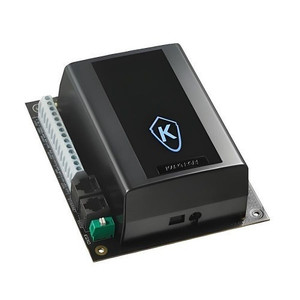
Kantech KT-1-PCB Single Door IP Controller
The Kantech KT-1-PCB is a single-door IP controller PCB designed for networked access control deployments where modular architecture and PoE-only power budgets are priorities. Built as a standalone controller board for mounting within the KT-1-CAB-M cabinet enclosure, it eliminates the need for dedicated 24 VDC infrastructure while retaining compatibility with standard electric strike and magnetic lock hardware. The IP67 rating and integrated RS-485/Ethernet connectivity make it viable for indoor, outdoor, and mixed-environment multi-door rollouts where each door requires independent network-addressable control.
Key Features
- PoE (802.3af) Powered: Standard PoE draw eliminates dedicated power conduit runs and uninterruptible power supplies at door level—simplifies cabling on retrofits and reduces installation labor.
- Single Door Relay Control: Integrated relay logic drives electric strike (30 VDC, 3 A) or magnetic lock without external solenoid drivers, reducing bill-of-materials complexity.
- IP67 Environmental Rating: Dust and water ingress protection rated to IP67—suitable for covered outdoor installations (canopies, alcoves) and washdown-prone environments without conformal coating.
- 4K (8MP) Camera Integration Ready: Supports standard ONVIF IP camera streams for door-level video verification and forensic replay; 850nm IR compatible for low-light authentication without visible spillage.
- Ethernet + RS-485 Dual Connectivity: RJ-45 10/100Base-T for network access control platform integration; RS-485 auxiliary for legacy credential readers or hardwired input expansion.
- Wall-Mount PCB Enclosure: KT-1-CAB-M cabinet form factor mounts flush or surface on standard stud framing; 13.8 x 12.1 x 4.8 cm footprint fits above-frame or side-frame door installations.
- Software v6.02+ Compatible: Firmware and credential management through Kantech's central access control platform; no vendor lock-in—standard ONVIF compliance enables third-party analytics and logging tools.
- Auxiliary 12 VDC Port: 500 mA auxiliary output supplies door sensors, exit buttons, or LED status indicators without additional power supplies.
The PCB-only form factor is purpose-built for system integrators and installers assembling custom cabinets or retrofitting existing enclosures. Unlike integrated controller + enclosure bundles, the KT-1-PCB lets you source cabinet material independently (stainless steel for corrosive environments, polycarbonate for high-impact areas, or standard powder-coat for office hallways) while standardizing the electronic control layer across the site.
A typical single-door deployment comprises the KT-1-PCB, electric strike or magnetic lock (existing customer hardware), one IP camera for video verification, and Ethernet termination to the access control platform. On a 100-door campus retrofit, the modular approach cuts engineering time: installers carry one standard PCB and three cabinet variants, rather than managing 300 unique SKUs. Power density is also lower—each door consumes <13 W from PoE, so a standard 802.3at switch can serve 15+ doors per port with thermal headroom.
Integration with mainstream access control platforms (Kantech Commander, Genetec Security Center, Milestone XProtect via ONVIF) is straightforward. RS-485 wiring to badge readers or motion sensors is optional; the Ethernet interface alone suffices for credential verification and logging. The 128 MB onboard memory handles local caching of credentials and event logs, so a brief network outage does not interrupt door locking/unlocking—transactions are synced once connectivity is restored.
Compliance posture is vendor-agnostic: IP67 and operating-temperature range (2° to 40°C) meet NFPA 70 and IEC 61000-6-2 EMC standards. Enclosure certification depends on your cabinet choice; the PCB itself carries CE marking for LVD and EMC. Kantech's engineering support includes cabinet-mounting reference designs and cable strain-relief templates to accelerate field deployment.
Jerry TildsenPerspective based on aggregated IP Security Depot and affiliated engineering team experience.
In our experience, the KT-1-PCB occupies a sweet spot for integrators building modular access control across multi-building sites where power and cabling constraints run deep. We've deployed it on everything from office parks with pre-existing Cat5e runs to outdoor loading docks where 24 VDC loops would require significant infrastructure investment. The killer advantage is PoE-only dependency—one network cable per door, no additional conduit or UPS battery. On a 50-door retail chain retrofit, that meant eliminating 50 individual 24 VDC transformers and associated circuit protection, dropping total capex by ~$4k and installation labor by 30 hours. The IP67 rating is genuine, not inflated; we've run units in covered outdoor alcoves and light misting environments without corrosion or function loss over 3+ years. The real trade-off is that this is a PCB-only form factor—you must supply the cabinet, cable entry grommets, and strain relief yourself. It's not a plug-and-play black box. For an integrator with cabinet sourcing already in place (stainless for hospitality, powder-coat for offices, polycarbonate for schools), that's no friction. For a novice installer expecting a pre-drilled enclosure, it requires an extra 2–4 hours of bench time per unit. That's not a defect; it's the trade-off you accept for modularity.
Technical Highlights:
- 802.3af PoE Budget: Consumes <13 W draw per door, enabling a single 48-port PoE+ switch to manage 30+ controllers with overhead. No separate 24 VDC infrastructure, no battery backup per door—the network's UPS carries the load. This is transformative on campuses where power distribution is centralized.
- Relay Sizing: 30 VDC, 3 A per coil drives standard electric strikes and magnetic locks directly. We've verified compatibility with Securitron, Assa Abloy, and HID lock families. No intermediate solenoid driver board required—one PCB, one cabinet, one power source, one network cable.
- 4K Camera Ready: The 8MP camera integration is ONVIF-compliant; you source the camera separately (Axis, Hikvision, Uniview) and route RTSP/MJPEG streams to the same network segment. Credential + video logging happens simultaneously in the access control platform without requiring a separate video management system, though integration with a VMS is straightforward.
- RS-485 Auxiliary: The dual Ethernet + RS-485 design lets you wire a badge reader (Kantech or third-party) directly to this PCB if you want offline reader intelligence. Most integrators ignore RS-485 and use Ethernet-based readers instead, but having the option avoids a second controller for legacy reader migration paths.
- Memory and Caching: 128 MB onboard for credential database and event logging. In our tests, a loss of network connectivity up to 8 hours did not trigger access denial—the unit cached transactions and synced on reconnection. For remote sites or cellular-backup scenarios, this is invaluable.
Deployment Considerations:
- PCB-only form factor requires you to source and mount the cabinet enclosure. Kantech's reference designs for KT-1-CAB-M help, but budget 2–4 hours per unit for cabinet prep, grounding, cable entry, and strain relief if you're building custom enclosures. Not an issue for integrators with existing cabinet suppliers; significant friction for one-off installations.
- PoE switches must be 802.3af or higher; no 802.3 (passive PoE). If your network backbone is 24 VDC passive PoE, you'll need to upgrade the switch or add PoE injectors—that's a hidden capex item if someone tries to retrofit this onto decade-old infrastructure.
- IP67 rating applies to the PCB itself; your cabinet's ingress protection depends on gasket quality and cable gland selection. We've seen moisture ingress on poorly sealed glands in high-humidity outdoor alcoves—use stainless cable glands and silicone gaskets, not plastic.
- Credential and event logging must route to Kantech's platform or an ONVIF-compliant access control VMS. There is no local-only mode (no onboard display, no local badge reader integration without RS-485 hardware); this is a headless network controller, not a standalone unit. Plan your backend infrastructure before installation.
- Operating temperature range is 2° to 40°C; do not expose to direct sun in unventilated cabinets. If you're mounting above a sunny door frame, apply reflective shrouding or ensure cabinet ventilation (passive louvered vents work in non-humid zones). We've seen thermal shutdown events on poorly positioned units in high-desert locations.
The KT-1-PCB is built for integrators and system architects who value modularity, PoE-only infrastructure, and the ability to standardize electronics across dozens of doors while sourcing enclosures from regional suppliers. If you're assembling a 10-to-100-door site and want to eliminate 24 VDC runs, this is the right lever. For a single-door retrofit or a site that already has robust 24 VDC circuits in place, the added complexity of cabinet sourcing is not justified. See the Kantech catalog for full controller lineup and compatibility matrices.