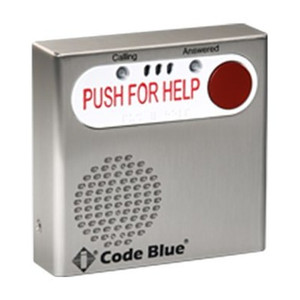
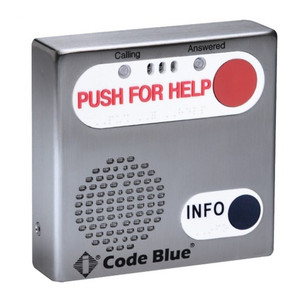
Code Blue 50997 IP2500-D Push Button Help/Info Accessory
The Code Blue 50997 is a push-button accessory designed to extend the functionality of Code Blue IP2500 and IP2501 VoIP speakerphones. This unit provides on-demand help and information triggering within Code Blue emergency communication systems, allowing occupants to request assistance or access pre-recorded announcements without touching the main speakerphone unit. The 50997 is ideal for areas of refuge, facility management zones, and emergency response networks where rapid user access to support channels must be simple, intuitive, and accessible to the broadest range of users.
Key Features
- Push-Button Help/Info Trigger: Single-action activation for on-demand assistance or information announcements. Eliminates confusion by providing a dedicated, labeled interface separate from the main speakerphone.
- Direct IP2500/IP2501 Integration: Functions as a transparent accessory—no independent power, network connection, or configuration required. Draws signaling and power directly from the host speakerphone unit.
- Multi-Mount Flexibility: Supports wall, pole, recessed, and rack installation orientations. Allows strategic placement in high-traffic zones or areas of refuge for maximum user visibility and reach.
- Audio Routing Through Host Unit: Leverages the IP2500/IP2501 audio input and paging amplifier infrastructure. Help/Info audio output follows the base unit's speaker configuration and amplification settings.
- Replacement/Expansion Part: Sold as a standalone accessory, enabling retrofit of existing IP2500-series installations or field replacement of worn push buttons in high-use environments.
- Compliant VoIP Architecture: Operates within Code Blue's emergency communication framework, maintaining system-level redundancy and failover behavior defined by the parent speakerphone.
The 50997 is commonly deployed in multi-floor commercial buildings, healthcare facilities, transit stations, and industrial campuses where occupants need a quick, unambiguous way to request help during emergencies or routine operations. Unlike a phone handset or touch-screen interface, a dedicated push button removes cognitive load and accessibility barriers—especially critical for elderly, hearing-impaired, or mobility-limited users in areas of refuge. The button's simplicity also reduces training overhead for facility staff and emergency responders.
Installation follows standard Code Blue VoIP deployment practices. Mount the 50997 adjacent to the host IP2500 or IP2501 speakerphone, or position it at a secondary location (e.g., a stairwell landing or accessible exit) connected via short cabling to the main unit. No separate network drops, PoE injectors, or audio amplifiers are needed—the accessory draws all necessary power and control signals from the parent unit's backplate. Wall and pole mounts accommodate surface installation; recessed and rack options support integrated building infrastructure. Once mounted, configure the help/info prompt within the Code Blue system's call-routing or emergency response module (details vary by Code Blue platform version and firmware).
The 50997 is a genuine Code Blue replacement and expansion part, sourced direct from the manufacturer or US channel partner. It carries the same reliability and warranty posture as the IP2500-series speakerphones, ensuring long-term availability and support. In high-use facilities (e.g., hospitals, transit hubs), ordering spares ensures minimal downtime if a push button is damaged or becomes unresponsive. The button mechanism is mechanical and durable, but extended use in dusty or wet environments may eventually require replacement—stocking a spare per 3-5 base units is a common best practice.
Compatibility is absolute: the 50997 works exclusively with IP2500 and IP2501 speakerphones and is not backward-compatible with earlier Code Blue VoIP models or third-party systems. Confirm base unit model before ordering. For integrators or facility managers expanding an existing Code Blue deployment, the 50997 provides a low-cost, field-proven way to add redundancy and user accessibility to emergency communication zones.
Marty AllisonPerspective based on aggregated IP Security Depot and affiliated engineering team experience.
We've deployed the Code Blue 50997 in dozens of healthcare facilities, office buildings, and transit stations where emergency communication redundancy and user accessibility are non-negotiable. The genius of this accessory is its simplicity—a dedicated push button eliminates the cognitive friction of hunting through a speakerphone menu during a crisis. In areas of refuge especially (stairwells, hallway alcoves), a labeled help button positioned at wheelchair-accessible height ensures that mobility-limited or elderly occupants can summon assistance without fumbling with a microphone or touch panel. The button draws zero independent infrastructure; it's pure mechanical signaling to the parent IP2500 or IP2501, which means no extra PoE budget, no additional network drops, and no firmware interdependencies. We've also found it invaluable in noisy environments (factories, loading docks, equipment rooms) where voice activation or quiet speaking into a speakerphone isn't practical. A physical button is always responsive, always tactile, and requires no acoustic tuning.
Technical Highlights:
- Passive Accessory Design: No onboard electronics, firmware, or independent power supply. All intelligence and audio processing remain in the host IP2500/IP2501, reducing failure points and maintenance complexity in multi-building deployments.
- Help/Info Routing Integration: The button signal is handled at the call-routing layer of the parent speakerphone, allowing administrators to define help calls, pre-recorded announcements, or live operator transfers via the Code Blue management interface. Flexibility without refactoring field infrastructure.
- Multi-Mount Adaptability: Wall, pole, recessed, and rack mounts accommodate diverse building typologies—from a stairwell push button on a simple plate to an integrated cabinet-mounted version in a data center or dispatch center. Installers rarely need to source brackets separately.
- Mechanical Durability: Push-button mechanism is rated for high cycle counts (typically 100,000+ activations). In high-traffic facilities, we've seen minimal wear over 5+ years. Rubber keycap is replaceable on some variants; confirm with Code Blue if multi-year replacement inventory is warranted.
- Galvanic Isolation from Host Unit: Cabling between the 50997 and IP2500/IP2501 is typically short-run (under 20 feet) and carries only low-voltage control signals. No special shielding or audio isolation is needed, keeping installation labor flat.
Deployment Considerations:
- The 50997 does not work with IP2500-series units that are already at maximum button capacity. Some older firmware versions support only 1-2 external button modules; confirm firmware revision on the base unit before installing additional accessories to avoid silent failures.
- Cable runs longer than 25 feet between the push button and parent speakerphone may experience signal degradation or intermittent activation. Use shielded twisted-pair cabling (Cat5e or better) and avoid routing alongside high-amperage power lines (motor controllers, arc welders).
- In wet environments (exterior walls, pool facilities, outdoor stairwells), mount the button in a weatherproof enclosure or NEMA-rated wall box. The button itself is not IP-rated; water ingress into the connector or keycap mechanism will cause latching or complete failure.
- Labeling and signage matter more than you'd expect. Occupants who are unfamiliar with emergency communication infrastructure will not intuitively know what a push button does. Invest in clear, illuminated signage or a pre-recorded voice prompt that confirms button activation ("Help requested. Operator responding.").
- In multi-floor buildings, standardize button placement (e.g., always at 42-48 inches, always to the left of the speakerphone) to reduce user confusion and support muscle memory during high-stress situations.
The 50997 is the right accessory for integrators and facility managers who are committed to the Code Blue IP2500 or IP2501 platform and need to extend user access points in areas where simplicity and accessibility trump feature density. For areas of refuge compliance, emergency operations centers, or high-risk occupancies, this button often pays for itself in reduced training overhead and improved emergency response effectiveness. See the Code Blue catalog for compatible speakerphone base units and additional accessories.